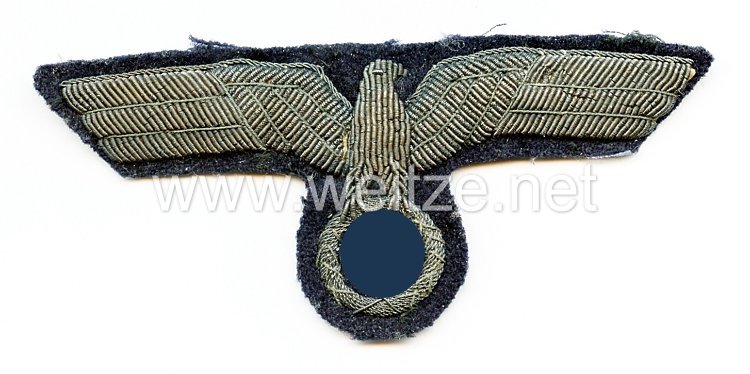
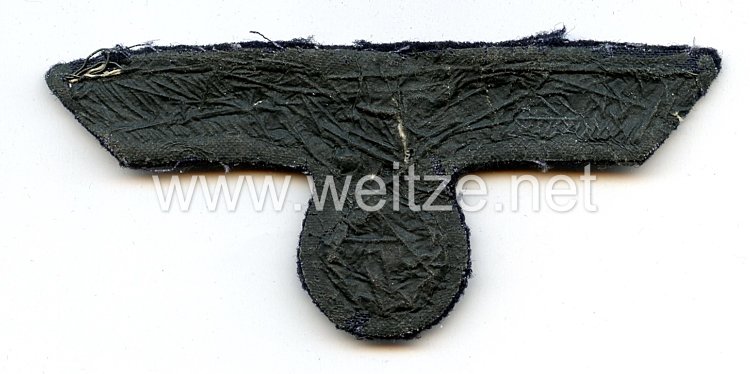
Kriegsmarine Breast Eagle for Naval Officers
The Kriegsmarine Breast Eagle for Naval Officers represents a significant uniform insignia of the German Navy during World War II (1939-1945). This hand-embroidered metal thread insignia on dark blue backing embodies the maritime tradition and military hierarchy of the German naval forces of that era.
The Kriegsmarine was officially established on June 1, 1935, after the German Reich under Adolf Hitler rejected the restrictions of the Treaty of Versailles. It replaced the Reichsmarine of the Weimar Republic and developed into one of the most significant naval forces of World War II. Under the supreme command of Grand Admiral Erich Raeder (1935-1943) and later Karl Dönitz (1943-1945), the Kriegsmarine played a central role in German warfare.
The breast eagle insignia for naval officers was an essential component of the service uniform and was worn on various uniform types. The design followed the Kriegsmarine Dress Regulations, which prescribed strict adherence to form, material, and wearing method. The eagle, as a symbol of German state power, held the swastika, the National Socialist emblem, in its talons.
The hand embroidery with metal threads characterizes a high-quality example as prescribed for officers. In contrast to the machine-woven or embroidered variants for enlisted men and non-commissioned officers, officer versions were frequently manufactured in elaborate handwork. The metal threads used typically consisted of aluminum or silver-plated wire, applied to a backing of dark blue wool cloth. This color choice corresponded to the traditional navy color and contrasted with the grey-green or field-grey uniforms of the Wehrmacht and Luftwaffe.
The production of such insignia was carried out by specialized military effects factories and private master tailors authorized by the Wehrmacht. Well-known manufacturers included companies such as BeVo (Barmer Bandweberei Vogel), BEVO Wuppertal, and numerous smaller workshops. Hand-embroidered variants often show individual differences in execution, as they were not industrially standardized.
The breast eagle insignia was worn on various uniform types, including the service uniform, the dress uniform, and the tunic. The position of the insignia was precisely prescribed: it was attached to the right breast, approximately at the level of the second button row. The wearing method differed according to uniform type and rank, with regulations detailed in the corresponding dress regulations (Anzugsordnungen).
The condition grade 2+ indicates a well-preserved example showing only minimal signs of wear. This is remarkable for textile insignia from this period, as many pieces were damaged by decades of storage, moth damage, or improper preservation. The dark blue backing retains its color intensity, and the metal threads likely show only minor oxidation.
From a military-historical perspective, such insignia document the complex hierarchy and symbolism of the National Socialist Wehrmacht. The Kriegsmarine developed its own uniform tradition, which derived from the Imperial Navy but was furnished with National Socialist symbols. The use of the eagle as a national emblem had a long tradition in German armed forces but was combined with NS symbolism in the Third Reich.
After the end of World War II in May 1945, the Kriegsmarine was dissolved. All uniform items and insignia bearing NS symbols were confiscated or destroyed by the Allies. Surviving pieces were often kept by veterans as personal mementos or entered militaria collections.
Today, such insignia are important historical documents preserved in museums and private collections for study purposes. They serve scientific research and historical education to understand the military culture and organization of the Third Reich. Handling such objects requires historical sensitivity and contextualization within the framework of the National Socialist dictatorship and its crimes.