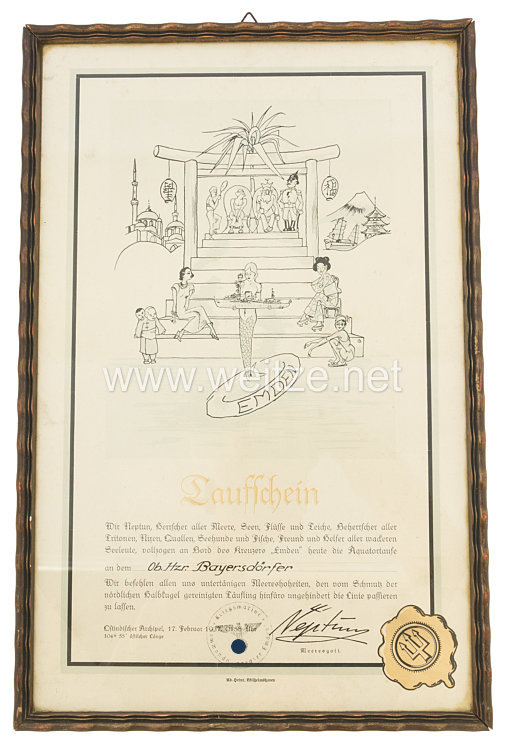
Equator Crossing Certificate, Neptune
This equator crossing certificate from 1937 represents a fascinating testament to maritime tradition, closely connected to the history of the German cruiser Emden. Such documents were an integral part of seafaring customs and document the centuries-old ceremony of the equator crossing or Neptune ceremony, practiced on ships worldwide.
The equator crossing ceremony is an ancient maritime custom whose origins trace back to the 16th century. When a ship crosses the equator, all crew members experiencing this for the first time are “baptized” in an often spectacular ceremony. This tradition symbolizes the transition from novice to experienced sailor and simultaneously serves to strengthen camaraderie on board. The mythological sea god Neptune plays the central role, which is why the ceremony is also known as the Neptune ceremony.
The cruiser Emden, from which this certificate originates, was the third warship of the German Navy to bear this honorable name. The Emden (II) was launched in 1925 and was a light cruiser of the Königsberg class. With a displacement of approximately 6,000 tons and a length of 155 meters, she embodied the restricted capabilities of the German Navy during the Weimar Republic, strictly limited by the Treaty of Versailles of 1919.
The name Emden held particular symbolic significance for the German Navy. The first SMS Emden had earned a legendary reputation during World War I through her successful raiding operations in the Indian Ocean. Under the command of Korvettenkapitän Karl von Müller, she sank or captured numerous Allied merchant ships in 1914 and became a symbol of German naval courage. When the new Emden was commissioned in 1925, she consciously connected to this tradition.
In February 1937, the date of issue of this certificate, the Emden was on one of her numerous overseas voyages. During the 1930s, the German Navy increasingly undertook training cruises and representation voyages to distant waters. These voyages served multiple purposes: they were part of the training of young naval cadets, demonstrated the growing strength of the German Navy after the repudiation of Versailles restrictions, and were intended to represent German interests overseas.
During the 1930s, the Emden undertook several significant voyages that took her to South America, Africa, and the Pacific, among other destinations. Whenever crossing the equator, the traditional Neptune ceremony was celebrated. The ceremony followed an established ritual: one crew member embodied King Neptune, accompanied by his consort Amphitrite and a retinue of “Tritons” and other sea creatures. The initiates had to endure various trials, were symbolically shaved, doused with seawater, and finally received their baptism certificate as proof of their initiation.
The certificates themselves were artfully designed documents, often decorated with maritime motifs depicting Neptune, mermaids, ships, and ocean waves. They typically contained the name of the initiate, the date of the equator crossing, the position, the name of the ship, and often the name of the commanding officer. In humorous, archaic language, “King Neptune” granted the bearer the right to henceforth call himself an experienced seafarer. These documents were treasured by sailors as valuable mementos and testify to personal maritime experiences.
The year 1937 marked a significant phase in the history of the German Navy. Germany was massively rearming under National Socialist rule, and the Navy was expanding considerably. The Emden, although a comparatively small ship, played an important role during this time in training and representation. The equator crossing ceremonies were more than mere tradition – they served to strengthen camaraderie and esprit de corps, values that received particular emphasis in military training of that era.
The history of the Emden ended tragically in World War II. The ship was deployed in various operations and survived the war heavily damaged. After the war ended, it was transferred to the Soviet Navy and served there for several more years under the name Pechora.
Today, such equator crossing certificates are sought-after collectibles and important historical documents. They provide insights into the daily life and traditions of sailors that extend far beyond purely military aspects. The tradition of the equator crossing ceremony itself has actually survived to this day and continues to be practiced in modified form on many ships worldwide, both military and civilian – a remarkable example of maritime continuity spanning centuries.