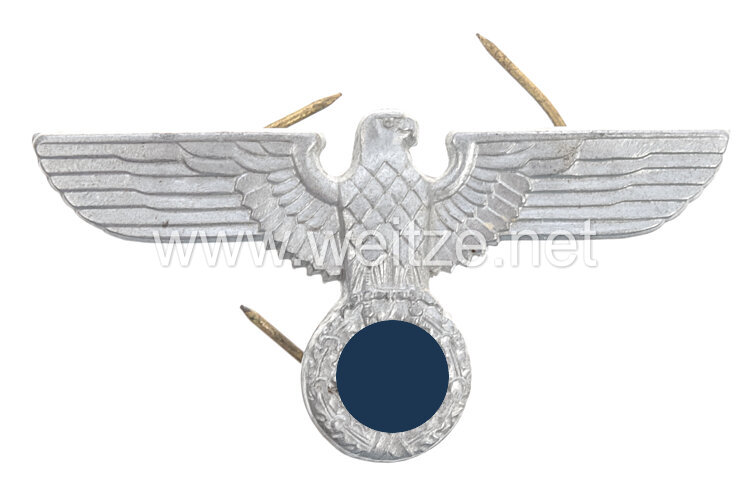
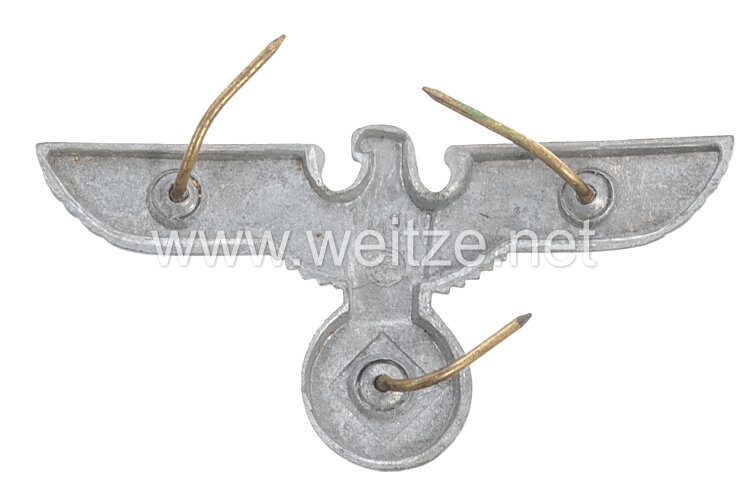
SA Cap Eagle for Peaked Cap

Fine zinc, circa 1943, all prongs present, RZM marked, condition 2-3.
463885
70,00

SA Cap Eagle for Peaked Cap

The SA Cap Eagle for the Peaked Cap represents a significant badge of the paramilitary organization known as the Sturmabteilung (SA) during the National Socialist period. This particular specimen made of fine zinc, dated around 1943, bears the RZM marking and retains all original prongs, indicating good preservation.

The Sturmabteilung, founded in 1920/21, developed into the largest paramilitary organization of the NSDAP. Its uniforms and insignia were subject to strict regulations laid down in various service regulations and uniform orders. The eagle as a sovereignty symbol played a central role in the symbolism of National Socialist organizations.

The Reichszeugmeisterei (RZM) system was introduced in 1929 to control the production and distribution of uniform parts and badges. The RZM marking guaranteed the official approval of the manufacturer and compliance with prescribed standards. Manufacturers had to register and received specific RZM numbers that were applied to their products. This served both quality control and economic regulation within the party organization.

The peaked cap (Schaftmütze) was a characteristic component of the SA uniform. It differed from other headgear through its specific form and was adorned with the corresponding sovereignty symbol. The eagle was attached above the cockade star and faced left (heraldically right), with spread wings and an oak wreath in its talons.

The use of fine zinc as a material around 1943 can be explained by wartime conditions. At the beginning of the war and in the pre-war period, higher-quality materials such as aluminum or silver-plated metal were used. With the progression of the war and increasing material shortages, manufacturers had to resort to alternative, less war-critical materials. Zinc was increasingly used as a substitute material, though in fine quality it could still produce appealing results.

The fastening method using prongs was characteristic of SA badges. These metal pins were pushed through the fabric of the cap and bent over on the inside. The presence of all original prongs is an important authenticity feature and indicates that the badge was not subsequently manipulated.

After the “Night of the Long Knives” in June 1934, during which the SA leadership was largely eliminated, the organization lost its original political and military significance. While it continued formally, its role became increasingly marginalized. The Wehrmacht and later the Waffen-SS took over military functions, while the SA assumed more representative and auxiliary service tasks.

In 1943, when this specimen was produced, Germany was already deep into World War II. By this time, the SA had long since lost its former power and significance. Its members were often engaged in home services, air raid protection training, or subordinate administrative tasks. The production of SA uniform parts continued, albeit on a reduced scale and under difficult material conditions.

The collectible value of such badges depends on various factors: condition, completeness of prongs, legibility of the RZM marking, and material. The indicated condition of 2-3 suggests light to moderate signs of use, which is quite normal for objects of this age.

From a historical perspective, such badges document the uniforming practice and organizational structure of the National Socialist movement. They are testimonies of a dark period in German history and today serve exclusively for historical research and documentation. Handling such objects requires historical responsibility and clear rejection of the ideology they once represented.

Understanding these artifacts within their proper historical context is essential for researchers, historians, and educators. They serve as tangible reminders of the mechanisms through which totalitarian regimes established visual identity and organizational cohesion. The study of such material culture contributes to our understanding of how symbols and uniforms functioned within the broader apparatus of National Socialist control and propaganda.

r