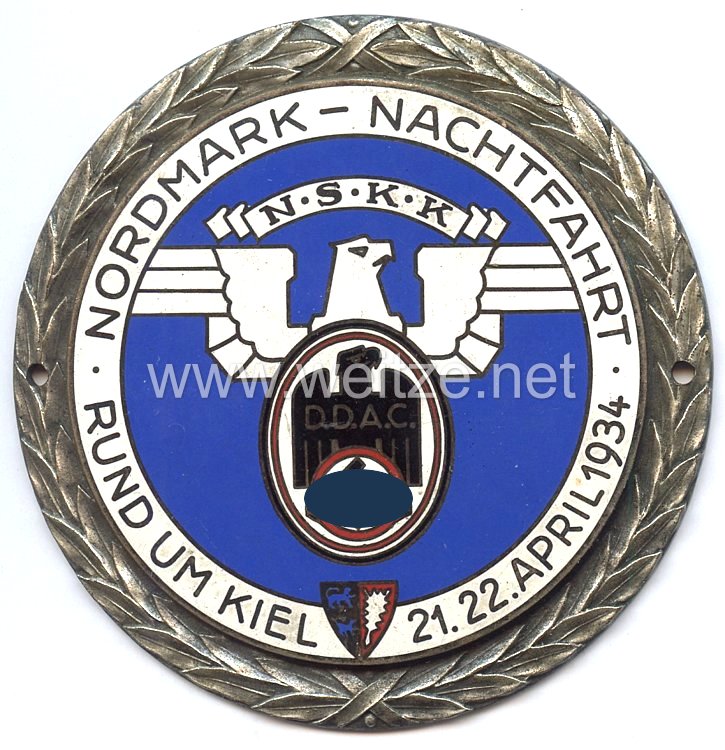
NSKK / DDAC - Non-Portable Participant Plaque - “Nordmark Night Drive around Kiel April 21-22, 1934”
The NSKK/DDAC Nordmark Night Drive around Kiel on April 21-22, 1934, represents a significant moment in the history of National Socialist transportation and motor vehicle organizations in the early Third Reich. This non-portable participant plaque documents the connection between motorsport, political propaganda, and the coordination of German automobile associations during the Nazi era.
The National Socialist Motor Corps (NSKK) was founded in 1931 as a motorized sub-organization of the SA and developed after 1933 into a paramilitary formation with several hundred thousand members. The German Automobile Club (DDAC), founded in 1903, was brought into line in 1933/34 and placed under NSKK Corps Leader Adolf Hühnlein. The merger of both organizations symbolized the instrumentalization of motorsport for Nazi purposes.
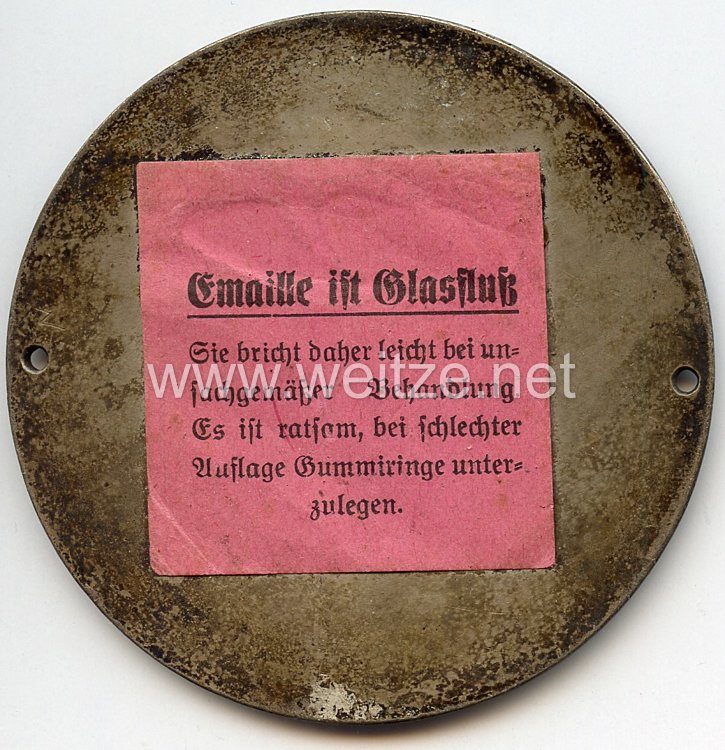
This plaque, made of silver-plated non-ferrous metal with enamel overlay and measuring 75 mm, demonstrates the typical craftsmanship quality of such memorabilia from the 1930s. The two drill holes indicate that it was intended for mounting on vehicles, display cases, or wall brackets. The attached instructions for enamel care on the reverse emphasize the value placed on these objects.
Night drives were popular motorsport events of the interwar period that required special navigational and driving skills. The Nordmark region referred in Nazi terminology to the area of Schleswig-Holstein and Hamburg. Kiel, as a naval base, had particular strategic importance and was an important center of National Socialist activities.
In April 1934, the Nazi regime was in its consolidation phase. The "coordination" of clubs and associations was largely complete. Motorsport events served several purposes: they promoted technical skills relevant to future motorization of the Wehrmacht, they provided opportunities for mass organization and political indoctrination, and they demonstrated the supposed modernity of the new regime.
Such plaques were produced by specialized metalware manufacturers, often concentrated in southern Germany. The use of enamel was elaborate and required multiple firings at high temperatures. The silver plating and careful execution show that these pieces were designed as permanent mementos, not as mass-produced items.
Participant plaques like this document the everyday culture of the Third Reich and the penetration of seemingly apolitical leisure activities with Nazi ideology. They were issued to drivers and co-drivers who successfully completed the event. Unlike wearable decorations, they were commemorative and prestige objects for private use.
From a military-historical perspective, such objects are significant because the NSKK played an important role in pre-military training. The organization trained motor vehicle operators who were later employed as drivers, mechanics, and transport personnel in the Wehrmacht. The technical skills acquired during night drives were directly applicable to military use.
The preservation of the enamel care instructions on the reverse is remarkable and rare today. It demonstrates the care of the original owners and increases the documentary value of the object. The stated condition 2 indicates a well-preserved plaque with slight signs of use, which is considered excellent for an object nearly 90 years old.
Today, such plaques are important study objects for historians researching the everyday history of National Socialism. They document the connection between enthusiasm for technology, motorsport, and political ideology in the 1930s, and show how the Nazi regime attempted to penetrate all areas of life and instrumentalize them for its purposes.