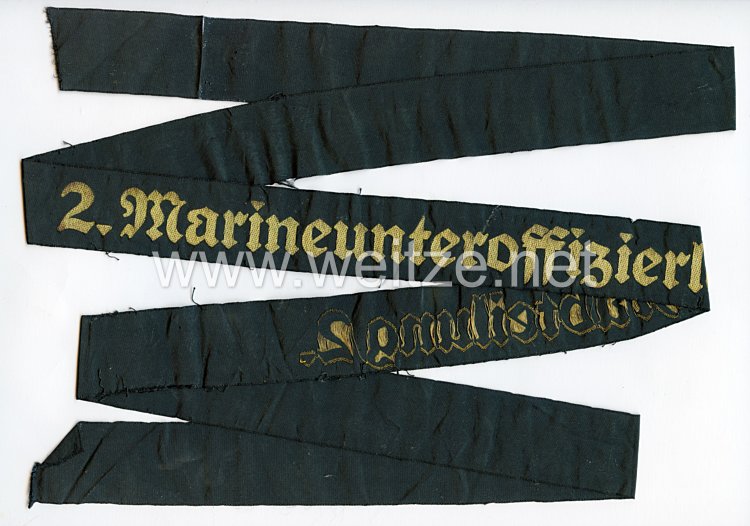
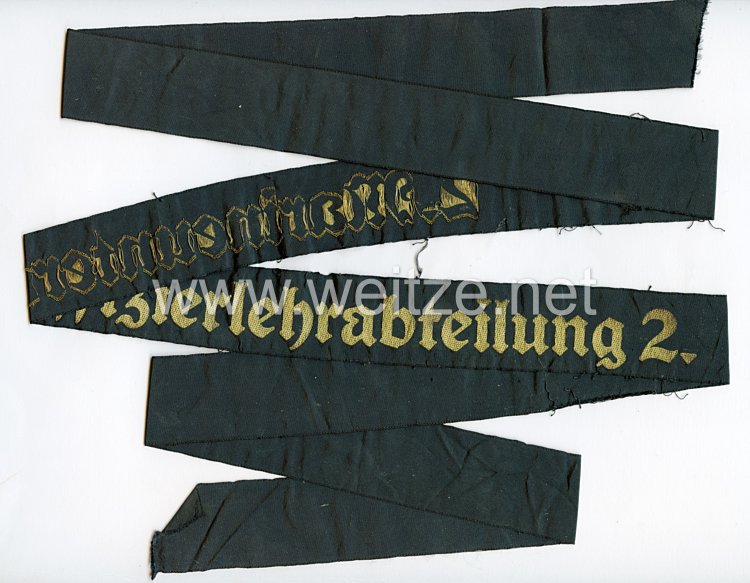
Kriegsmarine Cap Tally “2. Marineunteroffizierlehrabteilung 2.”

Metal thread woven construction, length approx. 110 cm, with adhesive residue, condition 2-3.
407085
25,00

Kriegsmarine Cap Tally “2. Marineunteroffizierlehrabteilung 2.”

The Kriegsmarine cap tally of the 2. Marineunteroffizierlehrabteilung 2 (2nd Naval Petty Officer Training Division 2) represents an authentic artifact from German naval training during World War II. This metal-thread woven example demonstrates the high craftsmanship standards maintained in the production of Kriegsmarine uniform components.

The Marineunteroffizierlehrabteilungen (Naval Petty Officer Training Divisions) were specialized training facilities of the Kriegsmarine tasked with the education and training of petty officers. These institutions played a crucial role in maintaining the professionalism and combat effectiveness of the German Navy. The numbering “2” indicates one of several parallel training divisions stationed at various locations throughout the German Reich.

The cap tally itself was a mandatory component of naval uniforms, worn on the peaked cap or sailor's cap. The tradition of cap tallies in the German Navy dates back to the 19th century and was established in the Imperial Navy. According to naval uniform regulations, all enlisted men and petty officers were required to wear a cap tally identifying their respective unit or ship.

The metal-thread woven execution was typical of high-quality Kriegsmarine cap tallies. In this technique, silver-colored metal threads were woven into the black base fabric, creating raised lettering that was particularly durable. This manufacturing method differed from simpler embroidered or printed variants and signified quality and authenticity. The length of approximately 110 centimeters corresponds to the standardized measurements of Kriegsmarine cap tallies.

Training in the Naval Petty Officer Training Divisions encompassed a broad spectrum of military and maritime skills. Recruits were instructed in navigation, weapons technology, ship operations, military leadership, and the specific requirements of their respective specializations. The duration of training varied depending on specialization but typically lasted several months to a year.

Within the context of Kriegsmarine organization, the training divisions were part of an extensive education system that included locations on the Baltic and North Seas as well as in occupied territories. Places such as Stralsund, Kiel, Wilhelmshaven, and Flensburg-Mürwik housed various training facilities. The exact location of the 2nd Naval Petty Officer Training Division 2 is difficult to determine today without additional documentation, as naval archives suffered significant losses.

Wearing the cap tally served multiple functions: it provided identification, strengthened esprit de corps and connection to one's own unit, and was part of maritime tradition. For the wearers, the tally represented a connection to their training facility and their comrades. Cap tallies were often kept as mementos, which explains their preservation to this day.

The adhesive traces on this example suggest that the tally may have been mounted in a collection or attached for exhibition purposes. This was a common practice among collectors and museums in the post-war period. The indicated condition grade of 2-3 corresponds to a well-preserved object with slight signs of use, which is remarkable for a textile item over 75 years old.

In contemporary military-historical research, such cap tallies serve as important sources for reconstructing Kriegsmarine organization. They assist in identifying units, documenting locations, and understanding the training system. For collectors and museums, they represent authentic witnesses of a past era and contribute to the preservation of naval history.

The metal-thread weaving itself was a specialized craft executed by only a few manufacturers. Companies such as the uniform factory August Brühl in Lübeck or other licensed manufacturers produced these tallies according to exact specifications from naval leadership. Quality control was strict, and only approved versions were permitted for use.

The historical significance of training units like the 2nd Naval Petty Officer Training Division 2 lies in their contribution to maintaining the operational capability of the Kriegsmarine throughout the war years. As losses mounted and the need for trained personnel increased, these training divisions became increasingly important to the German naval war effort.

r