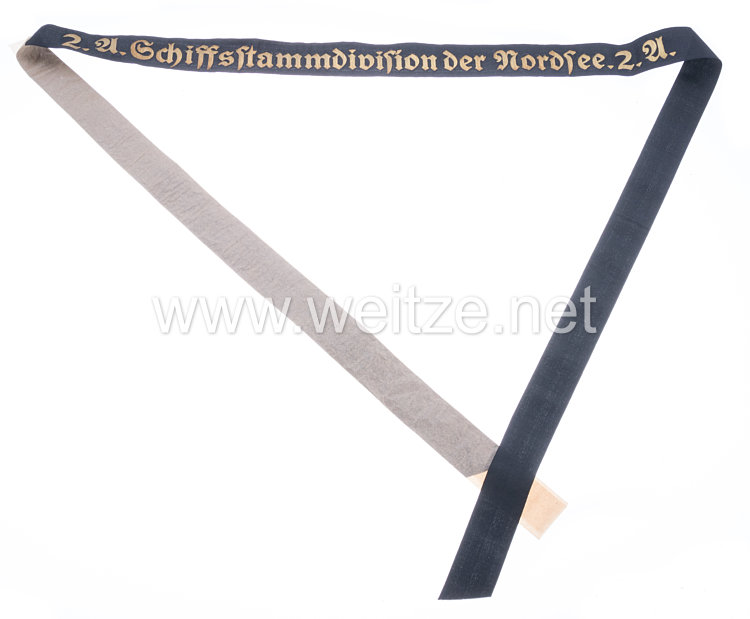
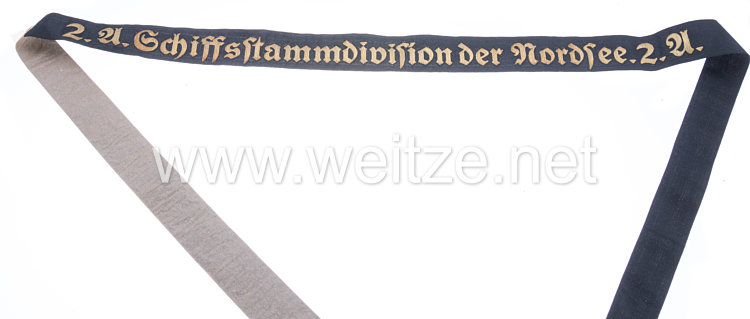
Kriegsmarine Cap Tally "2.A Schiffsstammdivision der Nordsee 2.A"
The cap tally of the 2.A Schiffsstammdivision der Nordsee (2nd A Ship Crew Division of the North Sea) represents a fascinating testament to the organizational structure of the Kriegsmarine during the Second World War. These ribbons, worn on the naval caps of German naval personnel, served not only as identification markers but also as symbols of belonging to a specific unit.
The Schiffsstammdivisionen (Ship Crew Divisions) were specialized training and replacement units of the Kriegsmarine, systematically established from 1935 onwards. Their primary function was to train recruits and provide trained personnel as replacements for frontline units. The designation “Stammdivision” referred to their role as base units from which active ship crews were supplemented.
The North Sea Ship Crew Divisions were subordinate to the Naval Commander North Sea and had their bases primarily along the German North Sea coast. The numbering “2.A” indicates a specific subdivision within the organizational system. The Kriegsmarine used alphanumeric designations to distinguish between different departments and companies, with letters frequently denoting different platoons or training companies.
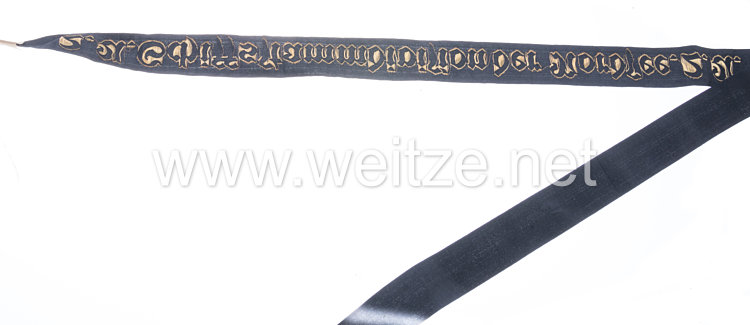
The cap tally described here is made of metal thread, indicating high-quality manufacture. Such ribbons were typically produced through elaborate handwork or with special weaving machines. The metal thread, usually made of aluminum or silver-plated copper, was interwoven with black cotton yarn to create the characteristic golden or silver lettering on a black background.
The fact that this specimen is described as unworn makes it a particularly valuable historical object. During the war, cap tallies were often heavily worn due to saltwater, sun, and mechanical stress. Unworn pieces typically have several possible origins: they may have been procured as spares but never used, or they come from stocks that remained unused after the war's end.
The cap tally regulations of the Kriegsmarine were strictly governed. According to the dress regulations for the Kriegsmarine, every sailor and non-commissioned officer without sword knot had to wear a cap tally on their naval cap indicating their current duty station. Officers and non-commissioned officers with sword knots, however, wore caps with gilt cockades but without cap tallies.
The lettering followed standardized specifications: the text was executed in Latin capital letters, with the unit designation written out in full. The length of the ribbon was measured so that it went once around the cap and was tied at the back of the head with a bow, whose ends hung down.
In the context of Kriegsmarine organization, the Ship Crew Divisions played a crucial role in maintaining personnel strength. As the war progressed and losses mounted, the importance of these training units grew considerably. They had to provide not only basic training but also teach specialized skills for various positions aboard ship.
The North Sea units were particularly important, as the North Sea was a central operational area of the Kriegsmarine. From here, U-boats, destroyers, fast attack craft, and other warships operated against Allied convoys and naval units. The Ship Crew Divisions in this area had to prepare personnel for these demanding and dangerous missions.
From a collector's and museum perspective, cap tallies from Ship Crew Divisions are rarer today than those from famous warships such as the Bismarck or Tirpitz. This is because the ribbons from famous ships were more popular among collectors and were preserved more frequently. Ribbons from training units were often considered less significant and not as carefully preserved.
The present object is an authentic witness to military everyday culture and the organizational complexity of the German Kriegsmarine. It represents the thousands of young men who passed through the Ship Crew Divisions and serves as a reminder of a dark chapter in German history. Such objects serve historical research and education today by helping to better understand the structures and life in the Kriegsmarine.
The metal thread construction and unworn condition suggest this piece may have been part of a supply stock or perhaps manufactured late in the war when material shortages were beginning to affect production. The craftsmanship evident in such items reflects the importance the Kriegsmarine placed on unit identity and naval tradition, even as the war situation deteriorated.