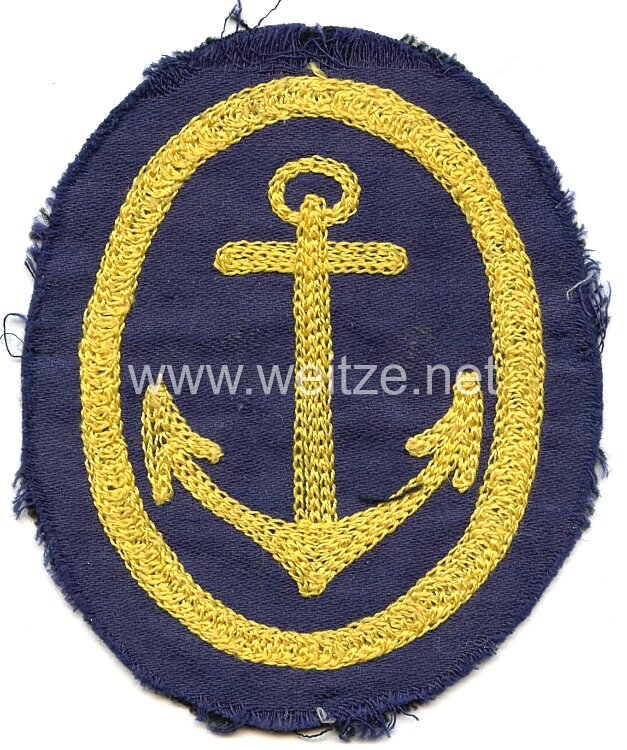
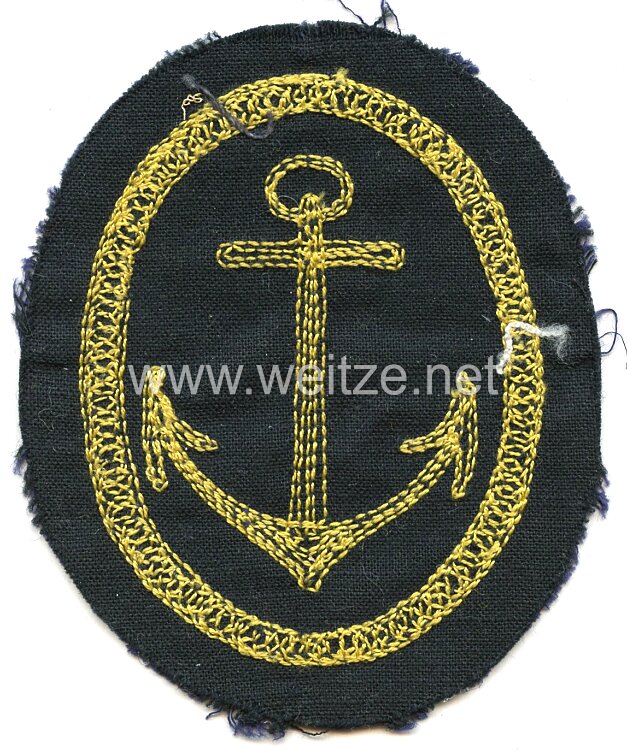
Kriegsmarine Sports Trousers Badge for Officers

Machine embroidery, condition 2.
462685
30,00

Kriegsmarine Sports Trousers Badge for Officers

The Kriegsmarine Badge for Sports Trousers for Officers represents a fascinating example of the military uniform regulations of the German Reich during the period from 1935 to 1945. These special badges embody the strict hierarchy and detailed clothing regulations that governed all aspects of military life in the German naval forces, including sportswear.

The Kriegsmarine, established as an independent branch of the Wehrmacht on June 1, 1935, developed a comprehensive system of uniforms and badges that extended far beyond traditional service dress. Under the leadership of Grand Admiral Erich Raeder and later Karl Dönitz, detailed clothing regulations were enacted that governed every aspect of the uniform, from parade dress to sportswear.

Officers' sportswear was by no means a trivial matter in the military training of the Kriegsmarine. Physical fitness was considered an essential component of officer training and daily military life. The naval schools and training facilities placed great emphasis on physical exercise, which served not only physical fitness but also promoted camaraderie, discipline, and military spirit.

The badge described here was manufactured using chain-stitch embroidery (Kurbelstickerei), a special embroidery technique executed using a chain-stitch machine. This technique enabled precise and durable processing of rank insignia and was characteristic of high-quality Kriegsmarine officer badges. Chain-stitch embroidery was distinguished by fine, uniform stitches and was frequently executed on a dark blue background typical of naval insignia.

Officer badges for sports trousers differed in their design from regular service rank insignia. They were typically smaller and more discreet in design but still had to clearly identify military rank. This corresponded to the basic principle of German military regulations that an officer's rank had to be recognizable even outside of regular service dress.

The dress regulations of the Kriegsmarine were governed by various decrees and regulations issued by the High Command of the Navy. These regulations specified exactly when and how certain uniform parts and badges were to be worn. Special regulations applied to sportswear, taking into account the practical requirements of physical activity without abandoning military order.

The production of such badges was carried out by specialized military equipment factories that worked according to exact specifications from the High Command. Officers typically acquired their uniform parts and badges from authorized dealers or naval clothing offices. The quality of workmanship was an important feature that reflected the status and professionalism of the wearer.

In the context of naval history, this badge illustrates the comprehensive regimentation of military life in the Third Reich. Even sportswear was subject to strict regulations and had to meet military standards. This reflects the totalitarian nature of the regime, which permeated and controlled all areas of life.

Today, such badges are important contemporary historical documents that provide insights into the structures and practices of the German Kriegsmarine. They are preserved and studied by military historians, museums, and collectors as testimonies of a bygone era. The preservation and scientific examination of such objects serves historical understanding and the coming to terms with this dark period of German history.

The condition assessment with category 2 indicates a well-preserved specimen that still clearly shows the characteristic features of chain-stitch embroidery. Such states of preservation enable researchers and interested parties to study the craftsmanship quality and details of the military effects of that time.