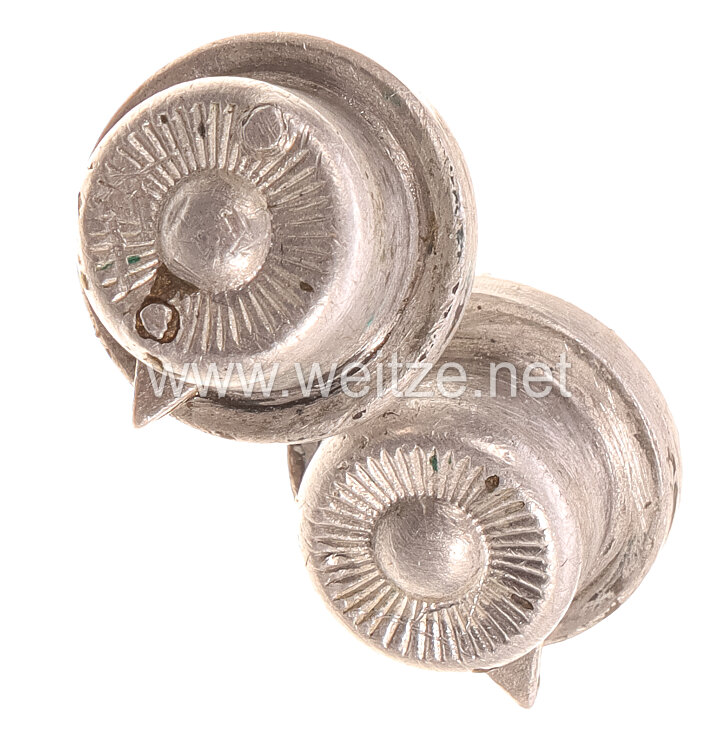
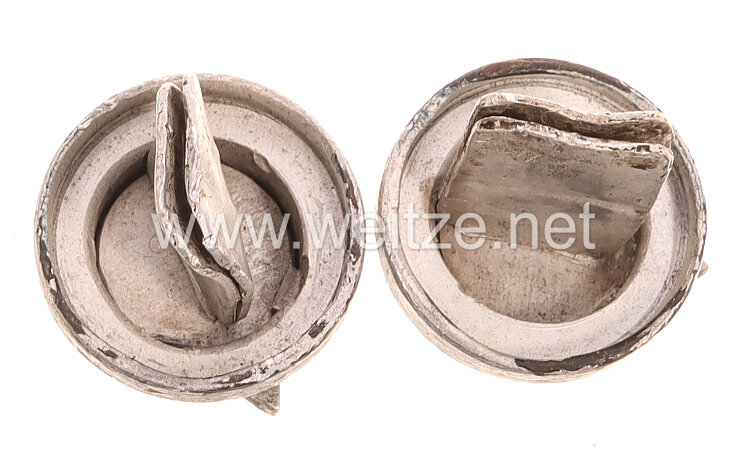
Third Reich Police, Pair of Buttons for Police Shako
These police shako buttons from the German Third Reich represent an interesting testimony to the uniform-technical development and standardization of German police forces between 1933 and 1945. Made of aluminum, these buttons were part of the official headgear of the uniformed police and reflect both the practical and representative aspects of the police uniform of that era.
The police shako had a long tradition in German police history, dating back to the 19th century. After the Nazi seizure of power in 1933, the German police was gradually unified and centralized. The Regulation on the Uniform Clothing of the Police of June 24, 1936, established uniform standards for police uniforms throughout the Reich for the first time. The shako, as a tall cylindrical headgear, was primarily worn by the Schutzpolizei (Protection Police) during ceremonial occasions and official duties.
The use of aluminum as a material for the buttons was a deliberate choice that offered several advantages. Aluminum was lightweight, corrosion-resistant, and easy to work with. During times of increasing raw material shortages, especially from the outbreak of war in 1939, the use of aluminum became increasingly important compared to brass or other copper alloys, as these metals were needed for armament production. Material economy played an increasingly important role in the manufacture of uniform components.
The buttons on the police shako had both functional and decorative significance. They served to attach straps, cords, or other shako components. Typically, they featured the police national emblem, showing an eagle with a swastika and often a star or other police-specific symbols. The exact design varied depending on the time of manufacture and the applicable uniform regulations.
The organizational structure of the police in the Third Reich was complex. After Heinrich Himmler's appointment as Chief of the German Police in June 1936, the police was increasingly merged with the SS. The Ordnungspolizei (Order Police) included the Schutzpolizei, Gendarmerie, and Municipal Police. The uniforming of these various police branches followed uniform guidelines, with the shako remaining a characteristic element of the Schutzpolizei.
The manufacture of police uniform items was carried out by various authorized manufacturers who had to comply with the quality standards and regulations of the Reichsführer SS and Chief of the German Police. The buttons were usually stamped or cast and then fitted with eyelets or attachment mechanisms. Quality could vary depending on the year of manufacture and producer, with simplification and quality reduction often evident toward the end of the war.
The state of preservation of such objects today is often affected by decades of storage. Slight bending, as present in the described buttons, is typical for aluminum objects of this type and testifies to their actual use or improper storage. The relatively soft nature of aluminum made these buttons susceptible to mechanical damage.
From a military-historical perspective, such uniform components document the everyday reality of the German police during one of the darkest periods in German history. The police were not only responsible for public order but were increasingly involved in the crimes of the Nazi regime, including the persecution of Jews, political opponents, and other victim groups. Police units were also involved in war crimes in occupied territories.
Today, such objects are important objects of study for historians and collectors concerned with uniform studies and the history of the German police. They help to understand the material culture and organizational development of this institution, while also serving as reminders of the historical responsibility and crimes of that time.