General Assault Badge - Wurster

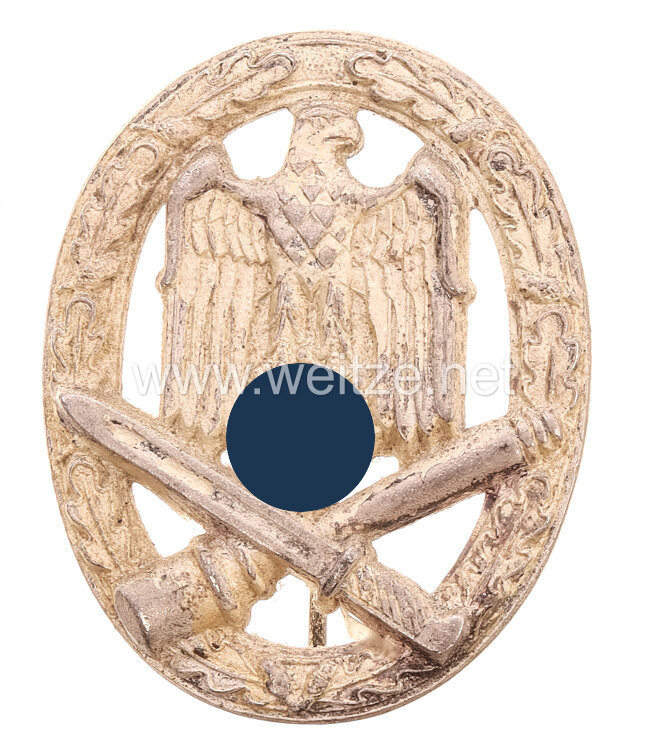
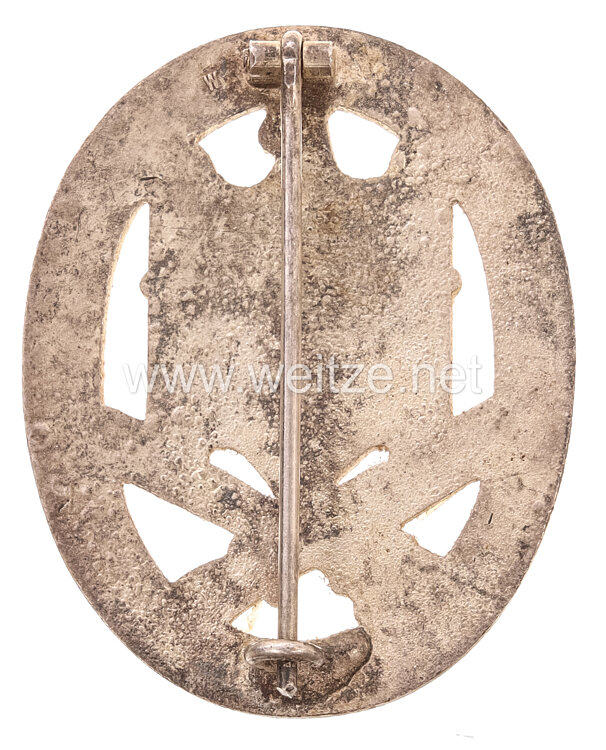
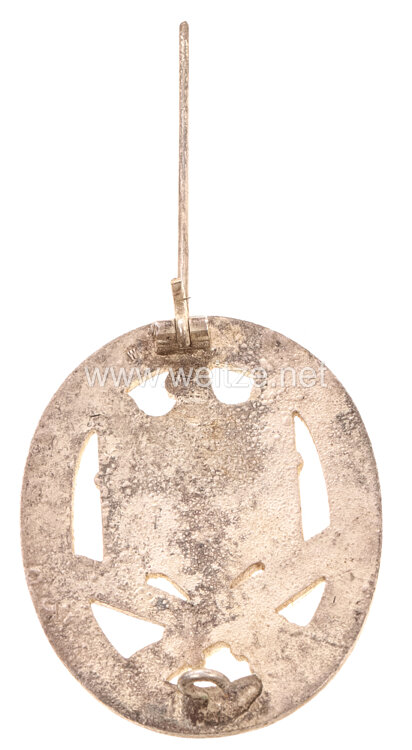
Silver-plated zinc alloy, maker marked “W” on reverse. Worn condition, Grade 2.
460385
450,00

General Assault Badge - Wurster

The General Assault Badge (Allgemeines Sturmabzeichen) represents one of the most significant decorations of the German Wehrmacht during World War II. This military valor award was instituted on June 1, 1940, by the Supreme Commander of the Wehrmacht, Field Marshal Wilhelm Keitel, and was intended to honor soldiers of all branches for their participation in attacks and assault operations.

The establishment of the General Assault Badge occurred in recognition of the special achievements of infantrymen and other ground troops who could not already be honored with the Infantry Assault Badge. The award criteria stipulated that the badge was to be conferred upon members of motorized units, tank hunters, engineers, signals troops, and other specialist units who had participated in at least three assault attack days or three anti-tank combats in the front line.

Design and Manufacture: The badge displays an oval oak leaf wreath oriented to the right, in the center of which is a rifle leaning to the right with fixed bayonet and a stick grenade lying beside it. Production typically occurred in silver-plated fine zinc, with various manufacturers commissioned bearing different maker marks. The present specimen bears the reverse marking “W”, which is attributed to the manufacturer Wurster & Co. of Markneukirchen. This firm was among the numerous contracted manufacturers of orders and decorations during the war.

The Wurster family had operated a metal goods factory in Markneukirchen in the Saxon Vogtland since the 1920s, a region known for its metalworking industry. During World War II, the company produced various military decorations for the Wehrmacht. The quality of Wurster production is generally assessed by collectors as good to very good, with the details of the stamping and silver plating exhibiting characteristic features.

Award Practice: The award guidelines were modified several times during the course of the war. Originally, the requirements had to be met on three different days, with a “assault attack day” precisely defined as active participation in an attack in the front line under enemy fire. Commanders at battalion or equivalent level were responsible for conferring the award. The decoration was recorded in the soldiers' pay books and military passes.

During the course of the war, especially after 1943, the award conditions were partially relaxed due to the increasing intensity of combat. There were also graduated forms of the badge: in addition to the basic grade, there was the General Assault Badge in Bronze (for 25 assault attack days), in Silver (for 50 assault attack days), and in Gold (for 75 or later 100 assault attack days).

Physical Condition and Wear: The described specimen is designated as “worn” and classified in condition 2, indicating authentic use. Worn pieces typically show signs of wear to the silver plating, particularly on the raised areas of the relief. The badge was worn on the left breast side of the uniform, below the breast pocket. Attachment was accomplished by means of a reverse pin with hook fastener.

Historical Significance: The General Assault Badge documents the military decoration practices of the Nazi regime and the reality of frontline combat during World War II. For historical science and military history, such objects serve as material witnesses of an era. They must be understood in the context of their time, as instruments of military motivation and hierarchy in a criminal war of aggression.

Today, such decorations are objects of study for military historians and collectors of historical militaria. In Germany, the display and trade of Nazi symbols are subject to strict legal provisions (§86a Criminal Code), with use for scientific, historical, or educational purposes explicitly permitted. Collectors and museums bear responsibility to present such objects within their proper historical context, neither glorifying nor trivializing the crimes of the Nazi dictatorship.

The maker mark “W” for Wurster provides important information for the attribution and authentication of such pieces. Knowledge of manufacturers and their specific characteristics is essential for distinguishing authentic period pieces from post-war reproductions that exist in significant numbers on the collectors' market.

r