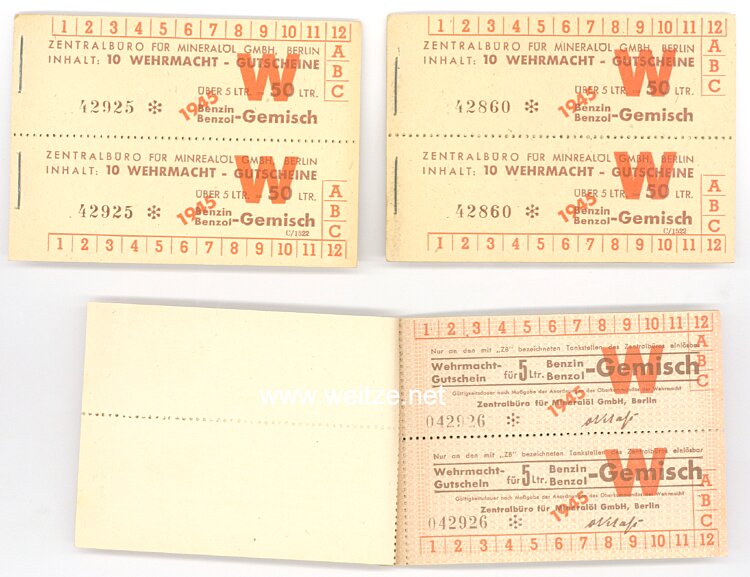
Wehrmacht Coupon Booklet for Gasoline-Benzol Mixture, circa 1945

Booklet containing 10 coupons for gasoline-benzol mixture, issued by Zentralbüro für Mineralöl GmbH-Berlin, dated 1945, complete and unused.
Price per piece:
19184
20,00

Wehrmacht Coupon Booklet for Gasoline-Benzol Mixture, circa 1945

The Wehrmacht fuel voucher booklet for gasoline-benzol mixture from 1945 is a remarkable testament to the increasingly desperate supply situation of the German Reich in the final months of World War II. These voucher booklets document not only the strict rationing of fuels but also the progressive erosion of the German war economy.

The Zentralbüro für Mineralöl GmbH Berlin (Central Office for Mineral Oil) was the central administrative body responsible for the distribution and rationing of fuels in the German Reich. This organization coordinated scarce petroleum resources and ensured that military units, war-essential industries, and other priority consumers received the necessary fuel. The voucher booklets were an essential instrument of management and control during a time of extreme resource scarcity.

The use of gasoline-benzol mixture is particularly revealing for understanding the German fuel crisis near the war's end. Since the 1930s, Nazi Germany had attempted to reduce its dependence on imported petroleum through synthetic fuels. The hydrogenation plants and Fischer-Tropsch facilities produced synthetic gasoline from coal. Benzol, an aromatic hydrocarbon mixture derived from coal, was blended with gasoline to extend available quantities and increase octane rating.

From 1944 onward, the fuel situation deteriorated dramatically. Allied bombing raids, particularly Operation Pointblank and subsequent campaigns, systematically targeted synthetic fuel plants and refineries. The hydrogenation plants in Leuna, Pölitz, Brüx, and other locations were repeatedly bombed. Simultaneously, Germany lost access to the Romanian oil fields at Ploiești, one of the last natural petroleum sources available to the Wehrmacht.

Fuel production collapsed from approximately 316,000 tons in March 1944 to under 17,000 tons in September 1944. This catastrophic shortage increasingly paralyzed Wehrmacht mobility. Tank formations had to be abandoned for lack of fuel, Luftwaffe units could no longer fly sufficiently, and even basic military operations were hampered by fuel shortages. The Ardennes Offensive in December 1944 failed partly due to inadequate fuel supply, with German units hoping to capture Allied fuel depots.

In this context, rationing systems like the voucher booklets took on existential significance. Every liter of fuel had to be meticulously documented and distributed. The vouchers enabled authorities to control consumption and set priorities. Military transports, supply convoys, and war-essential production facilities received priority, while civilian traffic virtually ceased.

The fact that this booklet survives complete and unused raises interesting questions. Perhaps it was never issued because the allocated unit was dissolved, the recipient was no longer reachable, or simply because no fuel remained available. In the chaotic final weeks of the war, many administrative structures collapsed, and such vouchers lost their practical value.

The design of such documents typically followed standardized administrative regulations. They contained information about the issuing authority, serial numbers for control purposes, fields for date and signature, and the authorized quantity in liters. The vouchers had to be presented at authorized distribution points, which in turn had to account for the quantities issued.

After the war's end, such documents became worthless but gained historical and collectible value over time. They document the everyday reality of the war economy and the increasing dysfunction of the Nazi system in its final phase. For military historians, they are important sources for understanding the logistical challenges and economic collapse of the German Reich.

Today, such militaria documents are part of collections that document Wehrmacht life and organization. They complement the understanding gained from official files, war diaries, and other sources, offering insights into the bureaucratic mechanisms of a collapsing war machine.