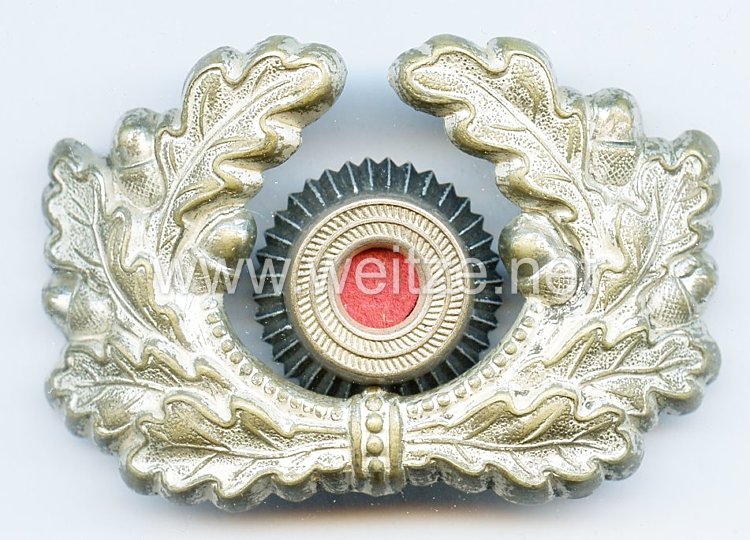
Wehrmacht Oak Leaf Wreath with Cockade for Visor Cap
The Wehrmacht Oak Leaf Wreath with Cockade represents a characteristic element of German military uniforms during the period of World War II. This component was attached to the Schirmmütze (visor cap) and served as an important rank insignia and identification feature for members of the Wehrmacht.
The Wehrmacht, officially established on March 16, 1935, through the Defense Law, was the unified armed force of the German Reich from 1935 to 1945. It consisted of three service branches: the Heer (Army), the Kriegsmarine (Navy), and the Luftwaffe (Air Force). Uniform regulations and insignia were governed by strict military regulation sheets and dress codes, which provided precise specifications for the appearance and placement of every element.
The oak leaf wreath holds deep symbolic significance in German military tradition. Oak leaves had symbolized bravery, strength, and steadfastness since Prussian times. This symbolism was adopted by the Wehrmacht and used in various rank insignia and decorations. The wreath typically framed the national cockade, which consisted of the colors black-white-red and represented the German Reich.
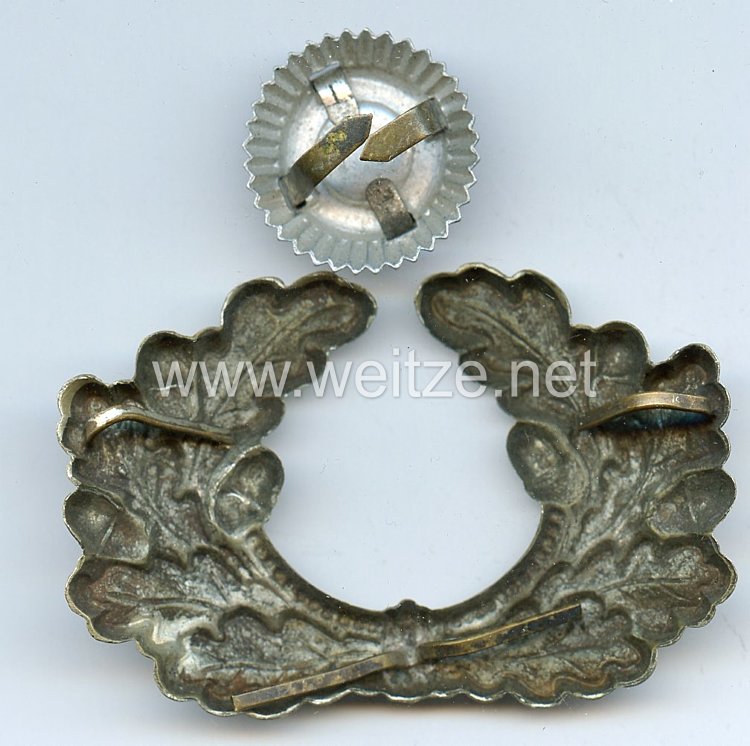
The manufacture of such insignia was carried out using non-ferrous metal (Buntmetall), an alloy characterized by good formability and durability. Production was handled by various manufacturers authorized by the Wehrmacht. Each insignia featured prongs (fastening pins) on the reverse side, with which it was attached to the cap. The typical construction included three prongs, which ensured secure and permanent attachment.
The visor cap itself was an essential component of the service uniform for officers and non-commissioned officers. While enlisted ranks frequently wore the field cap, the visor cap was part of the walking-out uniform and service uniform for higher ranks. The design of the cap and its insignia varied according to the branch of service and rank of the wearer.
The cockade was placed centrally on the front of the visor cap, surrounded by the oak leaf wreath. Above the cockade was typically the national emblem featuring the eagle and swastika. This arrangement was precisely specified in uniform regulations and could not be arbitrarily altered.
Historically, Wehrmacht uniform regulations underwent several changes during its existence. The first regulations were introduced in 1935 and modified multiple times in subsequent years. Material shortages during the war led to simplifications and the use of substitute materials, which also affected the quality and execution of insignia.
After the end of World War II in 1945, the Wehrmacht was dissolved. Uniform parts and insignia became collectors' items that are valued today by militaria collectors and historians. They serve as material witnesses to a significant, albeit dark, period of German and European history.
From a conservation perspective, such objects are susceptible to corrosion, especially when made from non-ferrous metal. Condition 2 in collector nomenclature typically designates an object with slight signs of use but still well preserved. The fact that the cockade is loose is not unusual, as connections can become loosened after decades through corrosion or mechanical stress.
The scientific study of such militaria objects contributes to understanding the material culture of World War II. It provides insights into manufacturing techniques, material procurement, military hierarchies, and the visual representation of military power. Museums and scientific institutions preserve such objects as part of cultural heritage and use them for educational purposes to convey history to future generations.
It is important to approach such historical artifacts with appropriate historical context and awareness. They represent a period of unprecedented conflict and human tragedy, and their study must be conducted with academic rigor and ethical responsibility. Modern scholarship examines these objects not to glorify the past but to understand the mechanisms of military organization, propaganda, and the visual culture of totalitarian regimes.