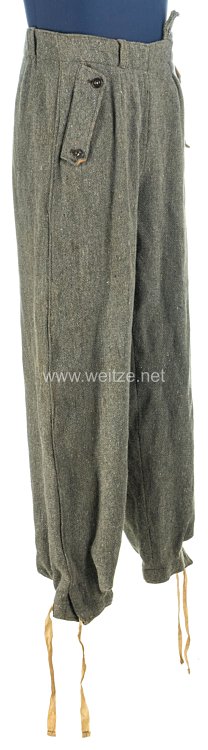
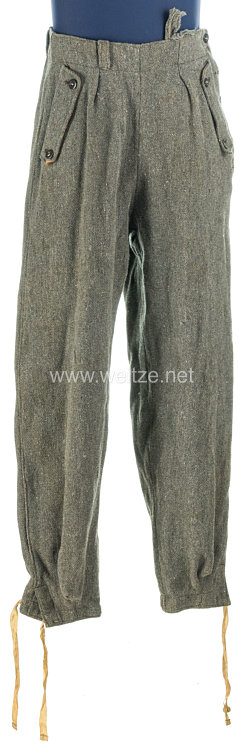
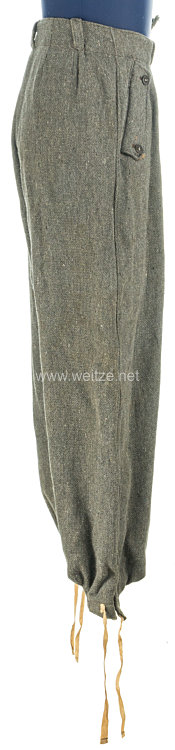
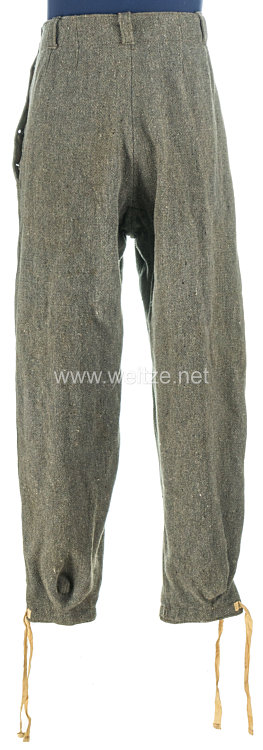
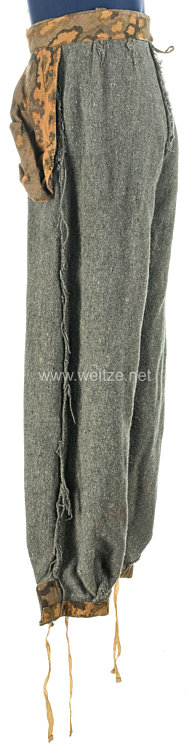
SS-Helferinnenkorps Overtrousers for Female Members of the Waffen-SS

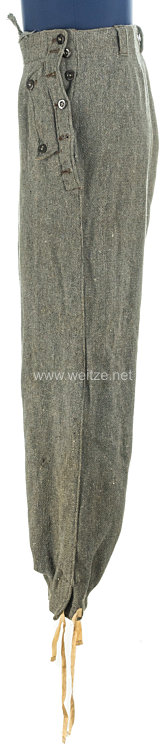
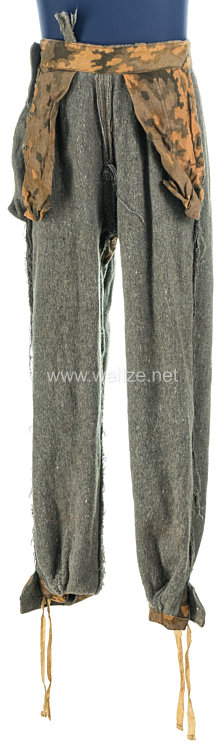
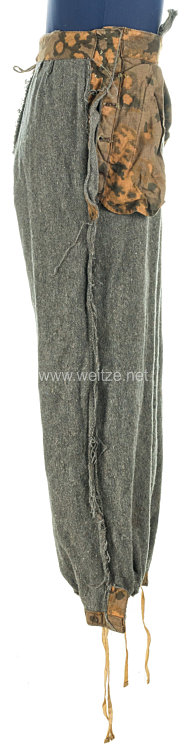
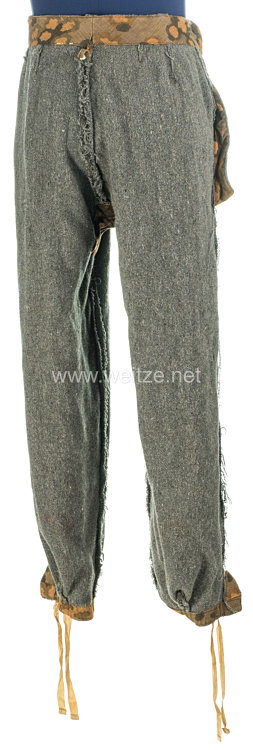
 circa 1944 - 1945. Manufactured from coarse gray cloth, with a button row on the side. Pocket flaps each with 2 buttons. Lined interior with Waffen-SS camouflage pattern, small illegible fabric label, 1 belt loop is damaged. Waist circumference 70 cm, length 104 cm, condition 3.
414784
1.700,00

SS-Helferinnenkorps Overtrousers for Female Members of the Waffen-SS

The assault trousers (Überfallhose) for members of the SS-Helferinnenkorps (SS Women's Auxiliary Corps) of the Waffen-SS represent a rare example of military clothing for female auxiliaries in the Third Reich during the final years of the war. This specialized form of clothing documents the increasing militarization and growing deployment of women in military-adjacent functions toward the end of World War II.

The SS-Helferinnenkorps was officially established in November 1942, although women had been employed in various support functions for the SS prior to this date. With the deteriorating military situation and increasing personnel demands on all fronts, women were systematically recruited for tasks in communications, administration, as radio operators, and in other non-combatant roles. The Waffen-SS primarily recruited its female auxiliaries from the Reich Labor Service (Reichsarbeitsdienst) and other Nazi women's organizations.

The assault trousers described here from the period 1944-1945 display characteristic features of late-war production. The coarse gray cloth corresponds to the material shortages of this period, when high-quality uniform fabrics increasingly had to be reserved for combat troops. The side button row allowed for quick donning and removal over boots - hence the designation “Überfallhose” (assault trousers), a term originally derived from equestrian sports denoting practical work trousers.

Particularly noteworthy is the lining made from Waffen-SS camouflage pattern fabric. The use of camouflage material as lining was not uncommon in the late war period and indicates the recycling of material remnants. The Waffen-SS had developed various camouflage patterns, including the pea-dot pattern (Erbsenmuster), the oak-leaf pattern (Eichenlaubmuster), and the plane-tree pattern (Platanenmuster). These patterns were developed from 1937 onward and represented an important innovation in camouflage technology.

The functional design with pocket flaps and buttons corresponded to the practical requirements of daily service. Female auxiliaries were frequently deployed in staff headquarters, communications centers, and administrative units where robust and practical work clothing was necessary. The trousers were intended to provide freedom of movement while conforming to military appearance standards.

Recruitment for the SS-Helferinnenkorps officially occurred on a voluntary basis, though considerable social pressure and ideological indoctrination played a role. The auxiliaries underwent basic training and were then deployed according to their abilities. They received pay and were bound by military disciplinary regulations, though they did not have the status of soldiers in the strict sense.

After the war's end, many members of the SS-Helferinnenkorps were interned and treated differently in denazification proceedings. The legal processing of their role proved complex, as they were formally not members of the SS but nevertheless worked for this organization. Their involvement in the Nazi regime varied considerably depending on individual function and deployment location.

Such uniform pieces are today important witnesses for historical research. They document not only the material culture and production conditions of wartime, but also the role of women in the National Socialist military apparatus. Historical research has only in recent decades examined more intensively the participation of women in Nazi organizations, thereby differentiating the earlier image of women as purely victims or uninvolved bystanders.

The preservation of such objects in collections and museums serves historical education and enlightenment, though it always requires critical contextualization to counteract any glorification or trivialization of the Nazi regime.