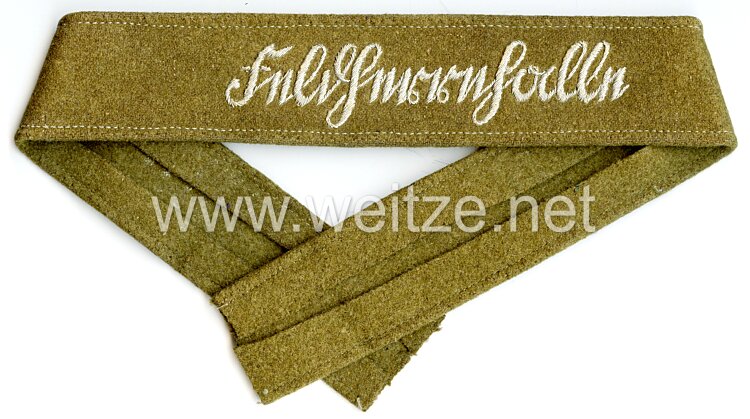
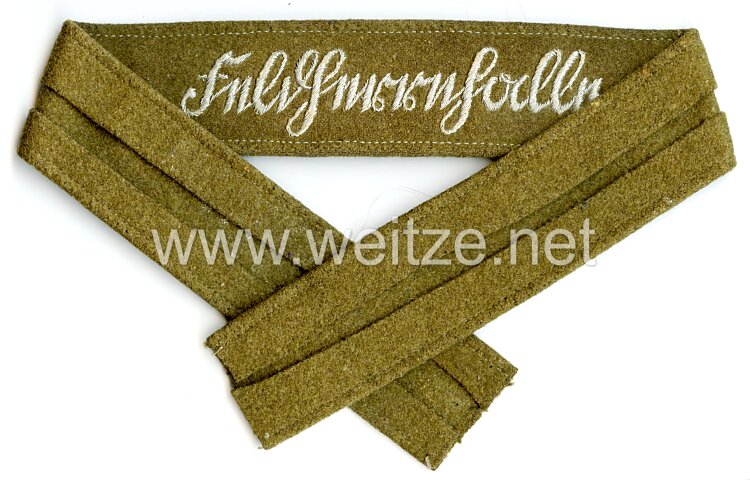
SA Standarte “Feldherrnhalle” Cuff Title for Leaders
The SA-Standarte “Feldherrnhalle” armband represents a significant piece of equipment within the complex organizational structure of the National Socialist Sturmabteilung (Storm Troopers). This particular armband, manufactured in 1944, embodies the final phase of the SA-Wehrmannschaften (SA Defense Units) and their integration into the military structures of the Third Reich.
The SA-Standarte Feldherrnhalle was founded in 1933 and received its name in commemoration of the failed Hitler Putsch of November 9, 1923, in Munich, which met its bloody end at the Feldherrnhalle monument. This unit occupied a special position within the SA and later became the foundation for military formations. In 1933, the unit was transformed into the SA-Standarte Feldherrnhalle (motorized), which was transferred to the Wehrmacht in 1935 and formed the core of Infantry Regiment Feldherrnhalle.
This armband dates from the later period and was intended for leaders of the SA-Wehrmannschaften. The SA-Wehrmannschaften were established in 1939 and served as a paramilitary reserve and training organization. After the SA was effectively neutered during the “Röhm Affair” in 1934, the organization lost its original power position and increasingly became a subordinate formation.
The technical execution of this armband is remarkable: it was manufactured in RZM metal-thread hand-embroidered execution. The Reichszeugmeisterei (RZM) was the central procurement office of the NSDAP and its subdivisions, responsible for standardization and quality control of uniforms and equipment. The use of metal thread indicates a higher-quality execution intended for leadership personnel.
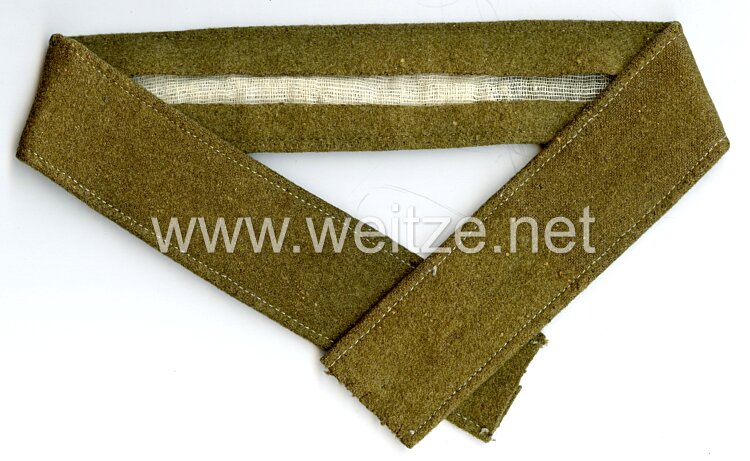
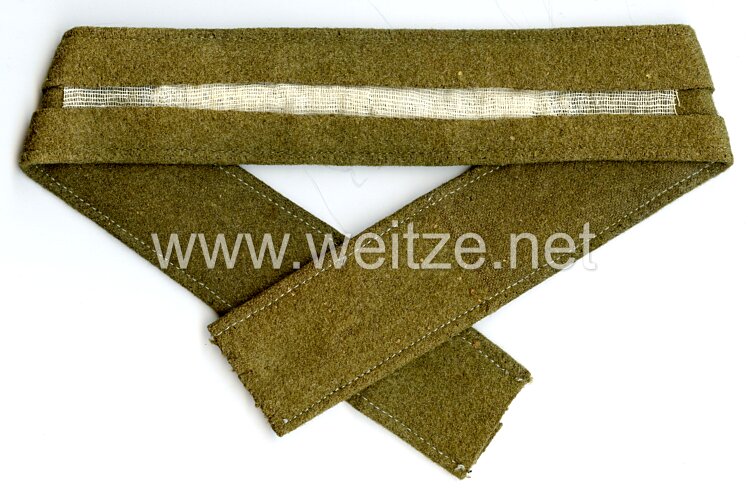
The armband is manufactured on olive cloth, which corresponded to the color scheme of the SA-Wehrmannschaften and differed from the brown uniforms of the regular SA. This color choice reflected the semi-military nature of this formation. With a length of 49 centimeters, it conformed to the standardized specifications for armbands, which were worn on the right upper arm of the service tunic or coat.
The production in 1944 is particularly interesting historically, as at this late stage of the war, the resources of the German Reich were already severely strained. The fact that hand-embroidered armbands of high quality were still being produced demonstrates the continuing importance of symbolic rank insignia and traditional ties even in the final phase of the war.
Armbands played a central role in National Socialist uniform studies for identifying membership in specific units, traditions, or special formations. The Feldherrnhalle armband was among the most prestigious, as it referred to one of the best-known episodes in National Socialist movement history.
The unworn condition of this specimen is remarkable and raises questions about its history. Possibly it was produced but never issued due to war developments, or it belonged to stock that never reached distribution. The final phase of the war was characterized by chaotic conditions in which many uniform parts and equipment items never reached their intended recipients.
The SA-Wehrmannschaften themselves played an increasingly marginal role from 1943/44 onward. While the Wehrmacht and later the Volkssturm bore the main burden of military defense, the SA-Wehrmannschaften were partially used for local defense tasks and auxiliary services. However, their military significance remained minimal.
From today's perspective, such objects are important sources for uniform studies and the organizational history of National Socialism. They document the complex hierarchical structures, the importance of symbolism and tradition, as well as the material culture of the Third Reich. At the same time, they serve as reminders of a criminal dictatorship and its organizations, which were responsible for immeasurable suffering.
The rarity of this armband is explained by several factors: the late production period, the specific designation for leaders, the high-quality execution, and the unworn condition. Most uniform parts from this period were either worn in the war and lost, or they were destroyed after the war's end.
For military historians and researchers of the period, such artifacts provide tangible evidence of the organizational complexity and the attention to detail that characterized even subordinate formations of the Nazi regime. The Feldherrnhalle tradition, though rooted in the mythology of the Nazi movement, was perpetuated through various military and paramilitary units until the regime's collapse in 1945.