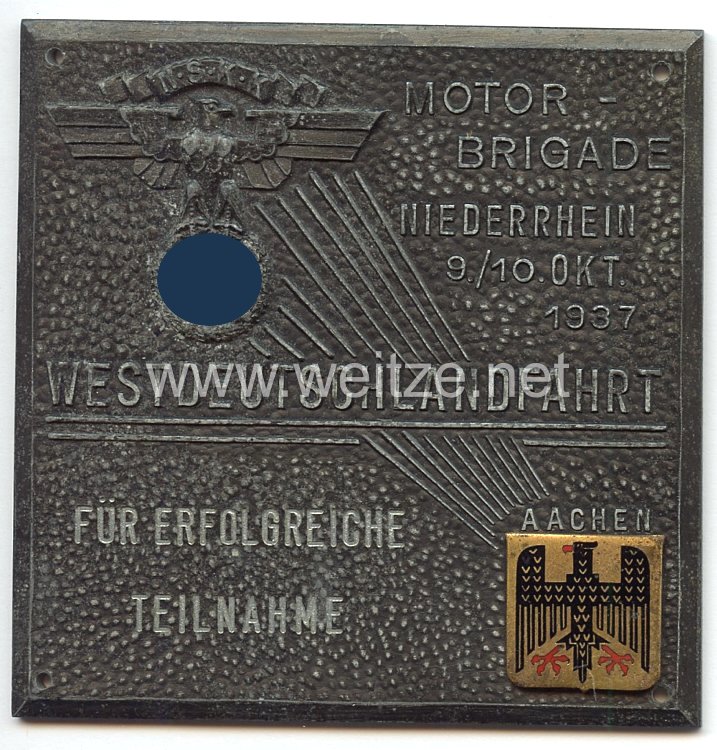
NSKK - Non-Wearable Participant Plaque - “NSKK Motorgruppe Niederrhein Westdeutschlandfahrt 9./10. Oct. 1937 - For Successful Participation”
This NSKK participant plaque documents an important chapter in German automotive history during National Socialism. It was awarded for successful participation in the West Germany Tour organized by NSKK Motor Group Niederrhein on October 9-10, 1937.
The National Socialist Motor Corps (NSKK) was initially founded in 1931 as a sub-organization of the SA and developed into an independent formation of the NSDAP after the seizure of power in 1933. Under the leadership of Corps Leader Adolf Hühnlein, the NSKK had the task of advancing Germany's motorization and providing technical driver training to the population. This occurred against the background of military rearmament and preparation for a future war.
The Motor Group Niederrhein was one of the regional subdivisions of the NSKK and encompassed the Lower Rhine area with cities such as Düsseldorf, Duisburg, Krefeld, and Mönchengladbach. This industrially rich region played a significant role in German armaments industry and motorization.
Orientation drives and motor sports events formed an essential component of NSKK activities. They served not only for sporting activity but primarily for driver training and propaganda purposes. The 1937 West Germany Tour was such an event where participants had to demonstrate their skills in handling motor vehicles. Such tours typically included orientation tasks, skill tests, and reliability trials over longer distances.
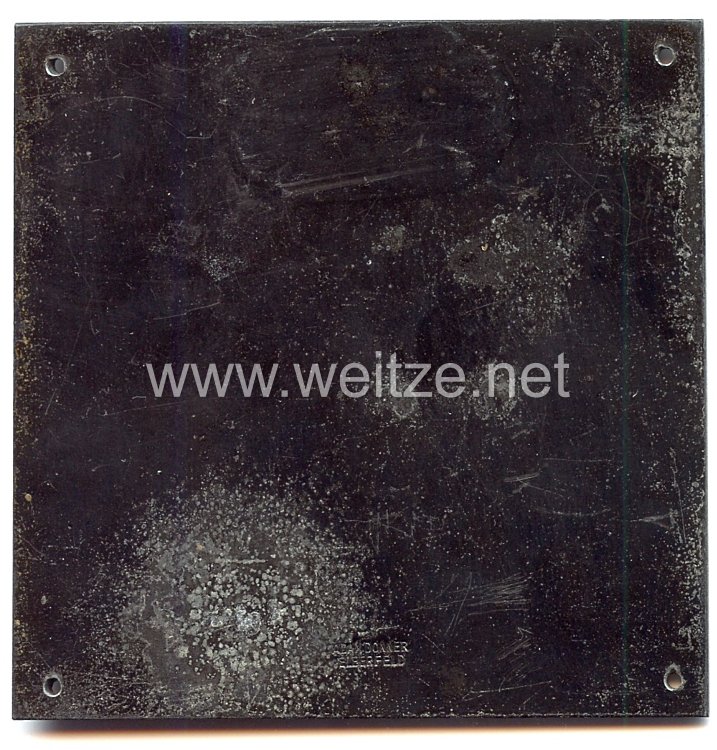
The plaque itself is an excellent example of the award culture of NS organizations. It was manufactured by Adam Donner from Elberfeld (today a district of Wuppertal), a well-known producer of badges and plaques during the Third Reich era. The technical execution is typical for the period: the base body consists of blackened fine zinc, while the applied representation is made of enameled non-ferrous metal. With dimensions of 80 x 80 mm and four mounting holes, this is a non-wearable plaque, presumably intended for storage or mounting on a wall or board.
In 1937, the Nazi regime was at the height of its consolidation. The Wehrmacht was being massively rearmed, and the NSKK played an important role in pre-military training. The motorization of society was promoted as a war-essential goal. Events like the West Germany Tour served to train drivers who could be deployed as motor vehicle operators for the Wehrmacht in case of war.
The awarding of plaques and badges for participation in such events was part of the comprehensive award system of NS organizations. These decorations were intended to create incentives, strengthen loyalty to the organization, and convey a sense of belonging and pride. At the same time, they documented the achievements of the bearers and served as visible signs of participation in the National Socialist system.
Today, such objects are important historical sources for researching the Nazi era. They document the penetration of society by National Socialist organizations and the mobilization of the population for the regime's goals. As collector's items, they are subject to German legal regulations regarding NS memorabilia and may only be used for purposes of civic education, defense against unconstitutional activities, and historical research.
The preserved plaque in condition 2 (very good) shows the craftsmanship quality of the time and serves as a contemporary witness to the systematic organization of motor sports events in the Third Reich, as well as the importance attached to the NSKK in preparing the population for the coming war.