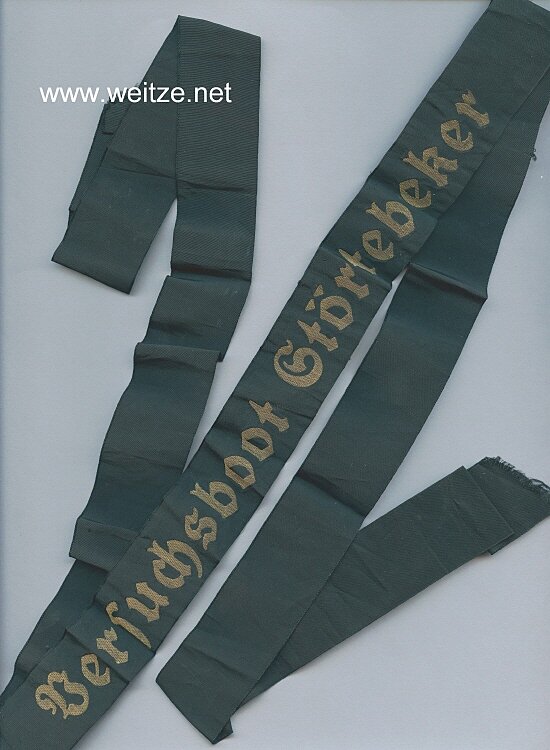
Kriegsmarine Cap Tally "Versuchsboot Störtebeker"
The cap tally "Versuchsboot Störtebeker" represents a fascinating testimony to the maritime history of the German Kriegsmarine during World War II. This headgear ribbon, manufactured in metal-thread woven execution, belongs to those military equipment items that not only possessed functional significance but also contributed to identity formation and esprit de corps among crews.
Cap Tallies in the Kriegsmarine
The tradition of cap tallies in the German Navy dates back to the 19th century. Since the Imperial Navy, sailors and petty officers wore black sailor caps with cap tallies bearing the ship's name or unit designation. This tradition was continued by the Reichsmarine of the Weimar Republic and later by the Kriegsmarine of the Third Reich. Cap tallies served a practical purpose: they enabled quick identification of a sailor's affiliation to a particular unit or ship.
The metal-thread woven execution was a high-quality variant in which gold or silver metal threads were incorporated into the black base fabric. This more elaborate manufacturing method was typical for the early war years, before material shortages led to simplified production methods.
Experimental Boats and Developmental Programs
The designation "Versuchsboot" (experimental boat) indicates a special category of naval vessels employed for testing purposes. The Kriegsmarine maintained various experimental programs for developing and testing new technologies, weapons, and tactical concepts. Experimental boats played a central role in advancing submarine technology, testing new propulsion systems, snorkel devices, and other innovative equipment.
The name "Störtebeker" refers to the legendary North German pirate Klaus Störtebeker (circa 1360-1401), who operated as leader of the Victual Brothers in the North and Baltic Seas. The German Navy had a long tradition of naming its ships after historical personalities, mythological figures, or geographical designations. The choice of a pirate name for an experimental boat was unconventional but not without precedent – it presumably symbolized boldness and fearlessness.
Organizational Context
Experimental boats frequently came under special command posts and development departments of the Kriegsmarine. They were not part of regular combat units but served technical testing under realistic conditions. The crews of such boats were often specially selected personnel with technical expertise who worked closely with engineers and designers.
Documentation about individual experimental boats is frequently fragmentary, as many records were lost at the war's end or deliberately destroyed. Additionally, experimental projects often fell under secrecy regulations, which complicates historical reconstruction.
Materials and Manufacturing
The production of cap tallies was carried out by specialized textile manufacturers who received orders from the Kriegsmarine. The metal-thread woven variants were technically demanding to produce. The golden-yellow lettering on black background had to be precisely woven, with the metal threads providing durability and visual effect. The standard length of a cap tally was approximately 140 centimeters, designed to encircle the sailor cap and be tied with a bow at the back of the head.
Collector Value and Historical Significance
Cap tallies from smaller units, experimental boats, or short-lived vessels are particularly rare today and highly sought after by collectors of military-historical objects. While cap tallies from large warships such as Bismarck or Tirpitz were produced in greater numbers, only few examples often exist from experimental units. This makes them valuable historical documents providing insight into lesser-known aspects of naval history.
The indicated condition 2 suggests a well-preserved specimen that may show slight signs of use but still displays all essential features clearly. The metal threads should still retain their luster, and the weave structure should be intact.
Historical Research Challenges
Researching specific experimental boats presents significant challenges for historians. Many projects were classified, and comprehensive documentation was either incomplete or lost. Post-war interrogations of German naval personnel provided some information, but details about individual experimental vessels often remain scarce. Cap tallies thus serve as tangible evidence of units that might otherwise be forgotten or poorly documented in written sources.
Conclusion
The cap tally "Versuchsboot Störtebeker" represents a piece of specialized naval history from a time of intensive technological development and military innovation. It commemorates the crews who, under often difficult and dangerous conditions, tested new technologies, and documents the organizational diversity of the Kriegsmarine beyond the well-known combat units. Such artifacts serve as important reminders of the human element behind technological progress and the complex structure of World War II naval forces.