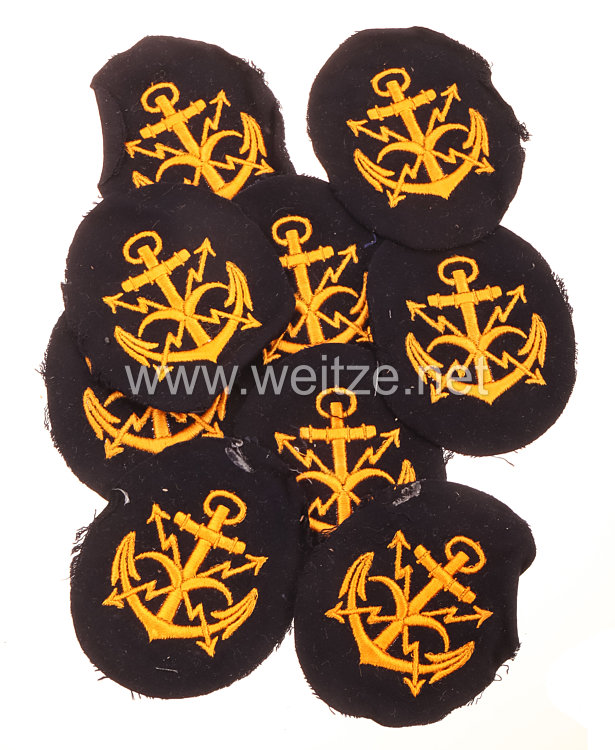
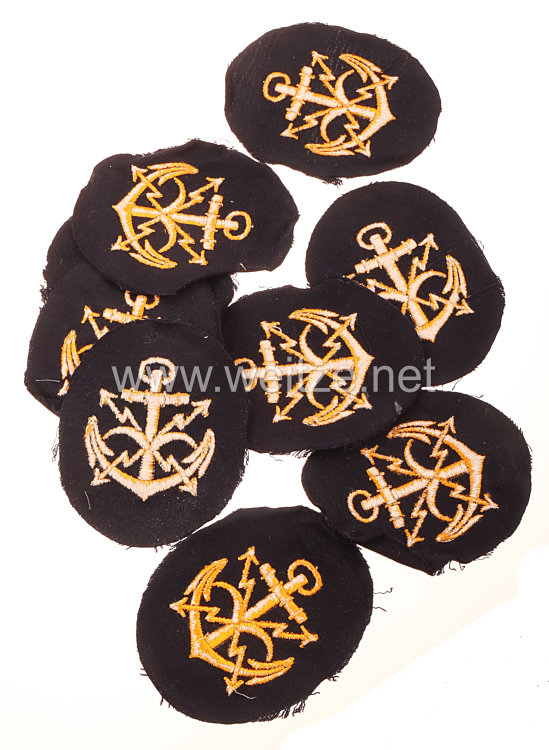
Kriegsmarine Sleeve Insignia Career Path Flugmeldemaat

for the blue blouse, slightly frayed, condition 2-.

Price per piece: 10 Euro.

Condition may vary.
440984
10,00

Kriegsmarine Sleeve Insignia Career Path Flugmeldemaat

The sleeve insignia for Flugmeldemaat of the Kriegsmarine represents a fascinating aspect of German naval organization during World War II. These specialized career badges served to visually identify the professional specialization of non-commissioned officers and enlisted personnel within the complex structure of the Kriegsmarine.

The Flugmeldemaat were specially trained naval personnel responsible for air surveillance and airspace monitoring. Their duty consisted of detecting, identifying, and reporting enemy aircraft – a critical function during a time when air attacks posed an increasing threat to naval bases and ships. This position required thorough knowledge of aircraft identification, communication, and radar technology.

The Kriegsmarine implemented a comprehensive system of career badges that was detailed in the Anzugsordnung der Kriegsmarine (Uniform Regulations of the Kriegsmarine). These insignia were worn on the blue jumper (Blaue Dienstbluse), which was part of the everyday service uniform. The system made it possible to recognize at a glance the specialty and qualification of a naval serviceman.

The insignia for Flugmeldemaat typically consisted of an embroidered symbol on a dark blue cloth background. Sleeve insignia were attached to the right upper arm between shoulder and elbow. The design followed strict regulations regarding size, placement, and quality of execution. The embroidery was usually done in light gray or white thread to create a clear contrast with the dark blue background.

The career system of the Kriegsmarine was extraordinarily differentiated and included numerous specializations. Besides the Flugmeldemaat, there were designations for mechanics, radio operators, medical personnel, torpedo specialists, and many other specialties. This system was continuously developed and refined, particularly as technological requirements increased during the war.

The establishment of specialized air surveillance positions within the Navy became especially important after the experiences of the first war years. The increasing threat from Allied air forces, particularly after 1942, made effective early warning indispensable. Flugmeldemaat were deployed both on ships and at coastal stations and naval bases.

Training to become a Flugmeldemaat took place in specialized naval schools and included theoretical instruction in aircraft recognition as well as practical exercises in observation and reporting procedures. Trainees had to learn to identify aircraft based on silhouettes, engine sounds, and flight characteristics – a skill that could determine life or death in a matter of seconds.

The present insignia for the blue jumper shows typical signs of use, as frequently found on worn uniform pieces from this period. The slight fraying indicates authentic use and is characteristic of textiles worn over several years under various weather conditions. Such insignia were either factory-produced or manufactured by specialized tailoring shops, often located near naval bases.

The preservation and collection of such military-historical objects today serves exclusively historical research and education. They enable us to understand the complex organization and structure of the Kriegsmarine and document the various specializations required for operating a modern navy of the 20th century.

After the war's end in 1945, many of these uniform pieces were destroyed or confiscated by occupation forces. Surviving examples are therefore of documentary value today for museums and scientific collections. They help reconstruct a complete picture of the naval organization of that era and understand the various professions within the Kriegsmarine.

The system of trade and career insignia in the Kriegsmarine reflected the increasing technical sophistication of naval warfare. As new technologies such as radar, sonar, and advanced communication systems were introduced, corresponding specialist positions were created, each with their own distinctive insignia. The Flugmeldemaat position exemplified the growing importance of air defense coordination in naval operations.

r