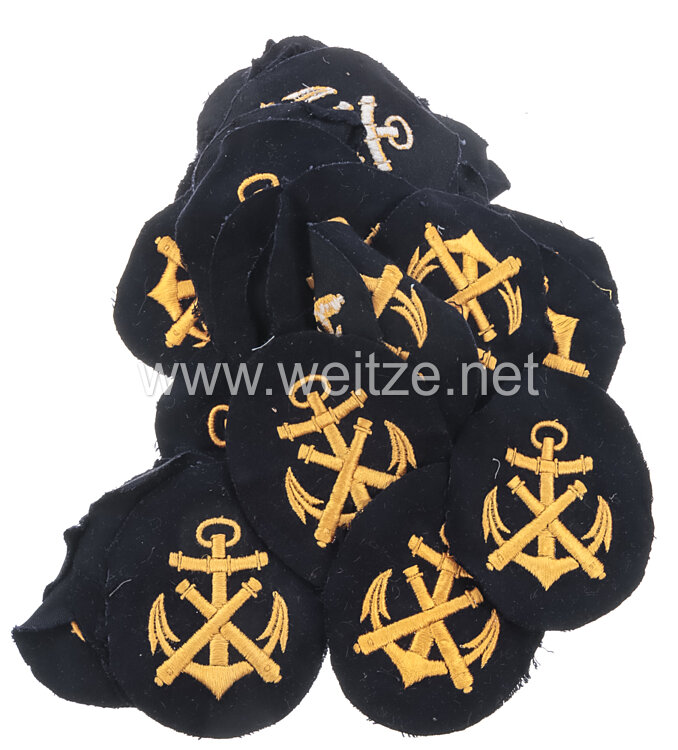
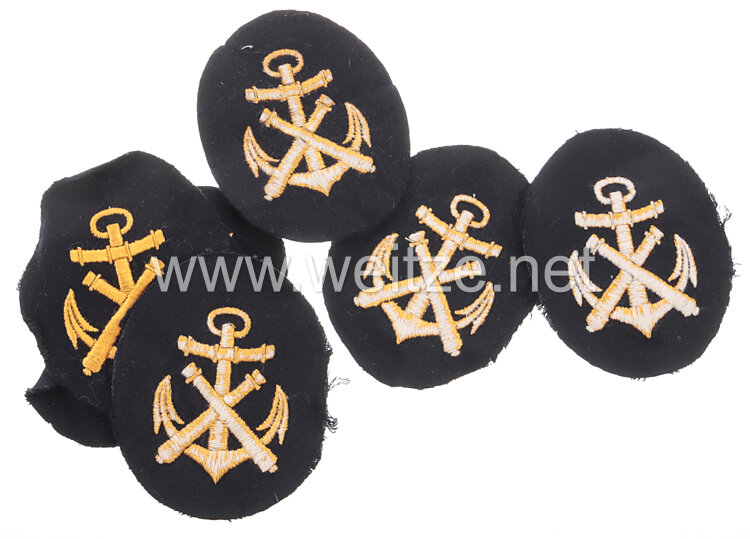
Kriegsmarine Sleeve Insignia Career Path Torpedoman's Mate
Price per piece: 15 Euro.
Condition may vary.
The Kriegsmarine sleeve badge for Feuerwerksmaat represents an important component of the complex rank insignia system of the German Navy during World War II. These specific career badges served the immediate identification of a sailor's specialized training and service area within the hierarchical structure of the Kriegsmarine.
The Feuerwerksmaat career path belonged to the technical specialist careers of the Kriegsmarine and was of particular significance. Feuerwerksmaate were non-commissioned officers responsible for ammunition, explosives, torpedoes, and related technical systems. The term “Feuerwerker” derives from a long military tradition and originally designated specialists in pyrotechnic matters and explosives.
The sleeve badge was worn on the blue blouse, the working and walking-out uniform of enlisted men and non-commissioned officers. The Kriegsmarine uniform regulations, based on the Anzugsordnung für die Kriegsmarine (A.V.O.), precisely regulated the wearing and position of these badges. Career badges were typically worn on the left upper arm and enabled immediate identification of the wearer's specialization.
The design of these badges followed a standardized system: they displayed specific symbols representing the respective career path. For the Feuerwerker career, this was usually a flaming grenade or similar symbolism that illustrated the connection to ammunition and explosives. These symbols were typically executed in yellow or gold embroidery on a dark blue background, corresponding to the maritime traditions of the German Navy.
Training to become a Feuerwerksmaat was demanding and included both theoretical and practical knowledge. These specialists had to be familiar with various types of ammunition, from artillery shells to anti-aircraft ammunition to torpedoes and depth charges. They were responsible for the proper storage, maintenance, and handling of these dangerous materials, which required the utmost care and expertise.
The Kriegsmarine, officially founded in 1935 and replacing the Reichsmarine, developed a comprehensive system of career badges to identify the various specializations within its forces. Besides the Feuerwerksmaate, there were numerous other career paths such as torpedo mechanics, radio operators, machinists, medical personnel, and many others. Each had its own characteristic badges.
The manufacture of these badges was carried out by various contractors throughout the German Reich. Quality could vary, from machine-made standard versions to hand-embroidered examples of higher quality for officers. The versions intended for the blue blouse were generally more robustly manufactured, as these uniform items were worn more frequently in daily service.
In the context of naval organization, Feuerwerksmaate were present on all ship types, from small fast boats to large battleships. On submarines, where space was particularly limited, the responsible Feuerwerksmaat had a particularly critical role, as the safe storage and handling of torpedoes and ammunition in the confined environment was vital.
After the war's end, these badges became sought-after collector's items. They document not only military organization but also the textile craftsmanship of the era. For historical research, they offer valuable insights into the structure and organization of the Kriegsmarine as well as the specializations necessary for operating a modern naval fleet.
The preservation of such badges varies greatly depending on storage conditions and use. Examples in good condition still show the details of embroidery and color intensity, while heavily used or poorly stored pieces show signs of wear, discoloration, or damage. For collectors and historians, these objects are important primary sources for understanding the uniform traditions and organization of the German Kriegsmarine.
Today, these badges serve as tangible reminders of the complex organizational structure of naval warfare and the specialized training required for military service. They represent a specific moment in naval history and the technical sophistication required in maritime warfare during the mid-20th century.