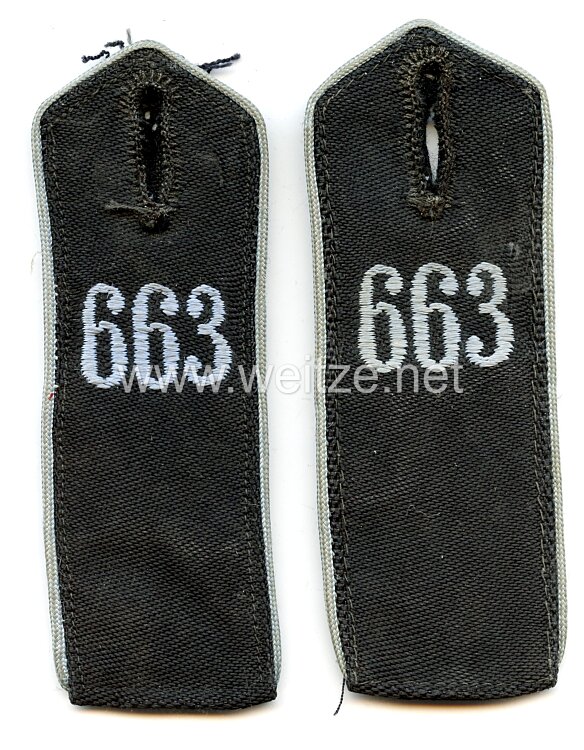
Flieger-HJ Pair of Shoulder Straps, Bann "663"

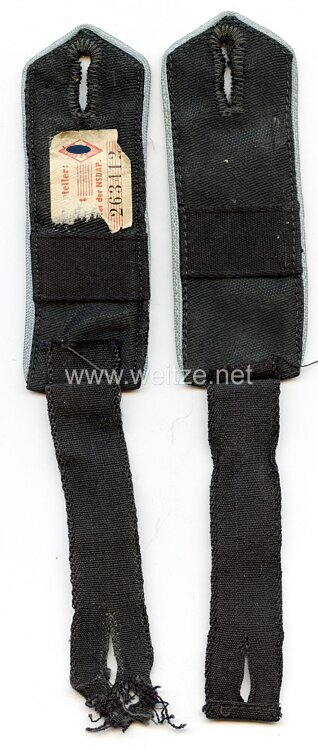
Bann 663 = Litzmannstadt, Gebiet Wartheland. With loops, Condition 2.
462284
175,00

Flieger-HJ Pair of Shoulder Straps, Bann "663"

These Flieger-HJ shoulder straps marked with Bann 663 represent a significant chapter of the National Socialist youth organization during World War II. These equipment items document the systematic paramilitary training of adolescents in occupied Poland, specifically in the Wartheland region.

Bann 663 was stationed in Litzmannstadt, the German designation for the Polish city of Łódź during the German occupation from 1939 to 1945. The city was named after German General Karl Litzmann and formed the administrative center of the newly created Reichsgau Wartheland, one of the incorporated eastern territories of the German Reich. This Gau was established on October 26, 1939, following the invasion of Poland by decree of Adolf Hitler and encompassed large parts of western Poland.

The Flieger-HJ (Flying Hitler Youth) was a specialized unit within the Hitler Youth that was systematically expanded from 1937 onwards. It served for the pre-military training of young people in aviation and was intended to secure recruits for the Luftwaffe. The training included theoretical instruction in aerodynamics, navigation, and meteorology, as well as practical activities such as gliding and model building. From 1938, the Flieger-HJ was organized as an independent formation within the HJ and received special uniform parts and badges.

The shoulder straps served as textile rank insignia and unit identification on the uniform. They were worn on the shoulders of service jackets and enabled quick identification of membership in a specific unit. The marking with the Bann number was of particular importance: a Bann was a territorial unit of the HJ comprising approximately 3,000 to 5,000 members and containing several Stämme (tribes, each about 600 members). The numbering was consecutive throughout the Reich.

The presence of a Flieger-HJ Bann in the Wartheland demonstrates the Nazi regime's efforts to systematically organize and ideologically indoctrinate German youth even in occupied and annexed territories. The Volksdeutsche (ethnic Germans) living there, as well as the children of German settlers and administrative officials, were integrated into HJ structures. The Flieger-HJ played a special role as it was considered particularly prestigious and represented an elite within the youth organization.

The practical training of the Flieger-HJ was conducted in close cooperation with the National Socialist Flying Corps (NSFK) and the Luftwaffe. The young people completed courses at gliding fields, learned to handle aircraft, and were trained in military discipline. Many graduates later joined the Luftwaffe directly, underscoring this organization's function as a recruitment instrument.

The uniforming and insignia regulations of the HJ were precisely defined by several decrees and regulations. The service dress regulations detailed which uniform parts were to be worn and how various insignia were to be affixed. Flieger-HJ shoulder straps differed from those of other HJ divisions such as the Motor-HJ or Marine-HJ through their specific coloring and symbols.

After the end of World War II, Litzmannstadt became Łódź again, and the Wartheland was returned to Poland. The German population was expelled or fled before the advancing Red Army. The HJ was classified as a criminal organization and banned. Today, uniform parts and insignia of the HJ are important contemporary historical documents that document the history of this dark era in museums and collections.

The preservation of such objects serves exclusively for historical research and education about the mechanisms of totalitarian systems and their methods of youth indoctrination.