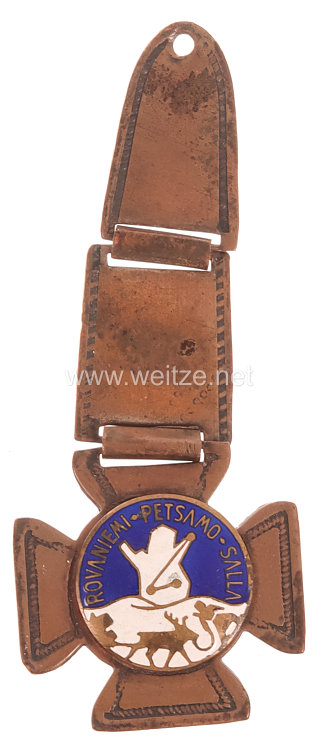
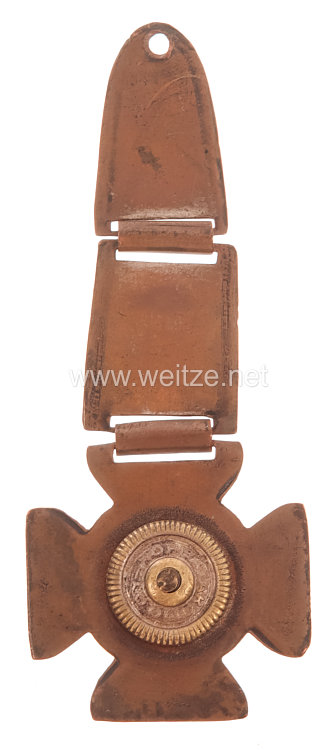
Wehrmacht Gebirgsjäger: Small Pendant with Rovaniemi-Petsamo and Salla Badge
This small sheet metal pendant with an enameled badge represents a fascinating testimony to the German Gebirgsjäger (mountain troops) units deployed on the Finnish Front during World War II. The badge bears the place names Rovaniemi-Petsamo and Salla, three strategically important regions in the far north of Europe.
The German military presence in Finland began in summer 1941 with the launch of Operation Barbarossa. The Army High Command Norway under Colonel General Nikolaus von Falkenhorst conducted several operations in the Finnish-Soviet border region. The Mountain Corps Norway played a particularly central role, which included the famous 2nd and 6th Mountain Divisions.
Petsamo (Finnish Petsamo, today Russian Pechenga) was Finland's only ice-free port on the Arctic Ocean and of immense strategic importance. The region also possessed important nickel deposits that were of great significance for the German armaments industry. German troops operated from Petsamo beginning in June 1941 with the goal of reaching the ports of Murmansk and cutting the Soviet supply line via the Murmansk Railway.
Salla lay further south, also in the Finnish-Soviet border region. Fierce fighting took place here from July 1941, in which Finnish troops initially achieved success. The German mountain troops supported the Finnish units in this inhospitable terrain, characterized by dense forests, numerous lakes, and extreme weather conditions.
Rovaniemi functioned as an important supply center and transportation hub in Finnish Lapland. The city served as a base for German operations in the far north and housed numerous military installations.
The Gebirgsjäger, recognizable by their characteristic mountain cap and edelweiss badge, were specially trained for combat in alpine and arctic terrain. On the Finnish Front, however, they had to contend with conditions that exceeded even their rigorous training. The polar night, temperatures down to minus 40 degrees Celsius, and the endless tundra presented extreme challenges.
Such commemorative badges and pendants were frequently made or acquired by soldiers as personal souvenirs. They served as mementos of deployment in these remote regions. Production often occurred locally through artisans or in small workshops, using available materials such as sheet metal and enamel. These objects were not official Wehrmacht decorations but private keepsakes.
The German operation to capture Murmansk, Operation Silver Fox, failed as early as autumn 1941. The front froze into an exhausting war of position that lasted until 1944. The mountain troops had to endure in primitive bunkers and dugouts, constantly threatened by Soviet attacks and the merciless nature.
In September 1944, Finland concluded an armistice with the Soviet Union. According to the terms, Finland had to expel German troops from its territory. This led to the Lapland War between former allies. During the withdrawal, the Wehrmacht practiced a scorched earth policy, with Rovaniemi being almost completely destroyed in October 1944.
The present object, dated around 1943, comes from the period before this dramatic final phase. The clearly worn condition suggests that it was actually carried by a soldier, possibly on a watch chain or as a talisman. Such personal items provide us today with immediate access to the lived experience of ordinary soldiers, far removed from grand strategic decisions.
For collectors and historians, such objects are valuable as they enable the regional assignment of military units and provide insight into the material culture of war. The enamel work and specific design can allow conclusions about manufacturing locations and techniques. At the same time, they remind us of a dark chapter in European history and of the soldiers who served under the most extreme conditions.