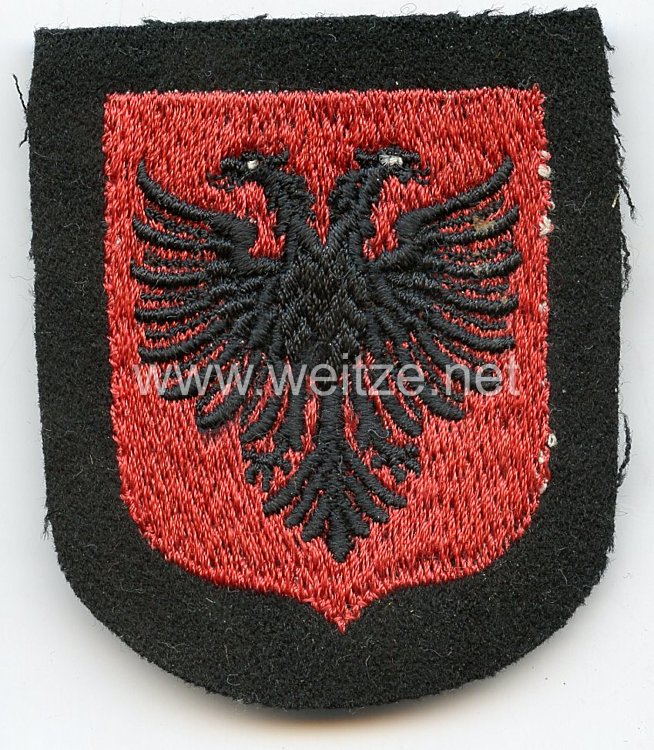
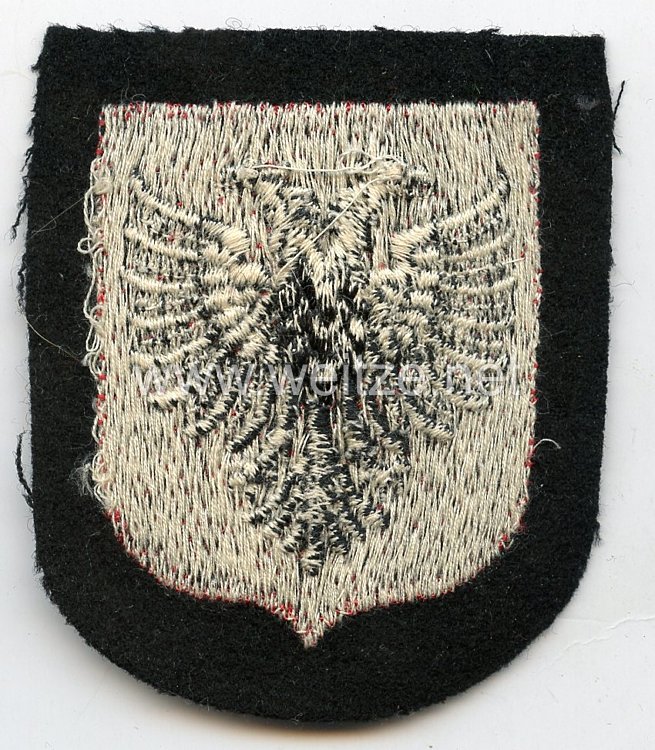
Sleeve Shield of the Albanian Volunteers of the Waffen-SS Div. “Skanderbeg”

RZM-embroidered version. Unissued condition, Condition Grade 2.
439283
265,00

Sleeve Shield of the Albanian Volunteers of the Waffen-SS Div. “Skanderbeg”

The arm shield of the 21st Waffen Mountain Division of the SS “Skanderbeg” (Albanian No. 1) represents a significant, albeit controversial, artifact from the complex history of World War II in the Balkans. This formation was established in spring 1944 as part of German efforts to mobilize local volunteers in occupied territories.

The division was officially formed on May 1, 1944, and named after the Albanian national hero Skanderbeg (George Kastrioti, 1405-1468), who fought against the Ottoman Empire in the 15th century. This naming was intended to appeal to the national identity of the Albanian population and facilitate recruitment. The division consisted primarily of Kosovo Albanians and Albanians from the Albanian heartland.

The arm shield typically displays a black double-headed eagle on a red background, the traditional symbol of Albania. This heraldic bird has a long history and has symbolized the Albanian nation for centuries. The use of this national symbol by an SS formation was a calculated attempt to present the unit as an Albanian national force, although it operated under German command.

The RZM-embroidered version described here refers to the Reichszeugmeisterei, the central procurement office of the Nazi Party responsible for quality control and standardization of uniform insignia. RZM-marked pieces were manufactured according to established guidelines and were considered official versions. The embroidered variant was of higher quality than printed or woven versions.

The “Skanderbeg” Division never reached its full authorized strength and experienced considerable organizational problems. Maximum strength was approximately 6,000 to 7,000 men, far below the intended divisional strength. Many recruits deserted, and the unit was primarily employed in anti-partisan operations in Kosovo and northern Albania. The division's military effectiveness remained limited.

Under the command of SS-Standartenführer August Schmidhuber, the division was deployed in an area characterized by complex ethnic and religious tensions. The formation was implicated in numerous war crimes, particularly against the Serbian civilian population in Kosovo and against Jewish communities. In May 1944, members of the division participated in the deportation of approximately 400 Jews from Pristina.

The division was already dissolved in November 1944 as the military situation for Germany in the Balkans deteriorated. Most Albanian members deserted or defected to the communist partisans. The remaining German cadres and some Albanian volunteers were integrated into other SS formations.

From a collecting perspective, arm shields of this division are relatively rare. The unit's short existence, limited production, and high desertion rate meant that few of these badges were actually issued. Unworn examples in good condition are even rarer, as many unissued stocks were destroyed after the war's end.

Research into such objects is important for understanding SS recruitment policy in occupied territories. The Waffen-SS expanded considerably from 1943 onwards through the establishment of “foreign” divisions, including besides “Skanderbeg” also “Handschar” (Bosnian No. 1), “Kama” (Croatian No. 2), and other Balkan formations. This policy reflected both the increasing shortage of German personnel and the attempt to instrumentalize ethnic and religious conflicts for German war aims.

Today, such objects serve in museums and educational institutions as teaching tools about the complexity of World War II and the issue of collaboration. They document a dark chapter of European history and remind us of the dangers of instrumentalizing national symbols and identities for criminal purposes.

The study of these insignia contributes to our understanding of how the Nazi regime attempted to manipulate local populations and exploit nationalist sentiments. The Albanian division, like similar formations from other regions, represents the intersection of occupation policy, collaboration, ethnic conflict, and the desperate German search for manpower in the final years of the war.

r