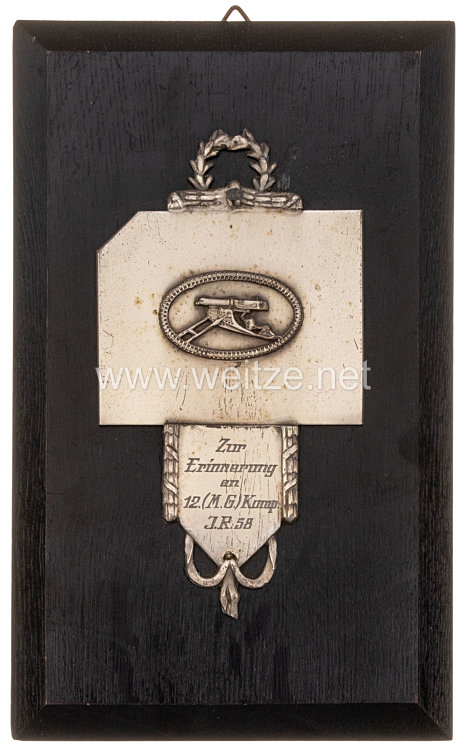
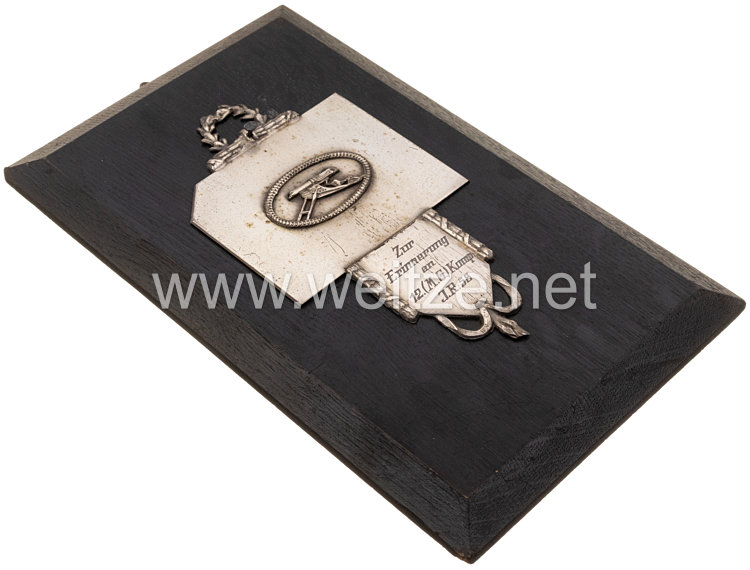
Wehrmacht Heer Wall Plaque Commemorating Service in the 12th Machine Gun Company, I.R. 58

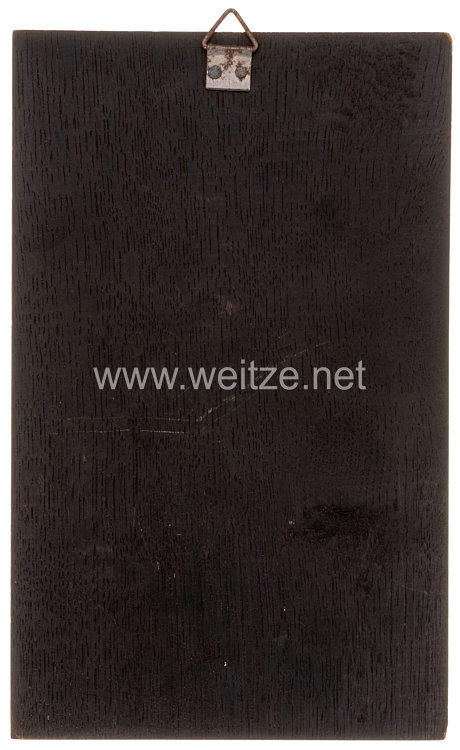
Black wooden plaque with applied insignia, dimensions approximately 21 x 13 cm, with wall hanging fixture, used condition.
385882
250,00

Wehrmacht Heer Wall Plaque Commemorating Service in the 12th Machine Gun Company, I.R. 58

This wall plaque represents a fascinating example of military commemorative culture from the era of the Wehrmacht. It was created to honor and commemorate members of the 12th Machine Gun Company of Infantry Regiment 58 (I.R. 58) and testifies to the tradition of preserving military comradeship and service time through material mementos.

Infantry Regiment 58 was a unit of the German Wehrmacht that was deployed in various combat theaters during World War II. The numbering of regiments followed a system that was partially based on the traditions of the Reichswehr and the Imperial Army. Machine gun companies formed the backbone of an infantry regiment's firepower and were typically organized within the regimental staff or battalions.

Machine guns played a central role in German infantry tactics. During World War II, the MG 34 and later the MG 42 were the standard weapons of these units. These weapons were characterized by high rate of fire and reliability and formed the basis of German infantry tactics, in which riflemen supported MG positions rather than the other way around.

Such commemorative plaques were widespread in the Wehrmacht and served several purposes. They strengthened esprit de corps and comradeship within the unit, documented membership in a particular formation, and served as personal mementos of service time. They were often presented on special occasions, such as transfers, farewells, or anniversaries.

The design of such plaques did not follow a uniform official pattern. While military decorations and medals were subject to strict regulations, unit memorabilia were often privately manufactured or locally commissioned objects. The black wooden base was a typical material that was available and affordable during this period. The applied overlay could be made of various materials - metal, painted wood, or plaster - and usually showed unit insignia, weapons, or symbolic representations.

The period of origin can be narrowed down to the years 1935 to 1945, the existence of the Wehrmacht. The exact dating of individual plaques is often difficult but can be narrowed down through stylistic features, symbols used, and known deployments of the unit.

In the context of military commemorative culture, such objects stand in a long German tradition dating back to the 19th century. Already in the Prussian Army and later in the Reichswehr, soldiers maintained memories of their service through various mementos. This tradition continued in the Wehrmacht, although political instrumentalization by the Nazi regime added a new dimension.

For collectors and historians, such plaques are of interest because they provide insights into the organizational structure and daily life of the Wehrmacht. They complement official military history with personal and unit-related perspectives. The study of such objects can help reconstruct the history of individual units, especially when official documents have been lost.

It is important to emphasize that such military-historical objects should today be viewed exclusively in the context of historical research and documentation. They serve as material witnesses of a past era and help to understand military structures, traditions, and the everyday reality of soldiers, without glorifying the actions of the Wehrmacht or the crimes of the Nazi regime.

The preservation of such memorabilia in museums and collections is part of the duty of historical documentation. They enable future generations to gain a comprehensive picture of the military organization and culture of this period and contribute to critical engagement with German history of the 20th century.

r