Spain Civil Medal of the “Hispano Americana” Academy

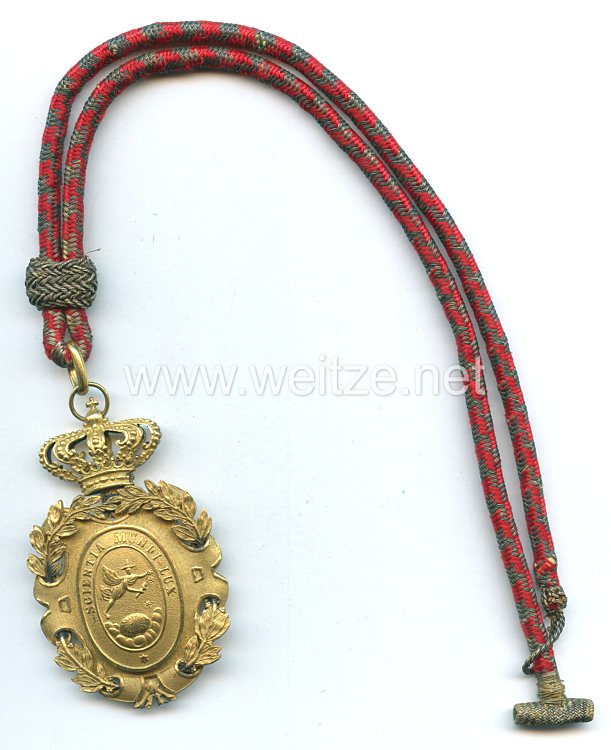
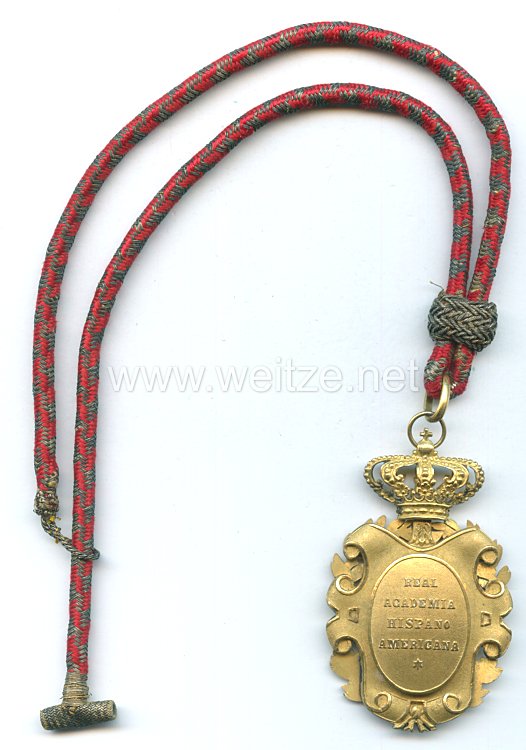
Version from 1931 onwards, gilt finish, very finely crafted, the center with applied medallion “Scientia Mundi Lux”, reverse “Real Academia Hispano-Americano”, comes with the original red cord, condition 2.
342582
550,00

Spain Civil Medal of the “Hispano Americana” Academy

The Medal of the Real Academia Hispano-Americana represents a significant civil decoration from one of Spain's most important cultural and scientific institutions in the early 20th century. This medal, awarded from 1931 onwards, symbolizes the Academy's commitment to promoting scientific and cultural relations between Spain and the Latin American nations.

The Real Academia Hispano-Americana was founded with the objective of strengthening the historical, cultural, and linguistic bonds between Spain and the former Spanish colonies in the Americas. At a time when the Spanish world empire had long since dissolved, the Academy played a central role in nurturing Hispanic identity and common cultural roots. The institution dedicated itself to promoting science, literature, history, and the arts throughout the Hispanic world.

This particular medal dates from the period after 1931, a decisive year in Spanish history. With the proclamation of the Second Spanish Republic on April 14, 1931, the monarchy under King Alfonso XIII came to an end. This political upheaval had far-reaching effects on all state and cultural institutions. The Academy had to adapt to the new republican circumstances, which was reflected in the design of its awards.

The central medallion with the inscription “Scientia Mundi Lux” (Science is the Light of the World) embodies the Academy's enlightenment mission. This Latin motto underscores the conviction that education and scientific knowledge form the foundation for human progress. The use of Latin as the language of classical scholarship connects the Academy with the centuries-old European tradition of science and education.

The craftsmanship of the medal demonstrates the highest quality. The gilding and fine workmanship correspond to the standards of important civil decorations of this era. The elaborate design emphasizes the value the Academy placed on honoring its members and benefactors. The reverse inscription “Real Academia Hispano-Americano” clearly identifies the awarding institution, with the title “Real” (Royal) referring to the Academy's historical origins under the monarchy.

The red cord from which the medal was worn follows Spanish tradition for civil decorations. Unlike military orders, which often featured complex ribbon arrangements with specific colors and patterns, civil and academic institutions frequently used single-colored cords or ribbons. The red color could indicate various symbolic meanings, including courage, passion for science, or connection to the Spanish national flag.

Such medals were typically awarded to individuals who had rendered service to the Academy's goals. These could include scientists, writers, historians, diplomats, or patrons who had contributed to promoting Hispano-American cooperation. The medal served not only as a personal honor but also as a visible symbol of membership in a prestigious intellectual community.

The period from 1931 until the outbreak of the Spanish Civil War in 1936 was a time of intense cultural and political activity in Spain. The Republic initially promoted education and science, which opened new opportunities for academic institutions like the Real Academia Hispano-Americana. At the same time, the political tensions of these years led to increasing polarization of society.

The outbreak of the Civil War and the subsequent Franco dictatorship (1939-1975) fundamentally changed the landscape of Spanish institutions. Many cultural and scientific organizations had to cease their activities or adapt to the new power structures. Relations with Latin America remained an important element of Spanish foreign policy, albeit under changed ideological auspices.

Today, such medals are important historical documents that provide insight into the cultural and institutional history of Spain in the 20th century. They recall a time when, despite political upheavals and social conflicts, cultural and scientific exchange across national borders was maintained. For collectors and historians, these decorations represent not only material objects but also the ideals of an era in which education and science were regarded as fundamental pillars of a progressive society.

The Academy's mission to bridge continents through intellectual collaboration remains historically significant. In an age of increasing nationalism and political fragmentation, the Hispano-American Academy sought to preserve and strengthen transnational cultural ties, making its medals enduring symbols of international scholarly cooperation.