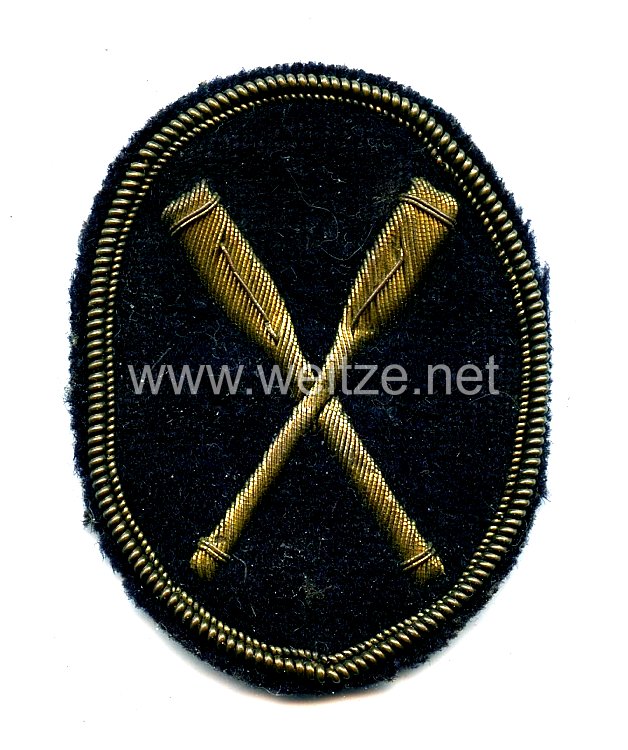
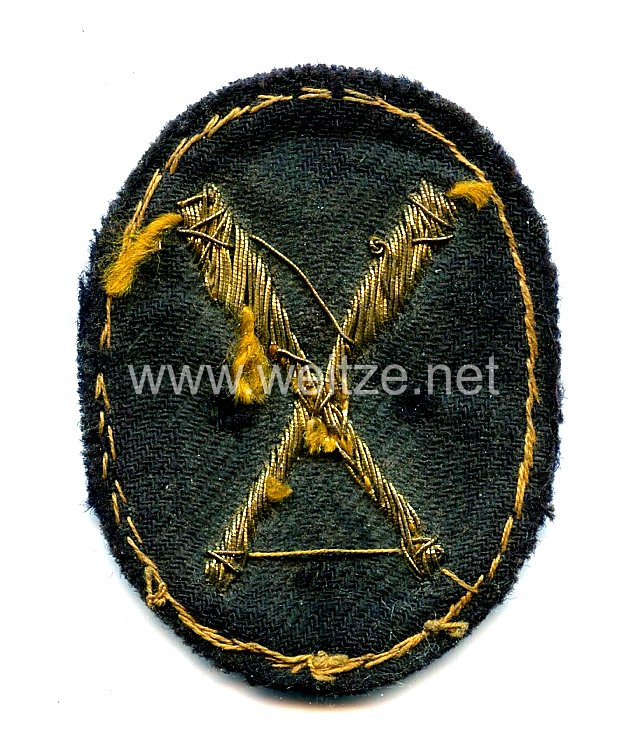
Rowing Club Visor Cap Insignia for the Blue Visor Cap

Metal thread hand-embroidered execution, 3 pinhead-sized holes. Worn.
363582
40,00

Rowing Club Visor Cap Insignia for the Blue Visor Cap

This rowing club cap badge for the blue peaked cap represents a fascinating intersection between sporting tradition and paramilitary uniform culture in German-speaking regions, particularly during the era of the German Empire and the Weimar Republic.

The manufacture using hand-embroidered metallic thread indicates a high-quality execution typical of club badges for the upper social classes between approximately 1890 and 1933. Rowing clubs enjoyed extraordinarily high social prestige during this epoch and were firmly anchored in bourgeois culture. Membership in a prestigious rowing club signified not only athletic commitment but also social belonging to the educated upper class.

The use of peaked caps in German sports clubs deliberately followed military models. Since the founding of the Reich in 1871, the army had been a central social model, and military aesthetics permeated wide areas of civilian life. Rowing clubs, similar to gymnastics and shooting clubs, adopted elements of military uniforming to demonstrate discipline, order, and national sentiment.

The three pinhole-sized holes in the badge served to attach it to the cap. This method of fastening was standard for high-quality club badges and allowed secure but removable attachment. The fact that the piece was worn underscores its authentic use and historical significance.

Rowing clubs emerged in Germany from the 1830s onwards, initially following English models. The first German rowing club was founded in Hamburg in 1836. In the second half of the 19th century, rowing experienced an enormous upswing, and rowing societies were established in all major cities along rivers and lakes. These clubs were strictly hierarchically organized, with clearly defined membership categories and corresponding uniform regulations.

The blue peaked cap was particularly popular among North German rowing clubs and was oriented toward the tradition of seafaring and the navy. Blue was considered the color of water and the navy, which represented a natural symbolic connection for rowing clubs. Different clubs maintained different cap variants: club caps for active rowers, honorary caps for distinguished members, and official caps for board members.

The metallic thread embroidery, also known as bullion embroidery, was an elaborate handcraft technique in which thin metallic threads - often made of gilded or silvered wire - were embroidered onto a fabric base. This technique required great skill and was correspondingly expensive. The use of this technique for a club badge underscores the elite character of the rowing club in question.

In the context of the period between 1900 and 1933, rowing clubs were not merely sports facilities but important social institutions. They organized regattas, summer festivals, and social events that shaped the social life of the upper class. Membership was often passed down from generation to generation, and club badges were visible signs of this tradition preservation.

After 1933, many rowing clubs were brought into line and incorporated into National Socialist organizations. Traditional club badges were partially replaced or supplemented by new, ideologically charged symbols. After 1945, many rowing clubs reconnected with their pre-war traditions, with old badges and uniforms often deliberately reintroduced as signs of continuity.

Today, such historical club badges are sought-after collectors' items that provide insight into the social and sporting culture of a bygone era. They document not only the history of rowing but also bourgeois club culture and the significance of uniforming and external signs of belonging in German society before World War II.

r