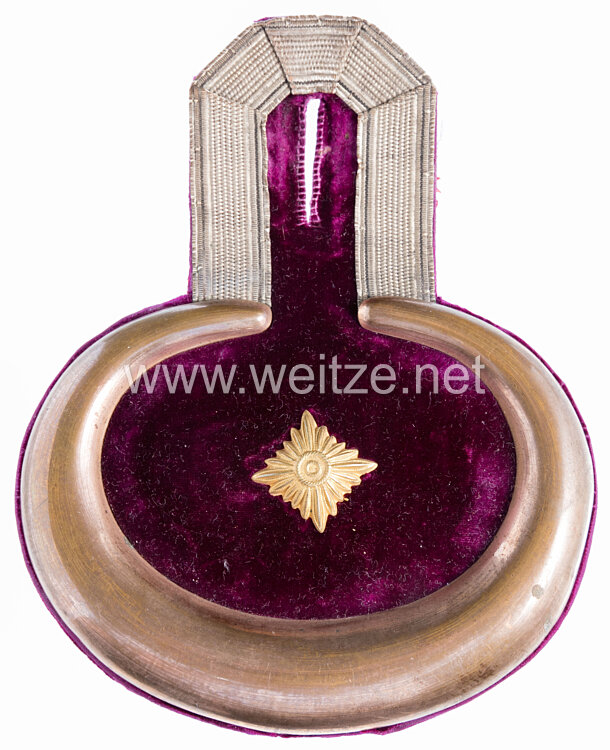
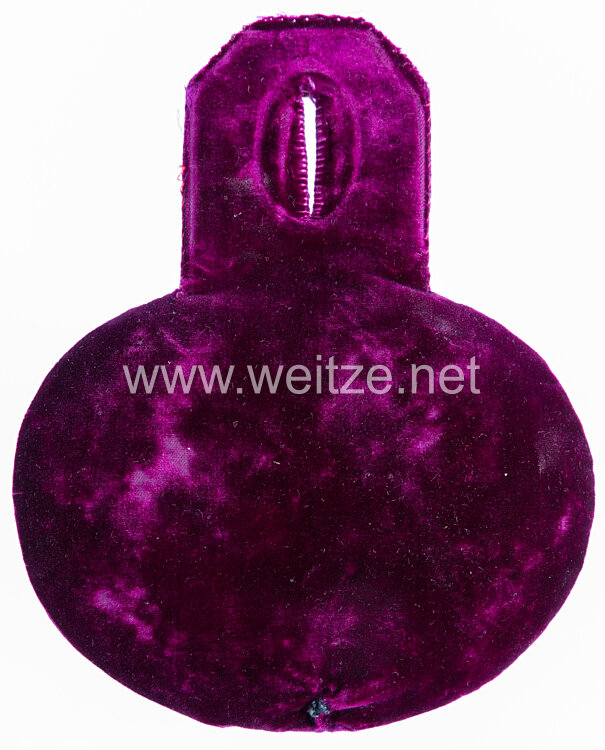
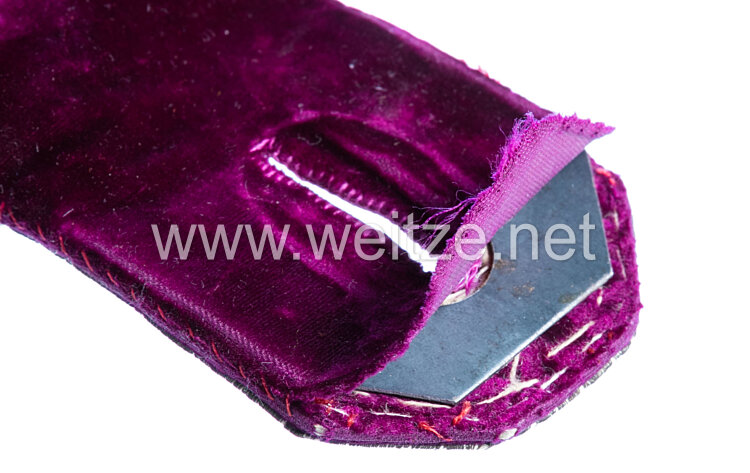
Prussia Single Epaulette for a Senior Pharmacist (Oberapotheker)
This single epaulette of a Prussian Oberapotheker (senior military pharmacist) holding the rank equivalent to a first lieutenant, dating from around 1910, represents a fascinating chapter in the military pharmaceutical history of the German Empire. These rank insignia document the increasing professionalization and integration of medical specialists into the military hierarchy during the Wilhelmine era.
In the Prussian Army of the early 20th century, pharmacists were integral components of the military supply structure as medical officers. The Oberapotheker held a significant position equivalent to the rank of Oberleutnant (first lieutenant). This equality with the officer corps was the result of decades of developments in military medical organization, intensified by reforms following the experiences of the Wars of Unification in 1864, 1866, and 1870/71.
The rank structure of medical officers was regulated by various Supreme Cabinet Orders and regulations. The basic organization of the medical service was based on the Military Medical Regulations, which underwent several revisions. Pharmacists in military service completed special training and had to demonstrate both pharmaceutical and military knowledge. The Oberapotheker ranked above the Apotheker (pharmacist) and below the Oberstabsapotheker (senior staff pharmacist).
The epaulette as a rank insignia had a long tradition in the Prussian Army, dating back to the 18th century. Originally conceived as shoulder protection, epaulettes evolved into an important distinguishing feature for indicating rank and branch of service. Special regulations applied to medical officers regarding the design of their rank insignia, distinguishing them from line officers.
The characteristic design of a first lieutenant's epaulette around 1910 typically consisted of a crescent-shaped base with braided or twisted metal fringes. The rank insignia indicated the specific grade through the number and arrangement of stars. For medical officers such as the Oberapotheker, additional distinguishing features were used to mark their affiliation with the medical service. This could be accomplished through special symbols, colors, or backing materials.
The fact that this is a single epaulette is noteworthy. Normally, epaulettes were worn in pairs, with both shoulders bearing the rank insignia. Single epaulettes could be preserved or passed down separately for various reasons: as samples, through loss of the matching piece, or as personal mementos.
The period around 1910 was characterized by intensive preparations and modernization efforts in the German military. The medical organization was continuously expanded and improved. Experiences from colonial conflicts, particularly the Boxer Rebellion in China (1900-1901) and the campaigns in German South-West Africa (1904-1908), had demonstrated how important functioning medical and pharmaceutical supply was for the combat effectiveness of troops.
The duties of an Oberapotheker included managing military pharmacies, procuring and quality-controlling medicines, training subordinate personnel, and providing pharmaceutical services to military hospitals and troop units. In peacetime, they worked in garrison pharmacies; in case of war, they were deployed according to mobilization plans.
The Medical Corps enjoyed high prestige in the German Army, not least due to the scientific achievements of German military physicians and pharmacists. Names like Robert Koch, who served temporarily as a military doctor, contributed to this reputation. The integration of academically trained pharmacists into the officer hierarchy reflected the growing importance of scientific expertise in military affairs.
The preservation of such individual pieces in worn condition is of considerable historical value. They document not only the formal aspects of military rank systems but also the practical reality of service. Signs of use tell of actual employment and lend the object a personal dimension that transcends purely representative function.
Today, such epaulettes are important testimonies to military history and the history of military pharmacy. They help historians and collectors understand the complex structures and hierarchies of the Imperial Army and trace the development of medical supply systems in the military context. The Oberapotheker represented a crucial link in ensuring the health and combat readiness of troops through proper pharmaceutical care, a role that would prove increasingly vital in the coming years leading to World War I.