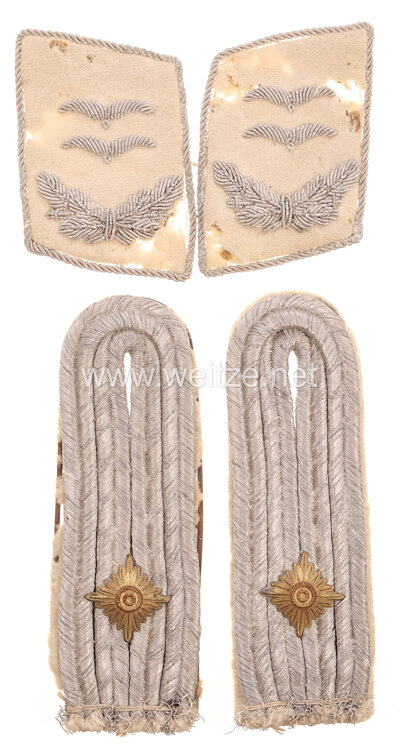
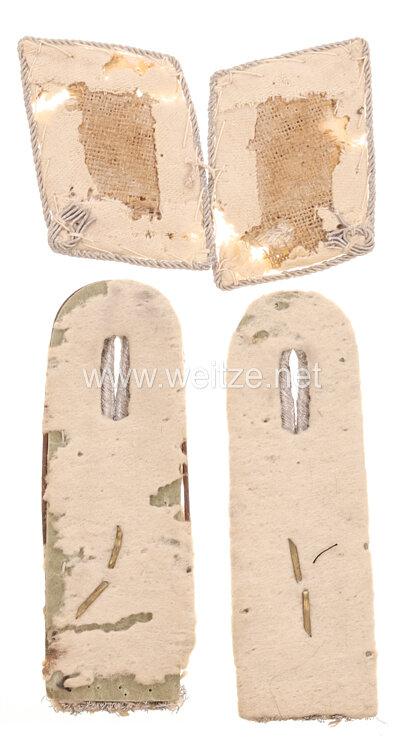
Luftwaffe Pair of Shoulder Boards and Collar Tabs for Oberleutnant Div. “Hermann Göring”
The shoulder boards and collar tabs for an Oberleutnant (First Lieutenant) of the “Hermann Göring” Division represent a fascinating chapter in German military history during World War II. These insignia belonged to one of the most elite and renowned formations of the Luftwaffe, which underwent an extraordinary evolution from a small police unit to a full panzer division.
The “Hermann Göring” Division (later Fallschirm-Panzerkorps Hermann Göring) was named after the Reichsmarschall and Commander-in-Chief of the Luftwaffe. Its origins trace back to the Landespolizeigruppe “General Göring” from 1933, which initially functioned as a Prussian police unit. In 1935, this formation was incorporated into the Luftwaffe and converted into the Regiment “General Göring”. During the war, the unit expanded considerably: in 1942 it became a Brigade, then a Division, and finally in 1944 a Fallschirm-Panzerkorps (Parachute Panzer Corps).
The rank insignia described here in bright finish correspond to parade uniform or walking-out uniform for Luftwaffe officers. The white cloth base (Waffenfarbe or branch color) identifies the wearer as belonging to the flying troops or general Luftwaffe units. This branch color was standardized according to Heeresdienstvorschrift (HDv) 470/7 and corresponding Luftwaffe uniform regulations.
The rank of Oberleutnant corresponds to a middle officer rank, comparable to a First Lieutenant in Anglo-American armed forces. An Oberleutnant's shoulder boards typically displayed two rank stars (pips) on braided metal backing. The Luftwaffe collar tabs were specifically designed and differed significantly from those of the Army or Waffen-SS.
The Hermann Göring Division fought on several fronts during World War II. After deployments in North Africa (1942-1943), where it suffered heavy losses near Tunis, the division was transferred to Sicily and later to Italy. It fought at Monte Cassino among other battles and during the Allied invasion. From 1944, the division was deployed on the Eastern Front, where it was involved in heavy defensive battles in Poland and later in East Prussia and Brandenburg.
The loops on the shoulder boards served to attach them to the uniform. They were pulled through the shoulder strap of the uniform tunic and fastened from inside with a button. This system allowed secure attachment while permitting relatively easy exchange of rank insignia upon promotion.
The described moth damage is typical for textiles from this period stored under suboptimal conditions. Wool and other natural fibers were particularly susceptible to insect damage. While this condition reduces the material value of the object, it simultaneously underscores its authenticity and age. Many original uniform pieces from World War II exhibit similar signs of aging.
The bright finish of the insignia indicates the use of aluminum or silver threads, which were typical for officer uniforms. In contrast, enlisted men and non-commissioned officers often wore duller versions. The quality of workmanship and materials in officer insignia was generally higher than for enlisted ranks.
From a historical perspective, these objects document not only the military rank structure and uniform practices of the Luftwaffe, but also the history of one of the most famous German divisions of World War II. The Hermann Göring Division enjoyed preferential treatment in equipment and personnel assignment due to its direct connection to the Luftwaffe leadership, which increased its military effectiveness but also led to tensions with other Wehrmacht branches.
Today, such uniform pieces are important study objects for military historians and collectors researching the material culture and organization of German armed forces during World War II. They offer concrete insights into the hierarchies, traditions, and everyday reality of military life in this era.