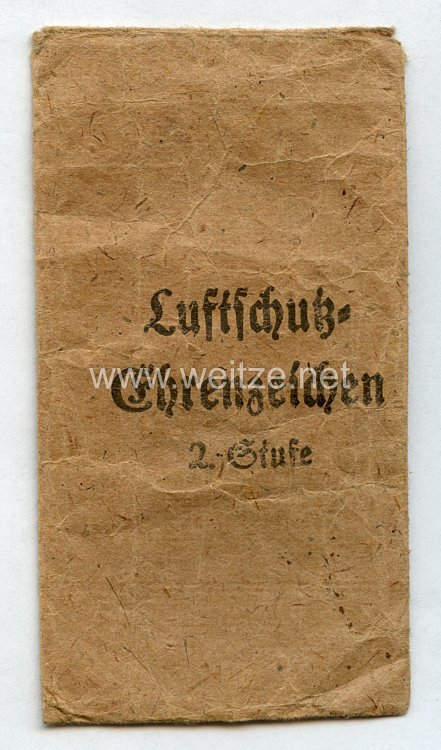
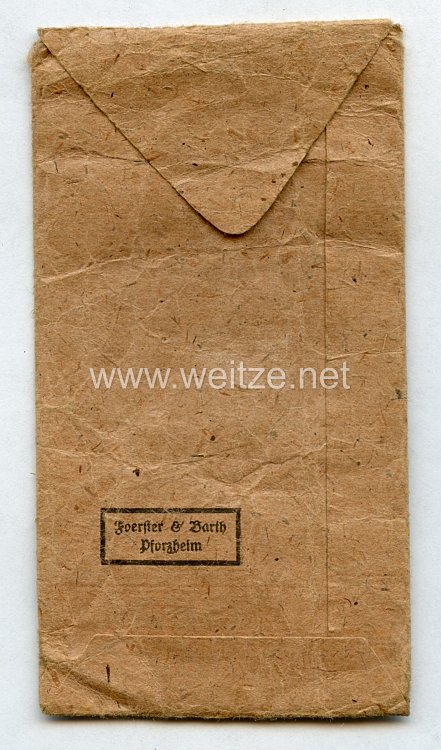
Air Defense Honor Badge 2nd Class - Award Packet
The Air Protection Honor Award 2nd Class (Luftschutz-Ehrenzeichen 2. Stufe) represents a significant decoration of National Socialist Germany, awarded within the framework of the civil air defense system during World War II. The presentation packet described here, manufactured by Foerster & Barth of Pforzheim, is an important artifact of the material culture of this era and the organization of German air defense.
The legal basis for the Air Protection Honor Award was established by a decree of the Führer and Reich Chancellor on August 24, 1938. This decoration was divided into two classes: the 1st Class for exceptional merit and the 2nd Class for special achievements in air defense service. The honor award was intended to express recognition for men and women who had particularly distinguished themselves in civil air defense.
The Reich Aviation Ministry under Hermann Göring was responsible for conferring the award. The 2nd Class of the Air Protection Honor Award could be bestowed upon individuals who had distinguished themselves through years of faithful duty, special dedication, or outstanding performance in air defense service. This included members of the Reich Air Protection League (Reichsluftschutzbund), air raid wardens, medical personnel, firefighters, and other civil air defense auxiliaries.
The firm Foerster & Barth in Pforzheim was among the prominent manufacturers of orders and decorations in the Third Reich. Pforzheim was traditionally a center of the jewelry and metal goods industry in Germany and housed numerous companies specializing in the production of military and civil awards. The quality of Pforzheim products was generally recognized, and many of the most renowned manufacturers of orders and decorations were based there.
The presentation packet itself is an important collector's item, as it represents the original packaging in which the honor award was issued to recipients. Such presentation packets typically consisted of paper or parchment and often bore the manufacturer's imprint as well as sometimes indications of the type of decoration. They served to protect the honor award during storage and transport and were handed to recipients together with the decoration.
Civil air defense played a central role in National Socialist Germany in war preparation and conduct. As early as the 1930s, a comprehensive system of air defense measures was established that was intended to include the entire population. The Reich Air Protection League, founded in 1933, had the task of preparing the civilian population for air raids and organizing them in case of emergency. Millions of Germans served in various functions in air defense service.
With the beginning of the Allied bombing campaign against Germany from 1940 onward, and especially after the expansion of the air offensive from 1942/43, air defense gained existential significance. Air defense auxiliaries had to fight fires, rescue those buried in rubble, provide first aid, and guide the population to shelters. Their work was often life-threatening and claimed numerous victims.
The Air Protection Honor Award 2nd Class consisted of a blue cross with a white border, in whose center was a silver-colored steel helmet surrounded by an oak leaf wreath. The decoration was worn on a ribbon, with the ribbon for the 2nd Class in blue. The precise design and craftsmanship by firms like Foerster & Barth testified to the importance attached to the external appearance of these decorations.
From today's perspective, such objects as the presentation packet are important sources for research on the Nazi era. They document not only the system of decorations and honors, but also industrial production, everyday culture, and the mobilization of the civilian population in World War II. For collectors of military historical objects, original presentation packets are particularly valuable, as they were often lost or discarded and are therefore rarer today than the decorations themselves.
The preservation and scientific documentation of such objects serves historical education and critical examination of German history in the 20th century.