General Assault Badge
The Allgemeines Sturmabzeichen (General Assault Badge) represents one of the most significant combat decorations of the German Wehrmacht during World War II. This award was instituted on June 1, 1940 by the Commander-in-Chief of the Wehrmacht, Generalfeldmarschall Wilhelm Keitel, and was designed to recognize active participation in infantry assaults.
The establishment of the General Assault Badge came as an extension of the Infantry Assault Badge introduced in 1939. While the Infantry Assault Badge was exclusively reserved for members of infantry troops, the General Assault Badge could be awarded to soldiers of all branches of service who had participated in assault and close combat actions. This included pioneers, tank destroyers, signals troops, and other units employed in infantry combat roles.
The award criteria were strictly regulated: A soldier had to participate in at least three assault, counter-attack, or patrol missions on different days. Alternatively, the decoration could be awarded if wounded during such an engagement. Recommendations were made by company commanders, with the actual award granted by regimental or battalion commanders.
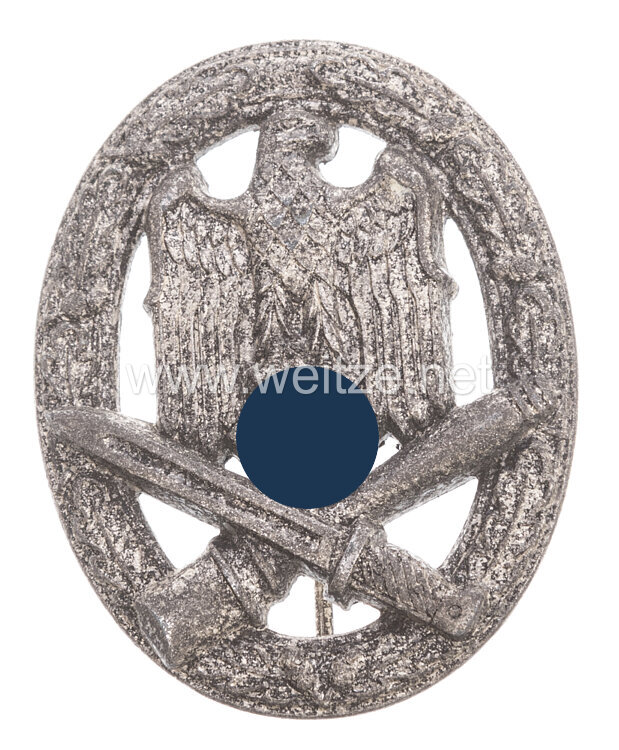
The described specimen was manufactured from fine zinc and subsequently silver-plated, representing a typical production method for these awards during the war years. The use of zinc instead of more precious metals reflects the increasing material shortages in the German Reich, particularly from 1942 onwards. Early versions were often made from silver or silver-plated base metal, while later wartime productions increasingly relied on substitute materials.
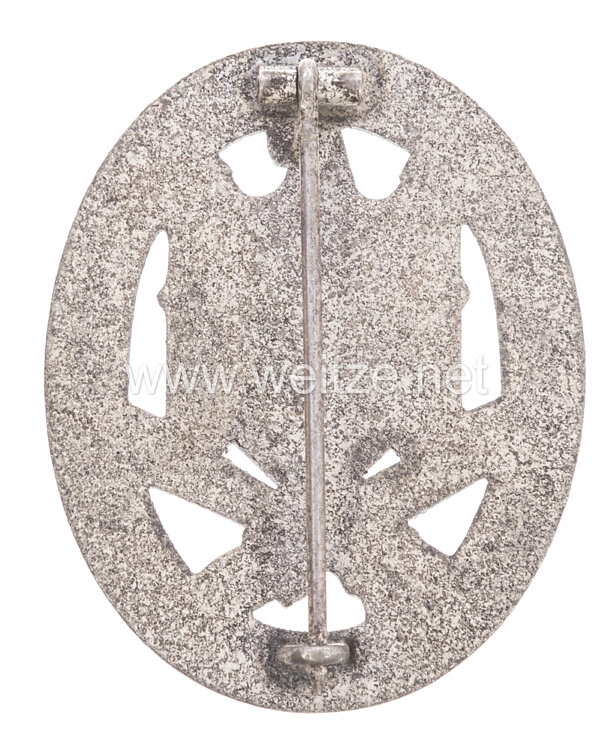
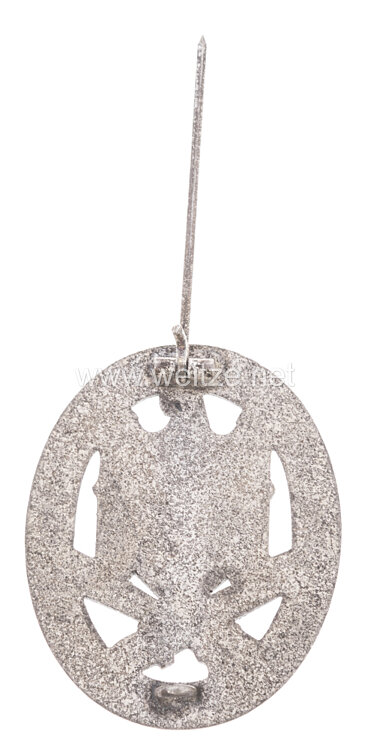
The design of the General Assault Badge features an oval oak leaf wreath, in the center of which is a stylized rifle with fixed bayonet and a stick hand grenade. This symbolism embodies infantry close combat. The reverse was fitted with a pin for attachment to the uniform. The badge was worn on the left breast of the uniform, below the ribbon bar.
Throughout the war, various variants and grades of the Assault Badge were introduced. From 1943 onwards, additions for repeated awards became available: after 25, 50, 75, and 100 days of combat, corresponding numerical attachments could be worn with the badge. These additional decorations document the intensive combat experience of their bearers.
The manufacture of the General Assault Badge was carried out by various producers throughout the Reich territory. Well-known manufacturing firms included Friedrich Orth from Vienna, Josef Feix & Söhne from Gablonz, and numerous other minting establishments. Many specimens bore a manufacturer's mark on the reverse, although this was not the case with all productions.
The “worn” condition of the described piece indicates that this decoration was actually attached to a soldier's uniform. This lends the object particular historical authenticity as testimony to individual wartime experience. Signs of wear such as oxidation, scratches, or deterioration of the silver plating are typical of worn specimens.
The historical significance of the General Assault Badge lies in its widespread distribution and its role as recognition for the most dangerous aspect of warfare: direct ground combat. Hundreds of thousands of these awards were conferred during the war, reflecting the intensive and costly nature of ground fighting on all theaters of war.
After 1945, the wearing of decorations with National Socialist symbols in Germany was regulated by the Law on Titles, Orders and Honours of 1957. According to this law, these decorations may only be worn in modified form without the swastika, although this rarely occurs in practice.
Today, such objects are important museum artifacts of World War II military history. They document the Wehrmacht's awards system and provide insight into the military culture of that era. Scholarly engagement with these objects requires critical contextualization that considers both military-historical aspects and the criminal nature of the Nazi regime.
For collectors and historians, the condition, maker marks, and manufacturing variations of these badges provide valuable information about wartime production methods and material allocation. The transition from precious metals to zinc and other substitute materials tells its own story about the deteriorating economic situation of Nazi Germany as the war progressed.