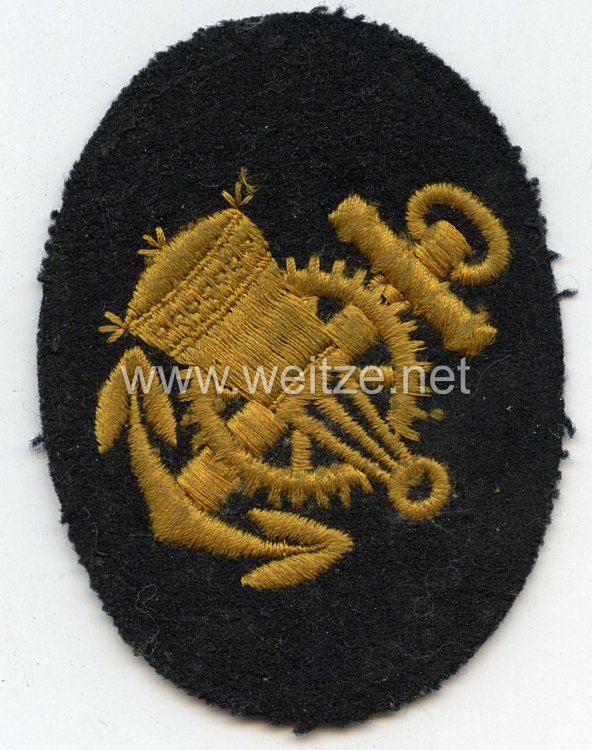
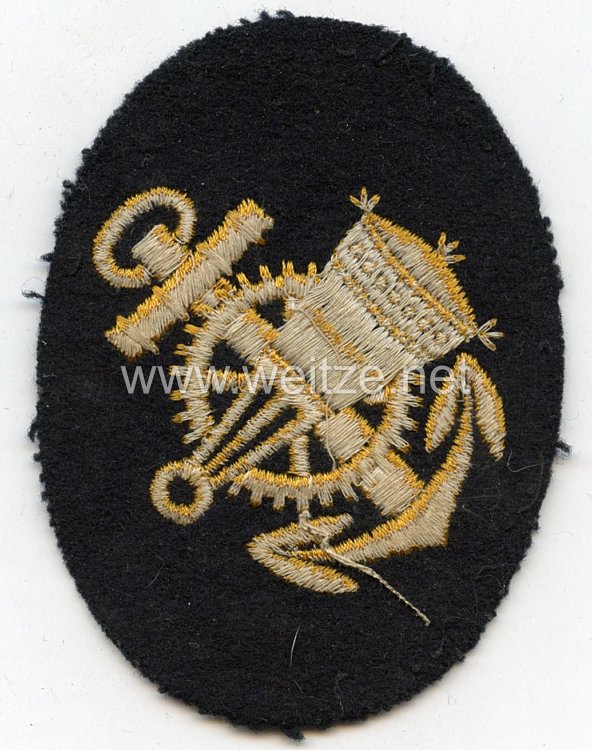
Kriegsmarine Sleeve Insignia Career Path Barrier Weapons - Mechanician Petty Officer Second Class
The Kriegsmarine sleeve badge for the Sperrwaffen career path - Mechanikermaat represents an important testament to the complex rank insignia and career structure of the German Navy during World War II. This machine-embroidered badge was worn on the blue blouse and identified the wearer as a member of the specialized Sperrwaffen (barrier weapons/mine warfare) career group holding the rank of Mechanikermaat.
The Kriegsmarine, officially established in 1935 following Germany's rearmament, developed a detailed system of career path badges to distinguish the various technical and nautical specializations within the Navy. Career path badges were worn on the right upper arm and differed distinctly from rank insignia, which were displayed on sleeves and shoulder boards.
The Sperrwaffen career path encompassed naval personnel who specialized in mine warfare, mine barriers, and related maritime obstruction weapons. This career path was crucial to German naval warfare strategy, particularly in defending German coastal waters and blockading enemy ports. Sperrwaffen specialists were responsible for laying, maintaining, and defusing naval mines, as well as operating minelayers and minesweepers.
The rank of Mechanikermaat belonged to the group of non-commissioned officers without sword knot (Portepee) and roughly corresponded to the rank of petty officer or chief mechanic in other naval forces. The term “Mechaniker” indicated technical skills, while “Maat” designated a non-commissioned officer rank in the German Navy. Mechanikermaate were experienced professionals who possessed not only nautical knowledge but also specialized technical skills in handling the complex mechanical and electrical systems of naval mines and barrier weapons.
The blue blouse on which this badge was worn was part of the Kriegsmarine's working and shipboard uniform. Unlike the dress uniform, the blue blouse was intended for daily service aboard ship and practical work. The uniform was made of dark blue wool fabric and was robust enough for the demanding conditions aboard warships.
The machine embroidery of these badges was standard in later Kriegsmarine production. While earlier badges were often hand-embroidered, machine production enabled faster and more cost-effective manufacturing with consistent quality. The badges typically displayed the specific symbols of the respective career path - in the case of Sperrwaffen, frequently a depiction of a mine or related symbols - combined with elements characteristic of the rank.
The organization of the Kriegsmarine into various career paths followed the career regulations, which precisely specified what training, examinations, and service time were required for each rank and specialization. The Sperrwaffen career path required intensive technical training, as handling naval mines demanded highly specialized knowledge of firing mechanisms, water pressure, magnetic and acoustic sensors, and electrical circuits.
In operational deployment, members of the Sperrwaffen career path played a decisive role in several theaters of war. In the North Sea and Baltic Sea, they were involved in establishing extensive mine barriers intended to block Allied shipping routes. Simultaneously, Sperrwaffen specialists were also indispensable in clearing mines from German waters to ensure safe passages for their own ships.
Technological development in the field of naval mines made significant advances during World War II. From simple contact mines, the technology evolved to magnetic mines, acoustic mines, and pressure mines that reacted to water pressure generated by passing ships. The Mechanikermaate of the Sperrwaffen career path had to be familiar with all these technologies and able to handle them under often dangerous conditions.
After the war's end, many of these specialists were employed by the Allies to clear the countless mines that had been laid in European waters during the war. These minesweeping operations lasted for years and continued to cost lives long after the war ended.
Today, such sleeve badges are important military-historical collectibles that provide insight into the organization, hierarchy, and specialization of the Kriegsmarine. They document the complexity of German naval organization and the importance placed on technical expertise in modern naval warfare.