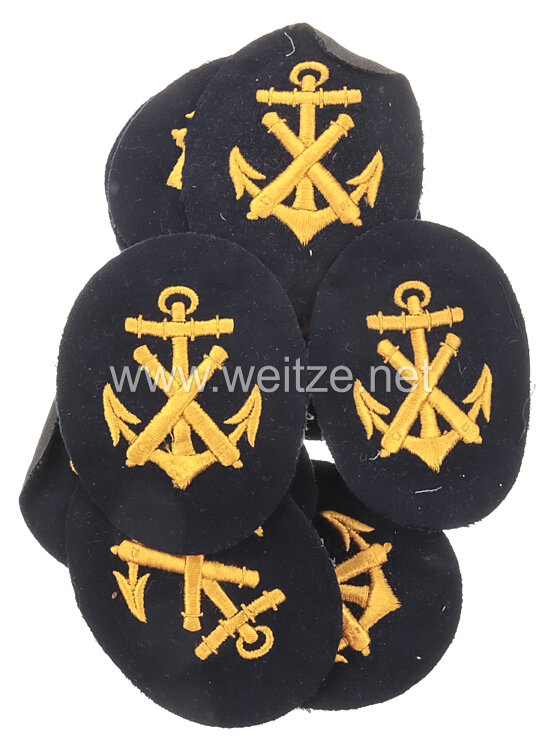
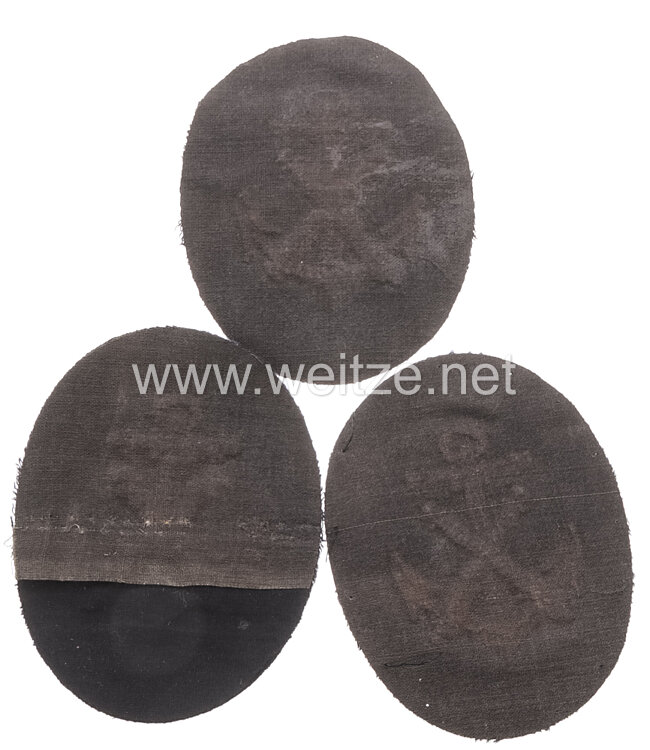
Kriegsmarine Sleeve Insignia Career Path Feuerwerksmaat (Ordnance Petty Officer)

for the blue jumper, Condition 2.

Price per piece: 12 Euro.

Condition may vary.
462481
12,00

Kriegsmarine Sleeve Insignia Career Path Feuerwerksmaat (Ordnance Petty Officer)

The Kriegsmarine Career Sleeve Badge for Feuerwerksmaat (Torpedo Petty Officer) represents a significant example of the career insignia of the German Kriegsmarine during World War II. These badges served to identify professional specialization and rank within the complex hierarchy of the German Navy between 1935 and 1945.

The Kriegsmarine, officially founded on June 1, 1935, replaced the Reichsmarine, which had been severely restricted by the Treaty of Versailles. With rearmament under the Nazi regime, a comprehensive system of uniforms and rank insignia developed that reflected the various careers and specializations within the Navy.

The Feuerwerksmaat was a non-commissioned officer in the torpedo branch, responsible for weapons, ammunition, and pyrotechnic devices aboard ship. The designation “Feuerwerker” derives from historical military terminology and originally denoted specialists in explosives and fireworks. In the Kriegsmarine, this specialization encompassed the maintenance and handling of torpedoes, mines, depth charges, and other underwater ordnance, as well as their associated launching systems.

The sleeve badge was worn on the blue blouse, the working and service uniform of enlisted men and petty officers. This dark blue uniform jacket was the most frequently worn uniform in daily service aboard ship and ashore. The sleeve badges were affixed to the left upper arm in accordance with the Dress Regulations for the Kriegsmarine.

The career badges of the Kriegsmarine followed a standardized system: they displayed symbolic representations indicating the respective specialization. For the torpedo branch, to which the Feuerwerker also belonged, a crossed torpedo design or similar symbolism was typically characteristic. These badges were usually executed in yellow or gold embroidery on a dark blue cloth background.

The manufacture of these badges was carried out both by military depots and by private manufacturers holding appropriate licenses. Quality could vary - from machine-made standard versions to hand-embroidered examples of higher quality for petty officers who had their uniforms made by private tailors.

In the Kriegsmarine hierarchy, the Maat was a middle-ranking non-commissioned officer rank, comparable to a sergeant in the Army. The Feuerwerksmaat had already completed several years of service and bore responsibility for the proper functioning of the weapons systems entrusted to him. He could instruct younger sailors and lance corporals and was often directly subordinate to a Senior Torpedo Petty Officer or an officer of the torpedo officer career path.

The torpedo branch was one of the most technically demanding specializations in the Kriegsmarine. Training to become a Feuerwerksmaat required extensive theoretical and practical knowledge in ballistics, explosive chemistry, electrical engineering, and mechanics. Training facilities were located at Flensburg-Mürwik and other naval schools, among other places.

The daily duties of a Feuerwerksmaat aboard a warship were diverse and critical to combat readiness. He was responsible for inspecting torpedo tubes, maintaining firing mechanisms, storing ammunition safely, and ensuring that all pyrotechnic signals and flares were functional. On U-boats, where space was extremely limited, the Feuerwerker's expertise was particularly crucial, as torpedoes represented the submarine's primary offensive weapon.

Today, such sleeve badges are important military-historical collector's items that provide insight into the organizational structure and specialization system of the Kriegsmarine. The condition of preservation varies greatly - from well-preserved examples that were never worn to badges showing clear signs of use. Classification according to condition grades (Condition 1 for mint to Condition 4 for heavily damaged) is common in the collector's field.

Academic study of such uniform items enables historians to better understand the everyday reality of naval service and contributes to the documentation of military history. They are testimonies of a bygone era and help to reconstruct the structure and organization of the German armed forces during World War II.

r