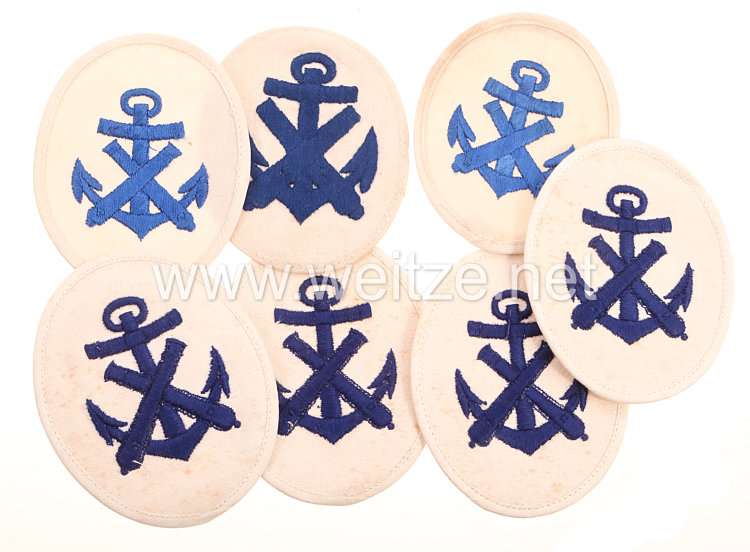
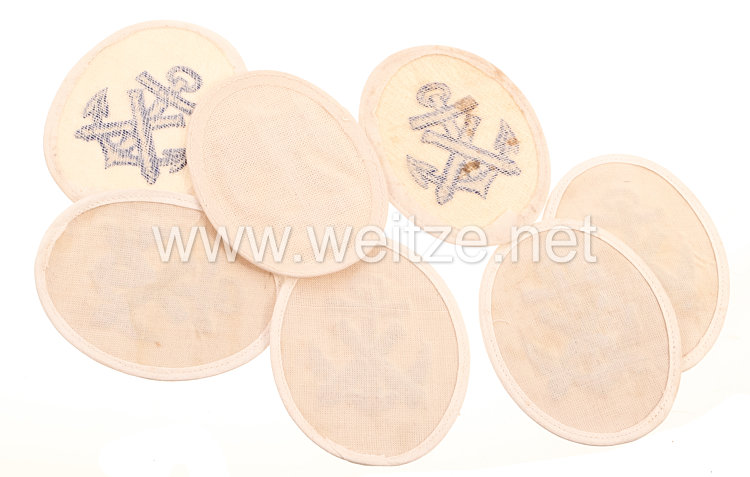
Kriegsmarine Sleeve Insignia Career Path Feuerwerksmaat

for the white blouse, condition 2.

Price per piece: 20 Euro.

Condition may vary.
440981
20,00

Kriegsmarine Sleeve Insignia Career Path Feuerwerksmaat

The Kriegsmarine sleeve badge for Feuerwerksmaate (Gunnery Mates) represents a fascinating testimony to the complex rank structure and career path identification system of the German Kriegsmarine during World War II. These special badges served to visually identify non-commissioned officers and enlisted men according to their respective career paths and specializations aboard warships.

The Kriegsmarine, as the naval force of the German Reich from 1935 to 1945, developed a sophisticated system of uniforms and insignia that built upon the traditions of the Imperial Navy while adapting to new requirements and National Socialist aesthetics. Following its official establishment on May 21, 1935, through the reintroduction of general conscription under Admiral Erich Raeder and later under Grand Admiral Karl Dönitz, the Kriegsmarine established detailed uniform regulations.

The Feuerwerksmaat belonged to the weapons career path and was responsible for ammunition, torpedoes, mines, and other ordnance aboard ship. The designation “Feuerwerker” derives from historical military terminology and refers to specialists in explosives and pyrotechnics. In the Kriegsmarine, these petty officers carried special responsibility, as the proper storage, maintenance, and deployment of ammunition were vital for ship safety and combat success.

The sleeve badges were worn on various uniform items, including the white summer blouse, which was part of the standard naval uniform equipment. The white blouse was worn primarily in warmer weather and southern waters and was part of the so-called “white service dress.” These sleeve badges differed according to career path through various symbols and colors, which were embroidered or woven onto dark blue fabric backing.

The career badge for Feuerwerker typically displayed a flaming grenade or bomb as the central motif, symbolizing the explosive nature of their duties. These badges were worn on the left upper arm according to the Dress Regulations for the Kriegsmarine (M.Dv. Nr. 352), with precise specifications for exact position and size. The regulations were regularly updated and issued in various editions during the war.

The manufacture of these badges was carried out by various authorized producers throughout the Reich territory. Quality varied depending on the manufacturer and production period. Early war years generally showed higher processing quality with fine hand embroidery or machine weaving on high-quality cloth. As the war progressed and material shortages increased, simplified versions were produced, sometimes with printed or coarser embroidery.

The hierarchical structure of the Kriegsmarine distinguished between various ranks within the Feuerwerker career path: from Feuerwerksmaat (petty officer without sword knot) through Oberfeuerwerksmaat to Stabsoberfeuerwerksmaat. Higher ranks such as Feuerwerksoffiziere (Ordnance Officers) wore different markings according to their officer rank. However, the sleeve badge remained the characteristic feature of the career path across all ranks.

Training to become a Feuerwerksmaat took place in specialized naval schools and included theoretical and practical knowledge of explosives, ammunition types, safety procedures, and ballistics. The torpedo schools in Flensburg-Mürwik and Wesermünde trained these specialists, who were indispensable on all ship types from submarines to battleships.

After the war's end in 1945 and the dissolution of the Kriegsmarine, these badges became historical collector's items. Today they are important testimonies to naval history and are sought by militaria collectors worldwide. The condition varies greatly, depending on storage and use during and after the war. Original badges can be distinguished from later reproductions through material analysis, manufacturer characteristics, and processing techniques.

The study of these uniform components enables historians to gain valuable insights into the organization, hierarchy, and daily life of the Kriegsmarine. They document not only military structures but also textile craftsmanship, uniform regulations, and the material culture of the era.