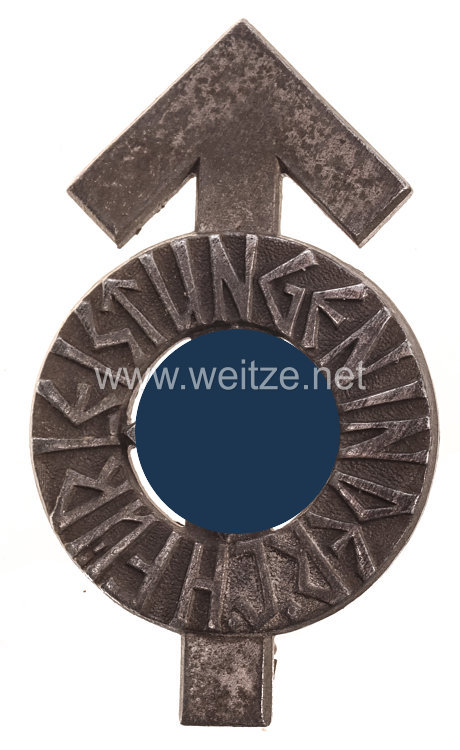
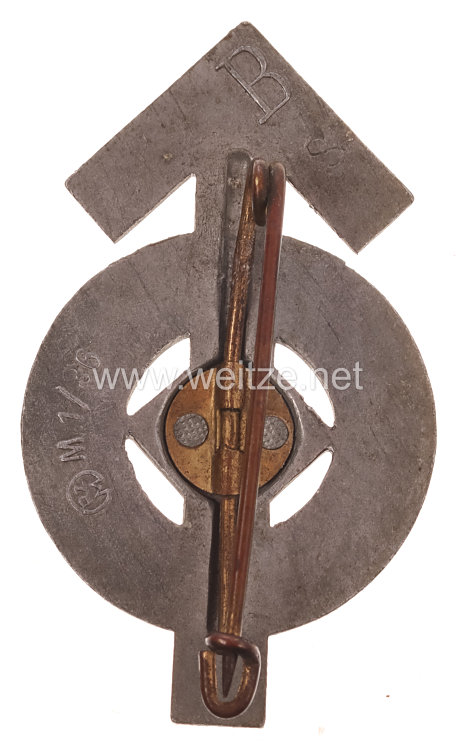
Hitler Youth Sports Badge in Silver - B-Piece
The HJ Sports Badge in Silver was a significant award of the Hitler Youth (Hitler-Jugend, HJ) during the National Socialist period in Germany. This organization, founded in 1926 and declared the state youth organization from 1936 onwards, employed various decorations and badges to motivate its members and reward their physical and ideological achievements.
The present specimen is classified as a B-Stück (B-piece), a designation referring to a specific production classification. It was manufactured from fine zinc (Feinzink), a material that became increasingly common, particularly in the later war years due to metal shortages. The manufacturer is identified by the marking RZM M 1/36. The abbreviation RZM stands for Reichszeugmeisterei, the central procurement office of the NSDAP, which from 1929 was responsible for quality control and licensing of all party and organizational badges.
The HJ Sports Badge was awarded in three grades: Bronze, Silver, and Gold, with the Silver grade requiring considerable athletic and physical achievements. The regulation introducing this badge was issued in 1934, as the Hitler Youth expanded its structures and recognition systems. Recipients had to complete various disciplines, including track and field, swimming, cross-country sports, and shooting exercises. The Silver grade had significantly higher requirements than Bronze, making this badge a coveted symbol of athletic excellence within the organization.
The RZM marking M 1/36 allows for more precise identification of the manufacturer. The RZM numbering system was introduced to control production and prevent counterfeiting. The manufacturer number identified specific production facilities that held licenses to produce official badges. The awarding of these licenses was strictly regulated, and manufacturers had to maintain certain quality standards.
The use of fine zinc as a material is an interesting detail that allows conclusions about the production period. While higher-quality materials such as silver-plated base metal were frequently used in the early years, there was an increasing shift to substitute materials as the war progressed. Zinc was available and easy to work with, but did not achieve the durability and appearance of more noble metals. The classification as a B-Stück might indicate a simplified manufacturing variant or a specific production series.
The design of the HJ Sports Badge typically displayed the HJ emblem – the Siegrune (victory rune) in the center, surrounded by an oak leaf wreath. The Silver version was finished in an appropriate silver color. The badge was worn on the uniform, usually on the left breast, thus publicly signaling the wearer's athletic abilities.
The historical significance of these badges lies not only in their function as awards but also in their role within the National Socialist education system. The Hitler Youth pursued the goal of ideologically indoctrinating young people and physically preparing them for possible military service. The sports badges were part of this comprehensive system that promoted competition, performance orientation, and the cult of the body.
From today's perspective, such objects are important witnesses to a dark period of German history. They document the methods and structures of a totalitarian youth organization and serve in museums and collections as educational material for historical research and education. Handling such objects always requires critical historical classification and clear contextualization of their origin and use under National Socialism.