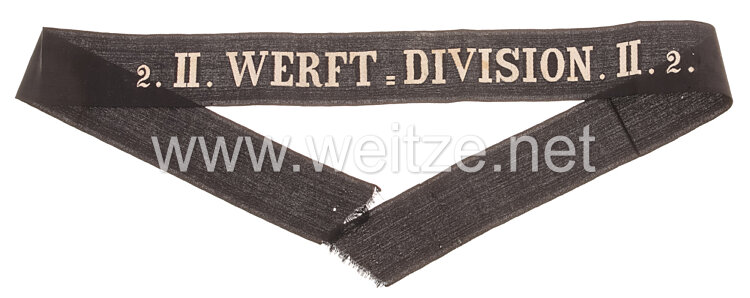
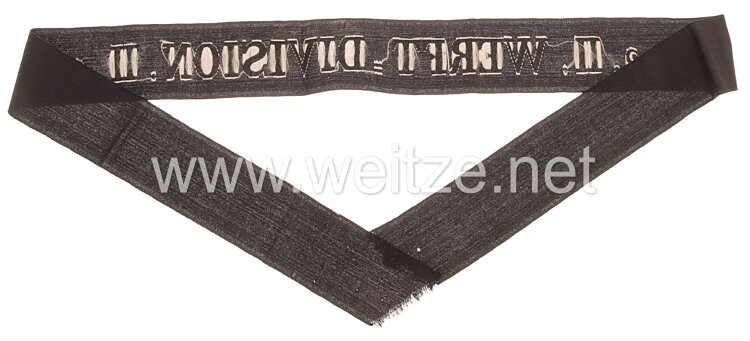
Imperial German Navy Cap Tally “2. II. Werft-Division. II. 2.”
The Imperial German Navy cap tally bearing the inscription “2. II. Werft-Division. II. 2.” represents a fascinating artifact of German naval history between 1871 and 1918. These cap ribbons, known in the German Navy as “Bandschleifen” or “Tellerbänder,” served not only as a functional component of the sailor's uniform but primarily as an important identification marker indicating assignment to a specific unit.
The Werft-Divisionen (Dockyard Divisions) of the Imperial German Navy formed an essential component of the maritime infrastructure of the German Empire. These units were responsible for the maintenance, repair, and construction of warships in the imperial dockyards. The II. Werft-Division belonged to the organizational structure of dockyard workers and technical personnel who, while part of the Navy, were primarily employed in dock facilities and shipyards rather than at sea.
The cap tally described here was manufactured from cotton thread on black silk, which corresponded to the standard specification for Imperial German Navy cap tallies. Production typically occurred through specialized manufacturers who were required to maintain strict quality standards. The golden-yellow lettering on a black background was characteristic of the entire Imperial Navy and was precisely regulated through various regulations, particularly the Dress Regulations of the Imperial Navy.
The length of approximately 68 cm corresponds to the usual dimensions for cap tallies, which were worn around the sailor's cap (also called “Tellermütze” or flat cap). The ribbons were worn with two flowing ends at the back, which was not only visually distinctive but also continued a centuries-old maritime tradition.
The complex designation “2. II. Werft-Division. II. 2.” follows the hierarchical organizational system of the Imperial Navy. Such multi-part designations were characteristic of the highly organized structure of the German armed forces under Kaiser Wilhelm II. The Werft-Divisionen were primarily stationed at the major naval bases such as Kiel, Wilhelmshaven, Danzig, and later also Cuxhaven.
The importance of the dockyard divisions cannot be overestimated. While the High Seas Fleet was massively expanded under Admiral Alfred von Tirpitz from the 1890s onwards, this expansion required corresponding infrastructure. Thousands of workers, engineers, and technicians were organized in the dockyard divisions and ensured that the modern war fleet of the Empire remained operational.
Wearing cap tallies was mandatory for sailors and enlisted ranks, while officers wore different headgear. The cap tallies enabled immediate identification of unit affiliation and promoted esprit de corps within the respective units. During special occasions or shore leave, sailors took pride in displaying their unit affiliation through their cap tally.
The Condition 2 of the present example indicates good preservation, with possibly minor signs of use. This is remarkable, as many cap tallies were subjected to heavy wear during daily use, and only a few have survived in good condition since the end of the Imperial Navy in 1918.
With the end of World War I and the November Revolution of 1918, the Imperial Navy was dissolved. The sailors' mutiny in Kiel in November 1918 symbolically marked the end of the imperial military monarchy. The cap tallies of various units became historical relics of a bygone era.
Today, Imperial German Navy cap tallies are sought-after collector's items that provide important insights into the organizational structure and daily life in the German Navy of the Empire. Cap tallies from dockyard divisions are particularly rare compared to those from ships, as they are less prominently represented in maritime commemorative culture. However, they serve as reminders of the thousands of people who worked behind the scenes to ensure the technical functionality of the fleet and thus made an indispensable contribution to German naval history.