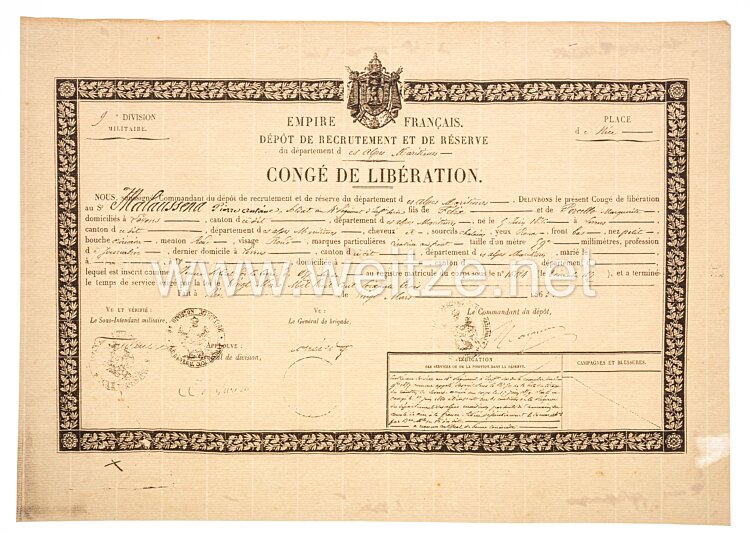
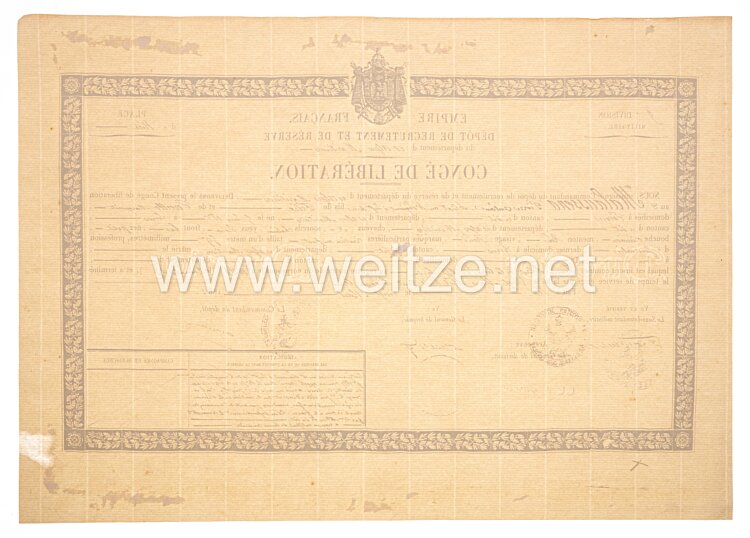
France Second Empire Discharge Certificate into the Reserve for Soldier “Malaussena” of the “4e régiment d'infanterie Sardes” 1863
This document is a discharge certificate into the reserve from the year 1863, issued to a soldier named Malaussena from the 4th Sardinian Infantry Regiment (4e régiment d'infanterie Sardes). The certificate originates from the Département des Alpes-Maritimes and represents a fascinating transitional period in European military history.
The historical significance of this document lies in its creation during the Second French Empire under Napoleon III (1852-1870). The year 1863 was a time of relative stability following the turbulent years of the Italian Wars of Independence. The mention of a “Sardinian” regiment in French service points to the complex political circumstances of this era.
Following the Treaty of Turin (1860), the County of Nice and Savoy were ceded by Sardinia-Piedmont to France. This was the price for French support during the Second Italian War of Independence (1859). The Alpes-Maritimes was established as a new French département, and the military units stationed or recruited there found themselves in a transitional phase between Sardinian and French administration.
Military discharge certificates of this period followed strict bureaucratic procedures. Every soldier completing his active service received an official document certifying his period of service, conduct, and military qualifications. These documents held considerable practical importance: they served as proof of completed military service, were essential for pension claims, and could be helpful when seeking civilian employment.
The French military system under the Second Empire was based on conscription laws that provided for universal military service, though with various exemptions and the possibility of hiring a substitute. The normal service period was seven years of active duty, followed by a reserve obligation. Discharge into the reserve did not mean the end of all military obligations but rather a transition to a status in which the soldier could be recalled in case of war.
Typical certificates of this type were printed on high-quality paper and contained pre-printed text with specific information filled in by hand. They usually bore official seals and signatures from military officers and civil authorities. The dimensions of approximately 41.7 x 29.4 cm correspond to the format commonly used for official military documents of the period.
The 4th Sardinian Infantry Regiment was part of the complex military structures that emerged during the territorial reorganization between Sardinia-Piedmont and France. Such units often retained their historical designations even when integrated into new command structures. This served to maintain military tradition and regimental pride.
The preservation of such documents is historically valuable as they provide insights into the individual experiences of common soldiers. Unlike official military archives that primarily focus on strategic and operational matters, discharge certificates document personal military careers and contribute to the social history of the 19th century.
The Département des Alpes-Maritimes, as a newly French territory, faced particular administrative challenges. The integration of former Sardinian subjects into the French system, including the military establishment, required careful bureaucratic procedures. Documents such as this discharge certificate were part of this integration process.
For collectors and historians, such documents provide important information about military administrative practices, regional history, and the impact of European territorial changes on individual lives. They complement our understanding of an era characterized by national unification movements, imperial expansion, and the modernization of military structures.
The document's condition and preservation also speak to the importance placed on such certificates by their recipients. Soldiers and their families often carefully preserved these papers as proof of service and as family heirlooms, connecting personal histories to the broader sweep of European events.