Wehrmacht Shoulder Boards for Turkistan Volunteers
These shoulder straps for Turkistani volunteers represent a significant chapter in German military history during World War II, particularly in the context of recruiting Eastern Legions and volunteer units from Soviet territories.
Beginning in 1941, after the start of Operation Barbarossa, the Wehrmacht systematically began forming units from Soviet prisoners of war and volunteers of various nationalities. The Turkistan Legion was founded in autumn 1941 and included members of various Central Asian peoples, including Uzbeks, Kazakhs, Kyrgyz, Turkmen, and Tajiks. These units were collectively termed “Osttruppen” (Eastern Troops) or “Ostlegionen” (Eastern Legions).
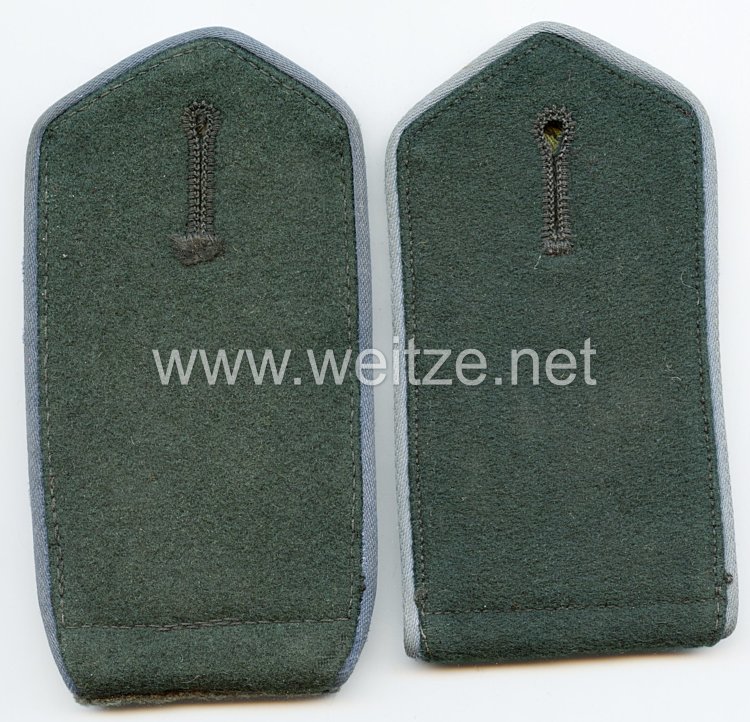
The dark green shoulder straps with blue piping correspond to the branch color (Waffenfarbe) designated for these special volunteer units. The blue piping specifically identified Turkestani units and distinguished them from other Eastern Legions such as the Caucasian Legion or the Volga Tatar Legion, each of which had their own branch colors. This color scheme was regulated through various Army Regulation Bulletins (Heeres-Verordnungsblätter) and uniform regulations between 1942 and 1944.
The Turkistan Legion was initially formed in Poland, where prisoner-of-war camps were combed for suitable volunteers. The volunteers' motivations varied: some hoped for the independence of their homelands from the Soviet yoke, while others simply wanted to escape the catastrophic conditions of the prison camps. German propaganda promised the legionnaires liberation of their homeland from Bolshevism and the establishment of independent states.
In 1943, the Turkistan Legion reached its peak strength with approximately 30,000 to 40,000 men, organized into various battalions. These units were primarily deployed on the Eastern Front, but also used for occupation and security duties in other occupied territories. From 1943 onwards, several Turkestani battalions were also transferred to Italy, France, and the Balkans.
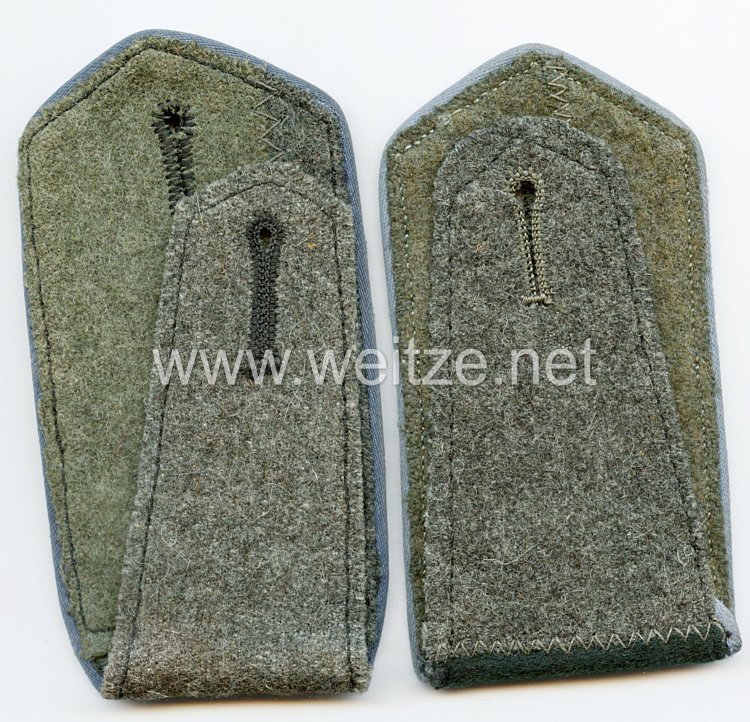
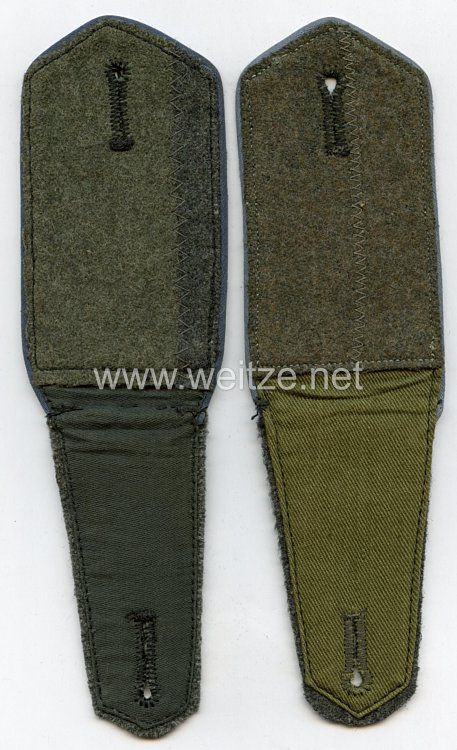
The slight mismatch of the present shoulder straps is a typical characteristic of field equipment from the late war period. From 1944 onwards, the Wehrmacht's supply situation increasingly deteriorated, and perfectly matching uniform items became rarer. Shoulder straps were often produced by different manufacturers or issued at different times, leading to slight variations in color, size, or workmanship.
The loops on the reverse side served to attach the shoulder straps to the uniform. They were pulled through the shoulder pieces of the field tunic or coat and secured with a button. This construction allowed for easy removal and replacement of shoulder straps, which was necessary for promotions or transfers.
The year 1944 marked a critical phase for the Eastern Legions. With the advancing Soviet forces, the position of these units became increasingly precarious. Many members of the Turkistan Legion feared capture by the Red Army, as they were regarded as traitors and could expect harsh punishment. After the war ended in 1945, many legionnaires were forcibly repatriated to the Soviet Union under the Yalta repatriation agreements, where they often faced severe repression.
The collection and preservation of such uniform items is of great importance for historical research. They document a complex and often overlooked chapter of military history that illustrates collaboration, the desperate situation of prisoners of war, and the instrumentalized nationality policy of the German occupation. These objects remind us of the difficult decisions people faced in extreme situations and the tragic consequences of World War II for all involved.