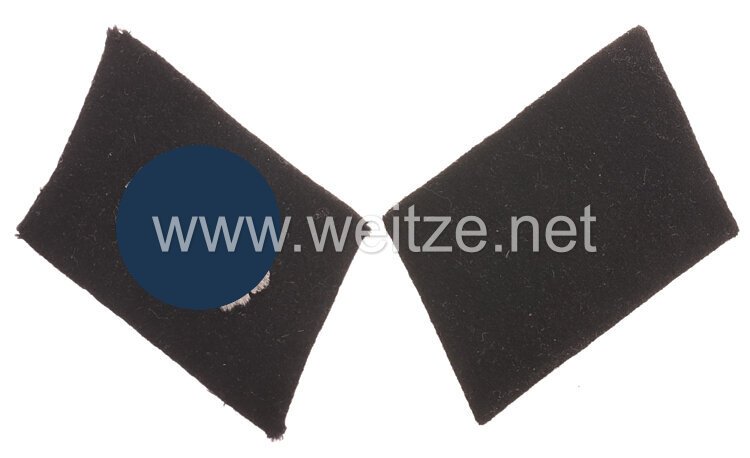
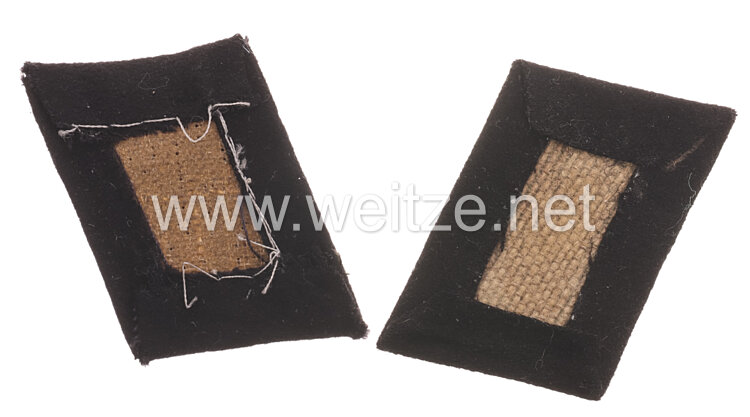
Waffen-SS Pair of Collar Tabs for Enlisted Men of the 3rd SS Panzer Division “Totenkopf”

RZM machine-embroidered execution circa 1944. Condition 2.
460778
1.350,00

Waffen-SS Pair of Collar Tabs for Enlisted Men of the 3rd SS Panzer Division “Totenkopf”

The collar tabs of the Waffen-SS represented an essential element of uniform identification in National Socialist Germany. The pair of collar tabs described here was manufactured for enlisted men of the 3rd SS Panzer Division “Totenkopf” and dates from around 1944. These machine-embroidered insignia in RZM quality represent the late wartime production of this division.

The 3rd SS Panzer Division “Totenkopf” was established in October 1939 under the command of SS-Obergruppenführer Theodor Eicke. Eicke, who had previously served as Inspector of Concentration Camps and Commandant of Dachau, significantly shaped the division. The unit originally recruited from the SS-Totenkopfverbände (Death's Head Units), which were responsible for guarding concentration camps. This origin explains the division's insignia: the death's head skull.

The collar tabs of the Waffen-SS served to indicate rank and unit affiliation. Enlisted men wore the SS runes on the right collar tab, while the left bore either rank insignia or, in the case of this division, the characteristic death's head symbol. The RZM designation refers to the Reichszeugmeisterei, the central procurement office of the NSDAP, which was responsible for quality control and standardization of uniform components.

The machine-embroidered execution from around 1944 corresponds to the production standards of the late war years. While more elaborate, hand-embroidered insignia of higher quality were still manufactured at the war's beginning, military necessities from 1942/43 onwards forced simplified manufacturing processes. Machine production allowed for faster and more cost-effective manufacturing, which became necessary given the high casualties and constant need for replacements.

The “Totenkopf” Division fought on various fronts during World War II. After its formation, it participated in the 1940 Western Campaign, where it was involved in war crimes, particularly the Le Paradis massacre, in which British prisoners of war were murdered. From 1941, the division was deployed in the Eastern Campaign, where it participated in the Demyansk Pocket and suffered heavy losses. In 1943, it fought in the Battle of Kharkov and the Battle of Kursk.

In 1944, from which these collar tabs date, the division was in the Kovel area and later on the Romanian front. Heavy losses necessitated constant re-equipping and reinforcements, explaining the need for uniform items such as the collar tabs described here. The division was repeatedly refreshed and reorganized throughout 1944.

The manufacture of Waffen-SS insignia was subject to strict regulations. The Clothing Office of the Waffen-SS issued detailed specifications regulating the form, size, color, and material of collar tabs. For enlisted men, the insignia were typically executed on black base fabric with silver-colored embroidery for the symbols. The quality of embroidery and materials varied depending on the time of production and manufacturer.

From a historical perspective, such uniform items are significant material witnesses of the Nazi era. They document not only military organization and hierarchy but also the industrial production of militaria in the Third Reich. At the same time, they are inseparably connected with the crimes committed by the Waffen-SS. The “Totenkopf” Division was involved in numerous war crimes and atrocities, particularly in the murder of civilians and prisoners of war on the Eastern Front.

The stated condition 2 indicates a well-preserved example that shows typical signs of use but still reveals all essential details. Such objects are today preserved in collections of military historical artifacts and serve the scientific documentation and examination of this dark period of German history.