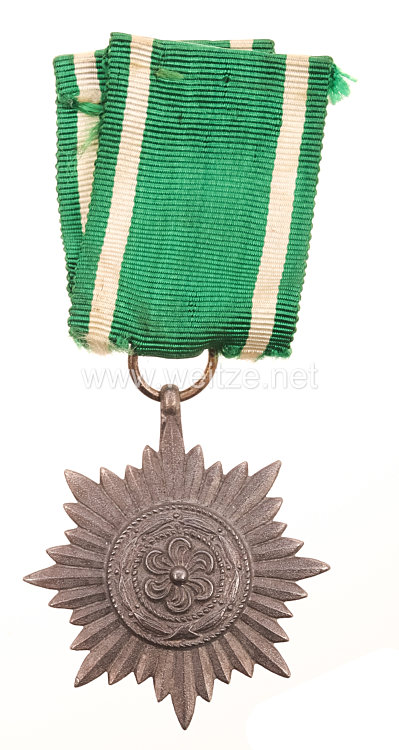
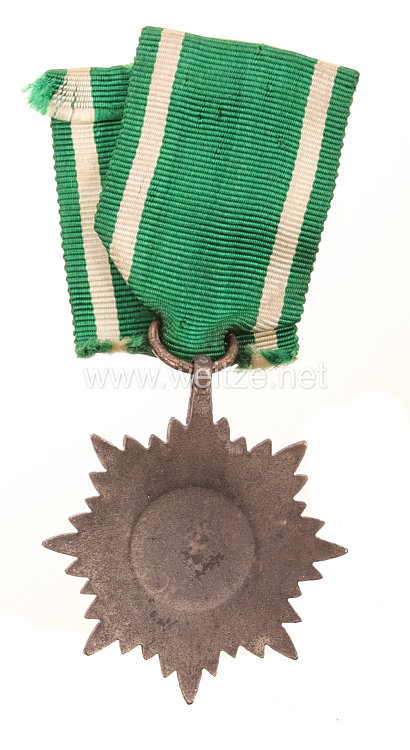
Eastern Peoples Medal of Merit 2nd Class in Silver

Silver-plated fine zinc, semi-hollow struck, on ribbon. Condition 2
440878
160,00

Eastern Peoples Medal of Merit 2nd Class in Silver

The Merit Decoration for Eastern Peoples 2nd Class in Silver represents a significant document of National Socialist decoration policy during World War II. This award belongs to a system of honors specifically created for non-German volunteers and auxiliary forces from the occupied eastern territories.

On July 14, 1942, the Merit Decoration for Eastern Peoples was officially instituted by decree of Adolf Hitler. The decoration was part of the National Socialist propaganda and recruitment policy aimed at winning and motivating collaborators and auxiliary troops from the occupied Soviet territories. The decoration could be awarded to members of the so-called “Eastern Peoples,” a term that included Ukrainians, Belarusians, Turkic peoples, Caucasians, and other ethnic groups from the Soviet Union.

The Merit Decoration system was divided into two classes: the 1st Class in Gold and the 2nd Class in Silver. The 2nd Class in Silver described here represented the lower of the two grades and was awarded for special services in the service of the German Wehrmacht. The decoration could be awarded to both military and civilian personnel who had distinguished themselves within the framework of German warfare.

The technical execution of the present specimen corresponds to the typical manufacturing methods of the later war years. The badge consists of fine zinc, a material increasingly used as precious metals had to be reserved for the armaments industry. The silver plating nevertheless gave the piece a dignified appearance. The semi-hollow embossed design was a common production method that saved material while still enabling a three-dimensional appearance.

The design of the decoration typically featured a sword surrounded by a laurel wreath, with the specific design reflecting the ideological concepts of the Nazi regime. The decoration was worn on the designated ribbon, which usually consisted of a special color scheme that distinguished the Eastern Peoples decorations from other German orders.

The awarding practice of this decoration was strictly regulated. The decision on awarding lay in the hands of higher German command posts. The decoration was intended on the one hand to promote the loyalty of the Eastern Peoples toward German warfare, but on the other hand also to clarify their subordinate status in the National Socialist system of rule. German soldiers were not allowed to receive this decoration – separate order systems existed for them.

The historical context of this decoration is inseparably connected with the brutal occupation policy of the Nazi regime in the East. While millions of Soviet citizens suffered and died under German occupation, the regime simultaneously attempted to instrumentalize certain groups for its own purposes through such decorations. The Merit Decoration for Eastern Peoples thus stands symbolically for the cynical and contradictory policy of National Socialism toward the conquered peoples.

After the war, the decoration, like all Nazi orders, was banned by Control Council Law No. 1 of October 1945. Wearing this decoration in Germany and Austria is only permitted today for historical and scientific purposes.

From a military-historical perspective, such decorations today are important sources for researching German occupation policy, collaboration, and the complex relationships between occupiers and occupied during World War II. They document the attempts of the Nazi regime to gain political and military support through symbolic recognition.

The stated Condition 2 indicates a well-preserved specimen that, despite being over 80 years old, has retained essential features. Such pieces today have exclusively documentary and scientific value and serve historical education and research.

r