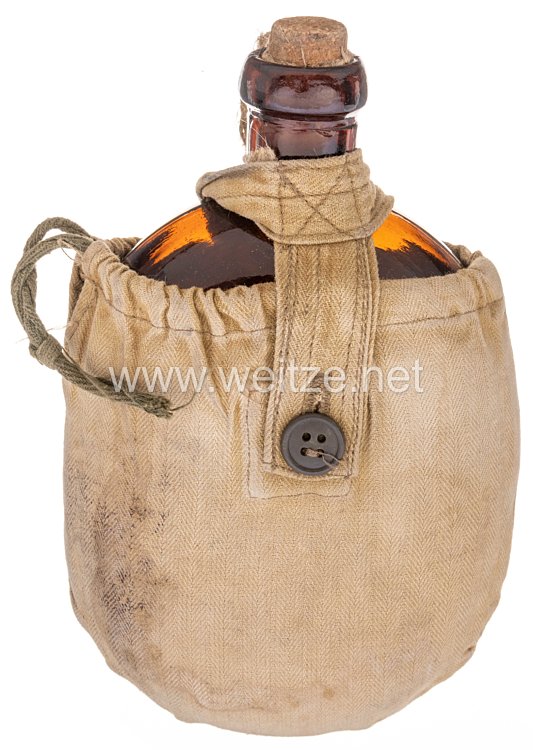
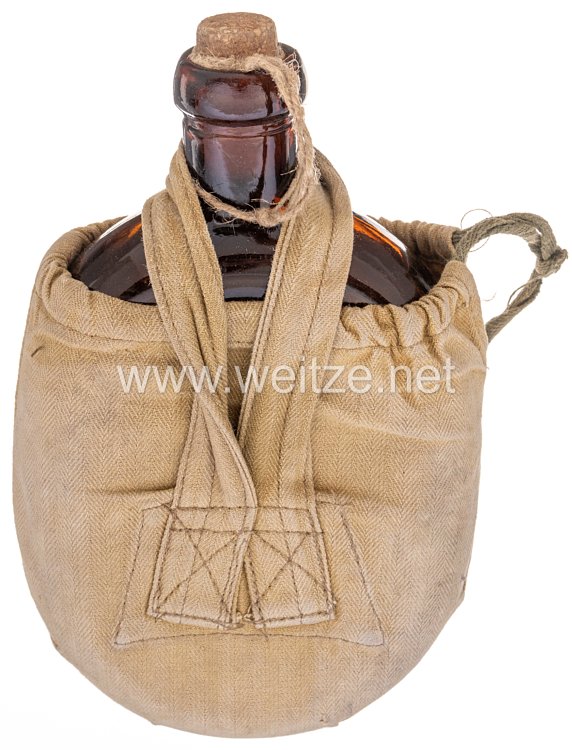
Soviet Union Canteen (Glass Bottle)

Linen cover from the 1960s, the glass canteen from World War II, condition 2.
448978
120,00

Soviet Union Canteen (Glass Bottle)

The Soviet Glass Field Flask - A Pragmatic Relic of World War II

The Soviet glass field flask represents a fascinating example of improvised war logistics employed by the Red Army during World War II. While Western armies predominantly used metal or aluminum canteens, the Soviet Union, out of necessity and resource scarcity, frequently resorted to glass bottles sewn into linen covers.

The Great Patriotic War (1941-1945), as World War II is known in Russia, presented enormous challenges to Soviet industry. Following the German invasion in June 1941, hundreds of factories had to be relocated behind the Ural Mountains within the shortest time possible. Metal production was concentrated on weapons, tanks, and aircraft, meaning that alternative materials often had to be used for equipment items such as canteens.

The use of glass as a canteen material may initially seem impractical, but it did have certain advantages. Glass was abundantly available in the Soviet Union, the glass industry could be quickly converted, and the material was chemically neutral, thus not affecting the taste of water. The greatest disadvantage - fragility - was partially compensated by robust linen covers.

The linen cover served multiple functions: it protected the glass bottle from impacts, provided insulation against heat and cold, and the capillary action of the fabric allowed for slight evaporative cooling when moistened. The covers were typically made from gray or olive-green linen and finished with simple seams. A carrying strap made of cotton or linen enabled wearing over the shoulder or attachment to a belt.

The flask described here with a cover from the 1960s demonstrates the continuity of Soviet military practice. Even after the war, the combination of glass bottle and fabric cover continued to be used, although more modern plastic and aluminum variants were gradually introduced. The 1960s marked a transitional phase in which old war stocks were still in service while new equipment was simultaneously being produced.

The capacity of Soviet field flasks was standardly about 0.75 to 1 liter. The bottles were usually sealed with simple corks or Bakelite stoppers. In practice, this meant that soldiers had to handle their equipment carefully - a broken canteen on the icy Russian steppe or during the advance to Berlin could become life-threatening.

Interestingly, various types of Soviet canteens existed in parallel during the war. Alongside the glass variants, there was also the standard model made of enameled sheet steel, which was mainly produced in the pre-war period. The glass bottles were often improvised solutions or were used in regions where metal supply was particularly strained.

The condition rating of 2 indicates a well-preserved collector's item. For military antiques, a scale from 1 (mint condition) to 5 (heavily damaged) is typically used. A condition 2 means that the object shows slight signs of use but is complete and functional - remarkable for a glass object over 80 years old.

For collectors and historians, Soviet glass field flasks offer an authentic insight into the material culture of the Red Army. They testify to the improvisational ability and enormous logistical challenges faced by the Soviet Union during total war. While German or American canteens were more technically sophisticated, the Soviet glass flasks represent a reality in which pragmatism triumphed over perfection.

The combination of a wartime flask with a post-war cover, as described here, is quite typical. Soviet soldiers and later collectors frequently replaced damaged covers with newer examples. This does not make the object less valuable, but rather shows the continuous use and care of such equipment items over decades.

Today, well-preserved Soviet glass field flasks from World War II are relatively rare collector's items. Many were broken during the war or in the post-war period. The surviving examples are silent witnesses to one of the greatest military confrontations in history and the unimaginable sacrifices made by the Soviet people - over 27 million war dead on the Soviet side alone.

The canteen reminds us that wars are not won only with tanks and aircraft, but also with the everyday items that ensured soldiers' survival: water, food, clothing. In this respect, the modest glass bottle in its linen cover is just as significant a historical artifact as any weapon or uniform.

r