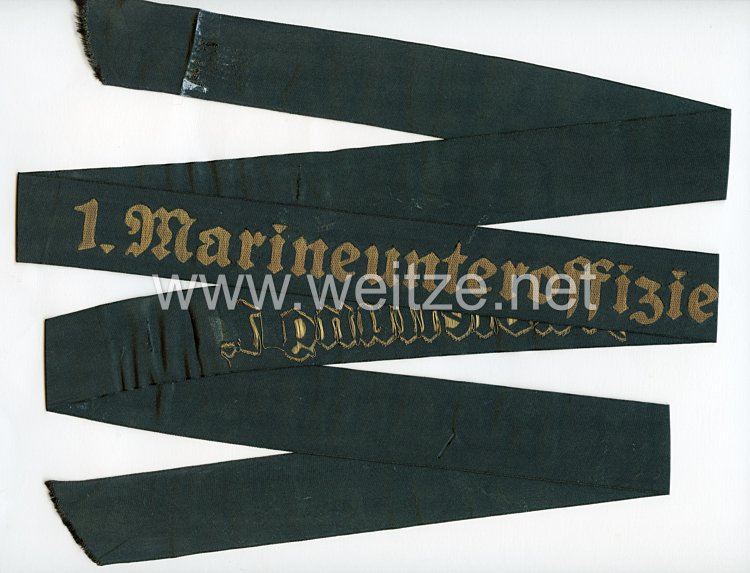
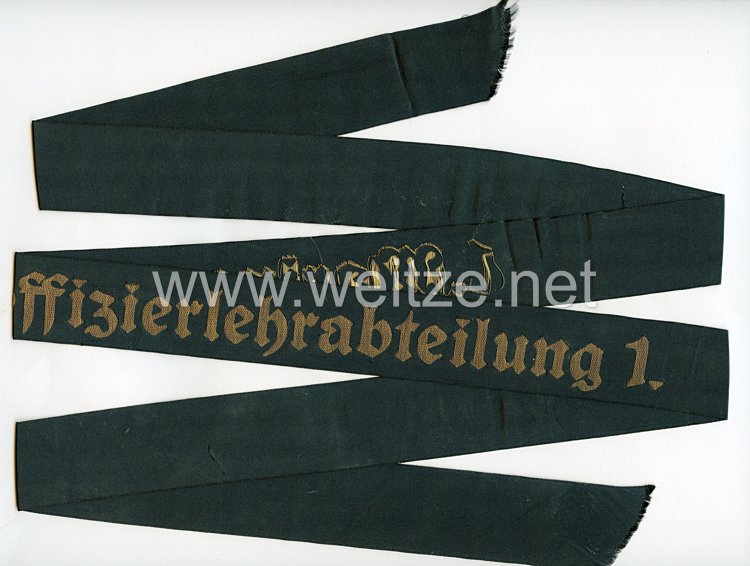
Kriegsmarine Cap Tally "1. Marineunteroffizierlehrabteilung 1."
This cap tally of the 1st Naval Petty Officer Training Division represents an important aspect of German naval history during World War II. Cap tallies were not merely functional components of naval uniforms but also served as crucial identification markers denoting affiliation to specific units, ships, or training divisions.
The Kriegsmarine, the official designation of the German Navy from 1935 to 1945, continued a detailed tradition of cap tallies that had been established in the Imperial Navy. These ribbons were worn around the sailor's cap (also known as the Tellermütze or flat cap) and typically displayed the name of the ship, unit, or training facility in gold or silver lettering.
The 1st Naval Petty Officer Training Division was a significant training establishment of the Kriegsmarine responsible for the education and training of petty officers. The petty officer corps formed the backbone of the German Navy and was essential for operational leadership at lower levels as well as technical expertise aboard warships. The training divisions played a central role in the systematic education of these important cadres.
This specimen displays the characteristic metal thread weaving, a high-quality manufacturing technique in which gold or silver metal threads were woven into the fabric. This technique gave the cap tallies their characteristic luster and durability. The production of such ribbons required specialized craftsmanship and was carried out by authorized manufacturers who had to meet the Kriegsmarine's quality standards.
The length of approximately 155 cm corresponds to typical measurements for Kriegsmarine cap tallies, which needed to be long enough to encircle the cap and hang down in two characteristic ribbons at the back. These hanging ends were a traditional feature of naval caps, dating back to maritime tradition.
Naval petty officer training during World War II was intensive and comprehensive. It encompassed both theoretical instruction in navigation, weapons technology, and naval regulations, as well as practical exercises at sea. The training divisions were located at various sites along the German coast and in occupied territories. They were hierarchically organized, with the numbering of divisions reflecting their administrative structure.
The material and workmanship of these cap tallies also reflect the economic realities of the war. While high-quality materials and careful workmanship were standard in the early war years, increasing resource shortages in later years often led to simplifications in production. Metal thread woven versions like this one were typical of the early to middle war years.
The presence of adhesive traces and slight tears on this piece indicates its authentic use. Cap tallies were frequently attached to caps and exchanged upon transfers or changes of duty station, leading to such signs of wear. For collectors and historians, such signs of authenticity are important indicators.
In the broader context of naval history, such cap tallies document the organizational structure and training system of the Kriegsmarine. They are material witnesses to the daily service practices and military culture of that era. The training divisions for petty officers were crucial for maintaining the operational capabilities of the fleet, particularly given the heavy losses suffered by the Kriegsmarine throughout the war.
Today, such cap tallies are important military historical objects preserved in museums, archives, and private collections. They serve as research objects for the study of naval history, uniform studies, and the material culture of World War II. These artifacts provide tangible connections to the individuals who served and the institutional structures that governed naval life during one of history's most significant conflicts.