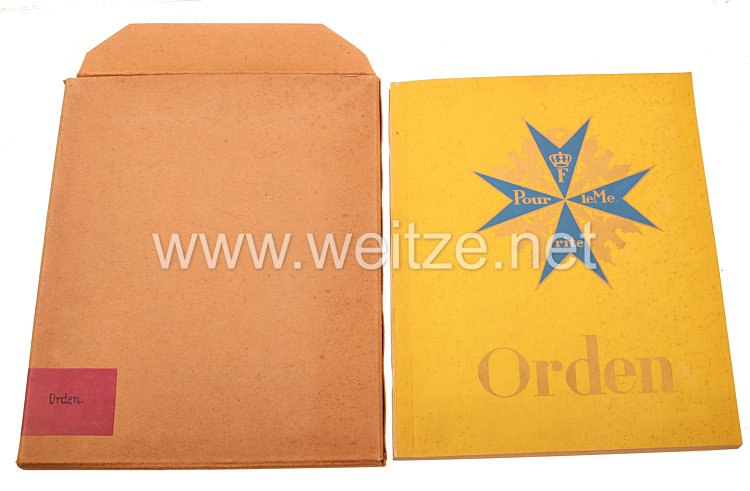
Decorations - A Collection of the Most Famous German Orders and Awards
This work represents a significant collection of German orders and decorations, systematically documenting the most important military and civil honors of German-speaking regions. Featuring 287 images, this reference work constitutes an important contribution to the study of orders and decorations (phalerstics) and provides a comprehensive overview of the rich tradition of German awards.
The history of German orders and medals dates back to the Middle Ages, when the first knightly orders were founded. The Teutonic Order, established in 1190 during the Third Crusade in Acre, was one of the most significant medieval orders of chivalry. Over the centuries, a complex system of decorations developed across the various German territories and principalities.
With the formation of the modern German state in the 19th century, the order system experienced a new golden age. The Kingdom of Prussia played a leading role in this development. The Iron Cross, instituted in 1813 by King Frederick William III during the Wars of Liberation against Napoleon, became the symbol of German military tradition. Designed by the architect Karl Friedrich Schinkel, this decoration was characterized by its distinctive black cross with silver border. The Iron Cross was awarded in various classes and was reinstituted during the wars of 1870/71, World War I, and World War II.
The Pour le Mérite, originally established in 1667 and reorganized by Frederick the Great in 1740, was Prussia's highest decoration for valor. The French designation reflected the court language of the time. After World War I, a peace class for science and arts was added in 1842, which continues to exist today.
The German Empire (1871-1918) produced a multitude of orders awarded both at the imperial level and within the federal states. Besides Prussia, Bavaria, Saxony, Württemberg, and other kingdoms maintained their own order systems. The Order of the Black Eagle, Prussia's highest order, the Bavarian Military Order of Max Joseph, or the Saxon Military Order of St. Henry were prestigious decorations of their respective states.
The Weimar Republic (1919-1933) abolished the monarchical order system but introduced the Cross of Honor of the World War in 1934, retroactively awarded to participants of World War I. The National Socialist period brought an entirely new system of decorations, including the Knight's Cross of the Iron Cross with its various grades.
Comprehensive collection works such as the one described serve several important functions. They provide scientific documentation and enable collectors, historians, and museums to definitively identify orders. Phaleristic characteristics such as materials, maker's marks, manner of wear, and award numbers are of inestimable value for historical research.
Phalerstics as the scientific study of orders and decorations developed particularly during the 19th century. Systematic catalogs and reference works became necessary to organize the abundance of different decorations. Works with extensive illustrations, such as the present one with 287 images, enable detailed comparative studies and the detection of forgeries, which were already a problem in the 19th century.
The condition of such reference works is of particular importance to collectors and scholars. Storage in a slipcase protects the hardcover binding from damage and light exposure that could affect historical photographs and prints. The quality of reproductions is essential for scholarly work.
After 1945, separate systems of decorations developed in the Federal Republic of Germany and the German Democratic Republic. The Federal Republic introduced the Order of Merit of the Federal Republic of Germany in 1957, while the GDR created its own state decorations. The traditional historical orders are today continued by various associations as heritage orders.
Such collection works are indispensable tools for museums, auction houses, and private collectors. They document not only the external appearance of orders but also convey historical knowledge about founding dates, award criteria, and historical contexts. The study of orders and decorations opens a window into the political, military, and social history of Germany spanning several centuries.