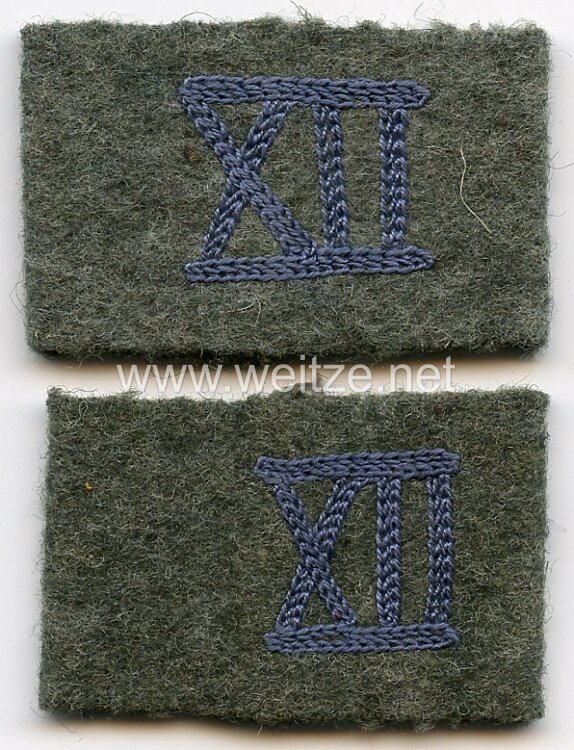
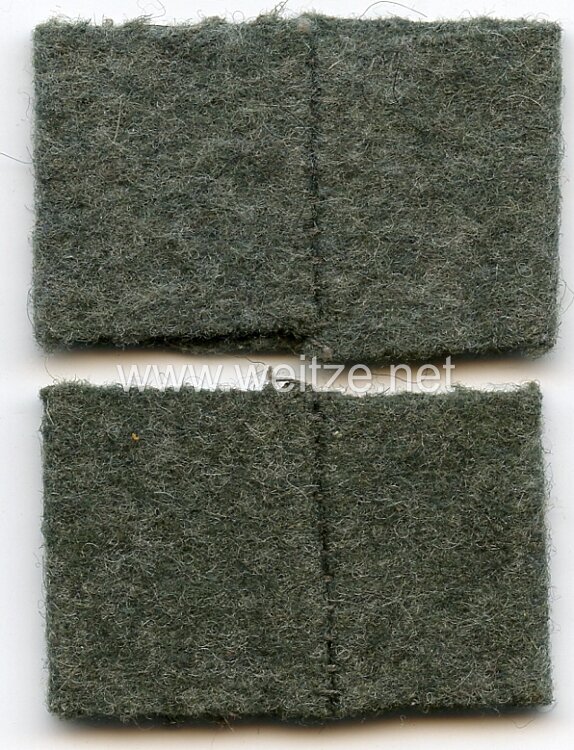
Wehrmacht Heer Pair of Slip-On Shoulder Strap Covers for Enlisted Personnel Motor Transport Troops in Military District XII
The present shoulder strap slides of the Wehrmacht Heer (German Army) represent an authentic testament to the military uniforming of the German Reich during World War II. These special slides belonged to the equipment of enlisted ranks (non-commissioned officers and enlisted men) of the Motor Transport Troops (Kraftfahrtruppe) in Military District XII (Wehrkreis XII).
The Kraftfahrtruppe (Motor Transport Troops) formed an essential component of the Wehrmacht and was responsible for motorization and transport operations. With the increasing mechanization of warfare, this branch of service gained considerable importance. The branch color of the Motor Transport Troops was pink (rosa), which is represented by the crank embroidery on these slides. This color designation was officially established by the Army Regulation of February 21, 1934 and remained valid until the end of the war.
Wehrkreis XII (Military District XII) was headquartered in Wiesbaden and geographically encompassed the areas of the Prussian Rhine Province, Hesse-Nassau, and the Palatinate. The military districts formed the territorial administrative structure of the Wehrmacht and were responsible for recruitment, training, and mobilization. Wehrkreis XII was established as early as 1935 during the rearmament period and played an important role throughout the war in providing replacement troops.
The crank embroidery (Kurbelstickerei) represents a special manufacturing technique in which the branch color was embroidered onto the field-gray background using a hand-crank machine. This method was more labor-intensive than mechanical processes but produced high-quality insignia with a characteristic structure. The use of field-gray base material corresponds to the uniform regulations for field uniforms of the Wehrmacht.
Shoulder straps and their slides served multiple purposes in the German Army system: they identified rank, branch of service, and territorial affiliation. The Roman numeral XII on these slides clearly identified affiliation with the corresponding military district. For enlisted ranks, shoulder straps were typically without braid or stars, while non-commissioned officers wore additional rank insignia.
The preservation as a pair is noteworthy, as many uniform items became separated or lost individually over time. The stated condition 2 according to the common collector's scale indicates well-preserved pieces with only minor signs of wear. Such pairs were prescribed for every soldier to attach to both shoulders of the uniform tunic.
Historically speaking, these slides represent an era when the Wehrmacht followed a strictly regulated uniform order. The Dress Regulations for the Army (Anzugsordnung für das Heer - A.O. H.) as well as the Army Service Regulation (Heeresdienstvorschrift - H.Dv.) meticulously regulated the appearance and manner of wearing all uniform components. These regulations were regularly updated and supplemented by directives.
The Motor Transport Troops themselves evolved from the motorized units of the Reichswehr and expanded considerably with the massive rearmament beginning in 1935. They included motor pools, transport columns, and workshop companies. Soldiers of this branch required special training in vehicle technology and logistics, making them indispensable specialists.
From a military-historical perspective, such uniform items document the organizational complexity of the Wehrmacht and the importance placed on marking and identification. Today they are important objects of study for research into the military history of World War II and are preserved in museums and private collections.