France - Ceremonial Saber from the Period of the 2nd Republic

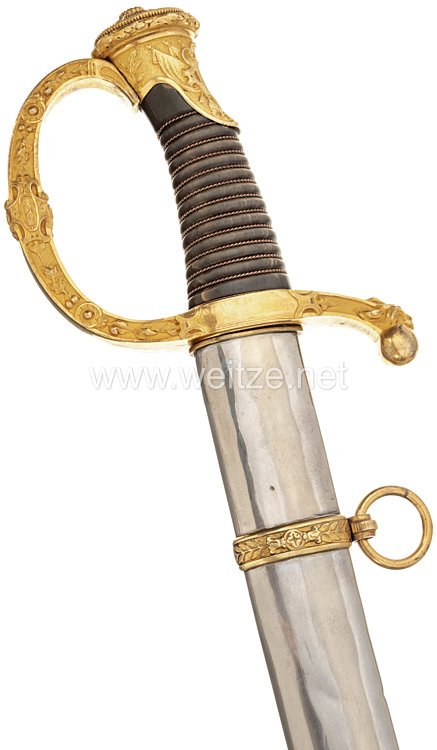
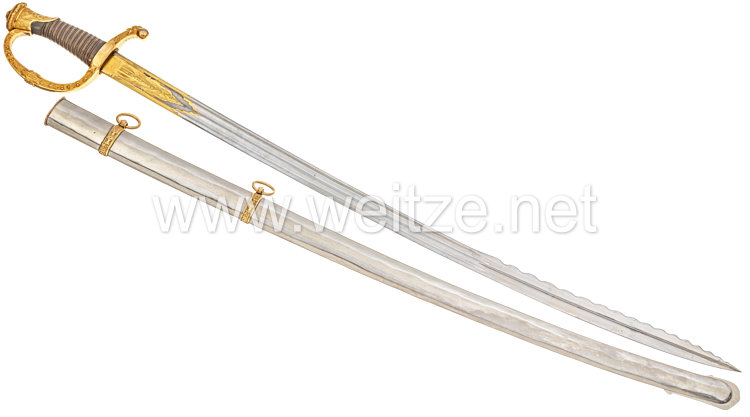
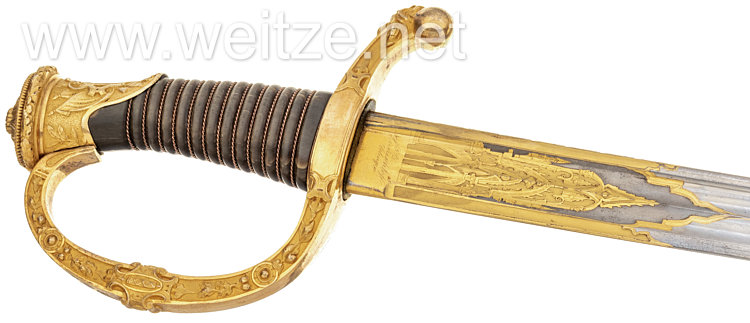
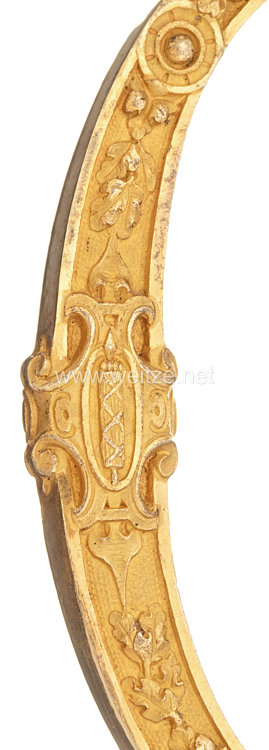
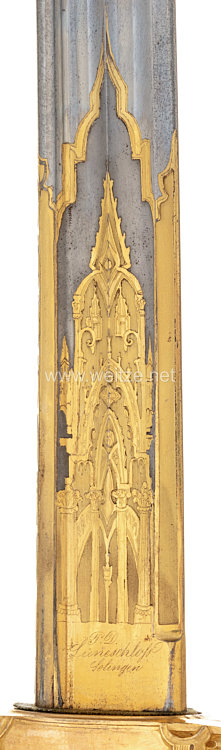
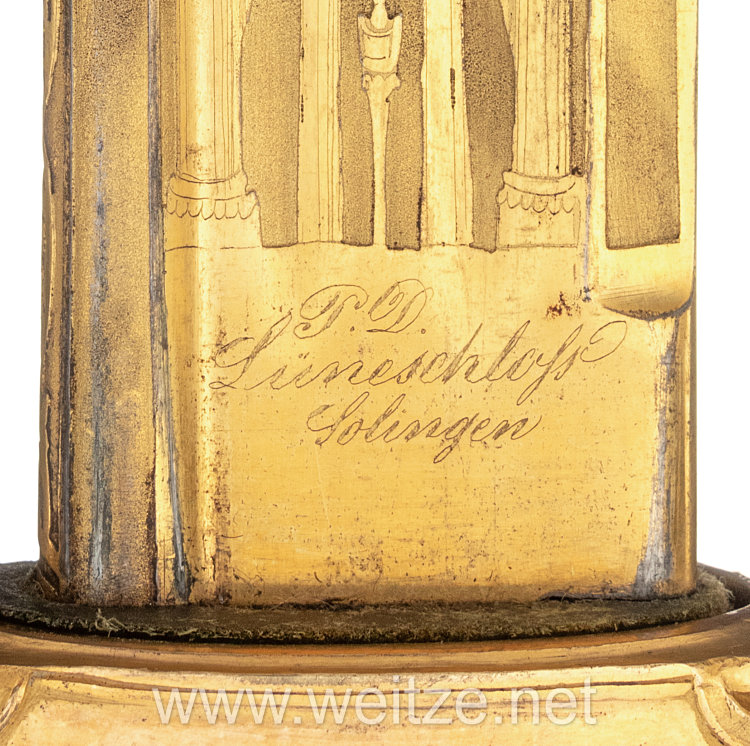
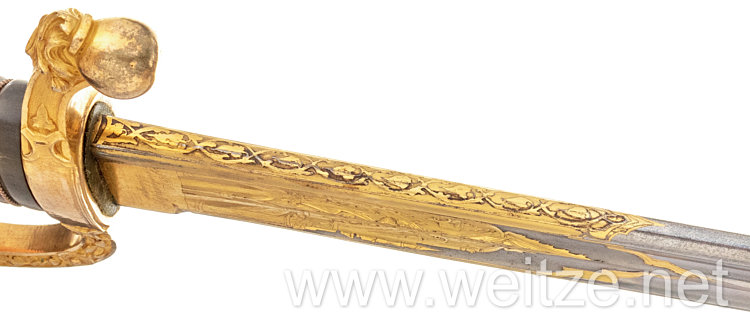
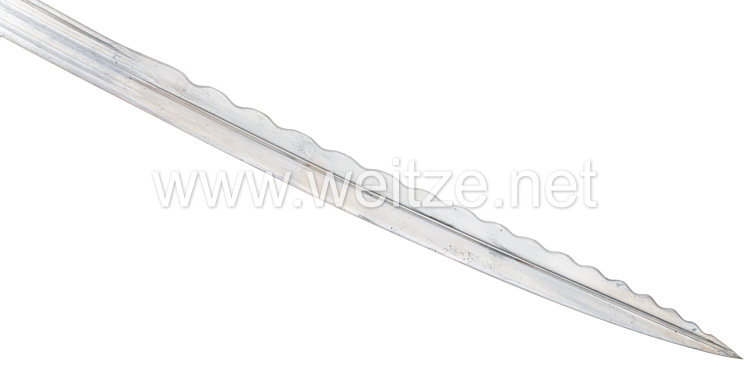
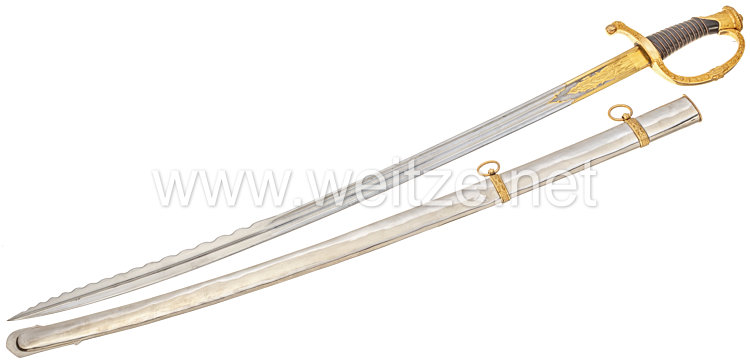
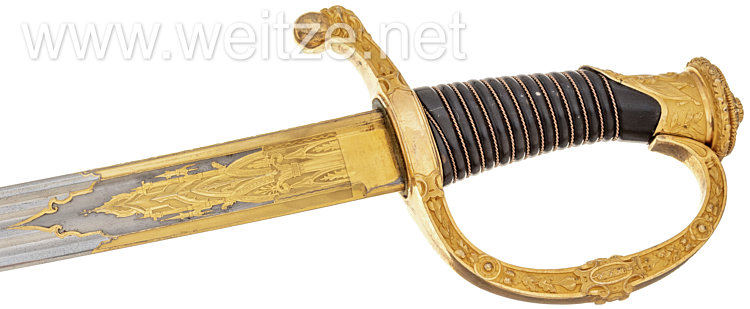
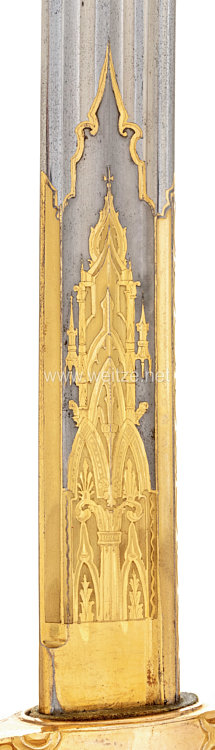
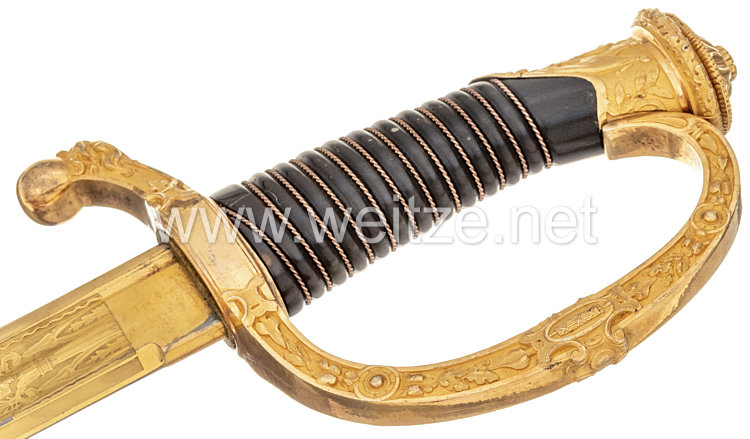
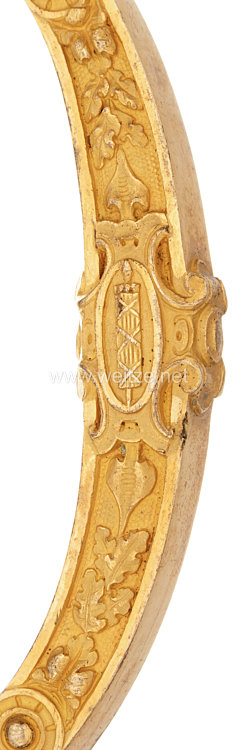
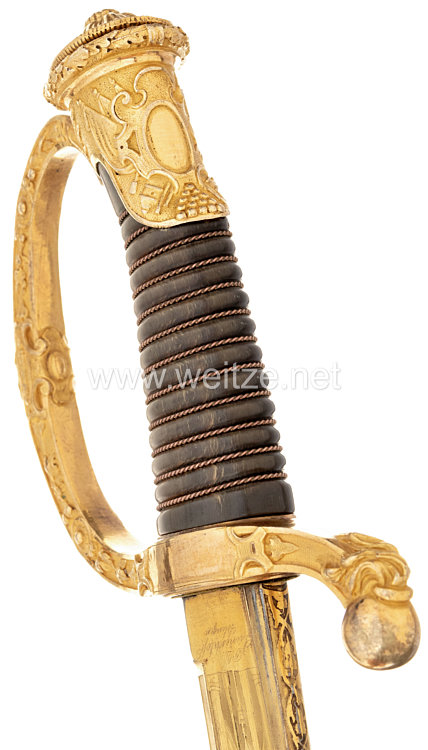
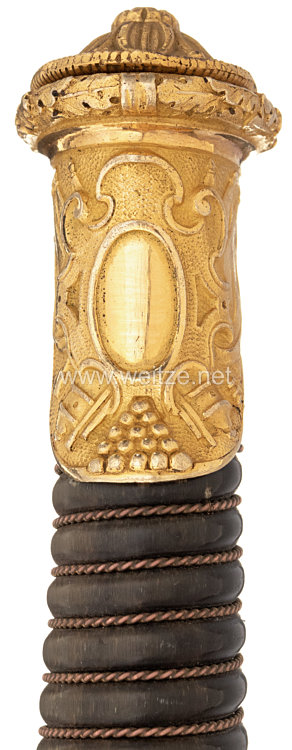
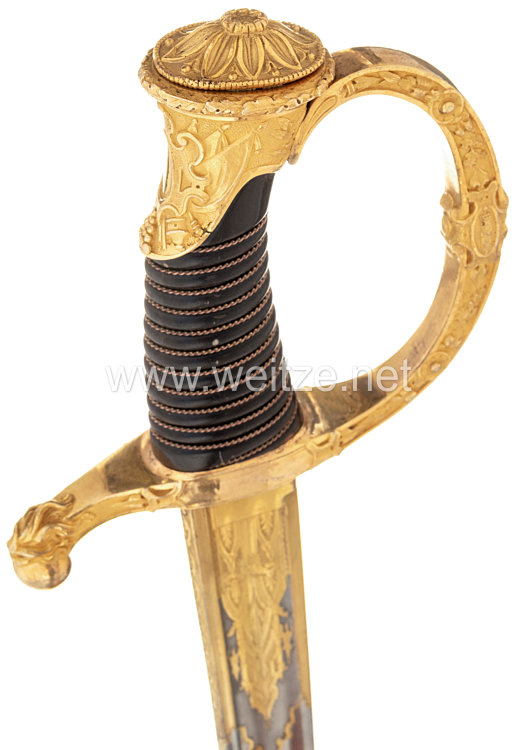
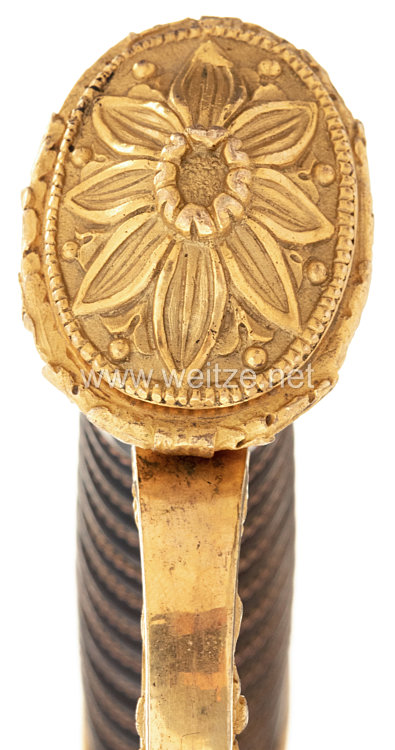
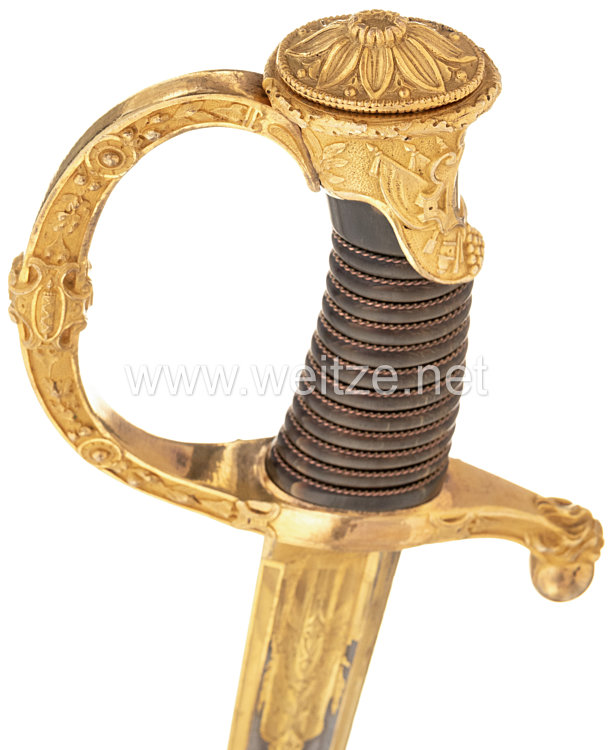
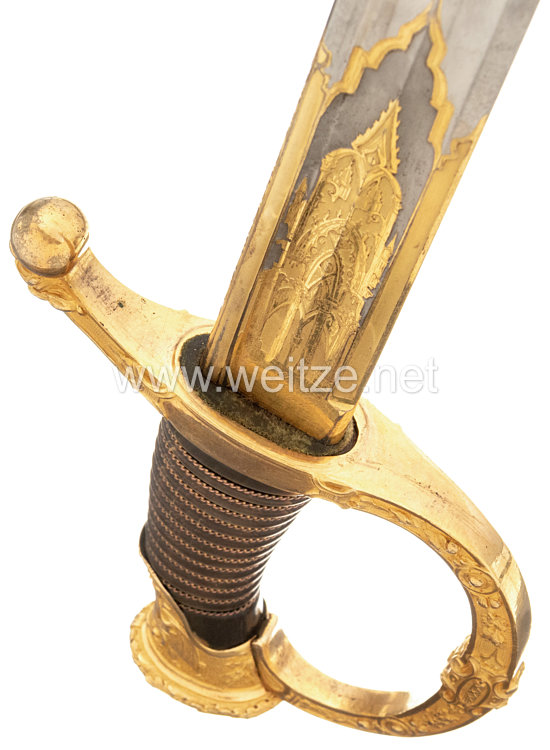
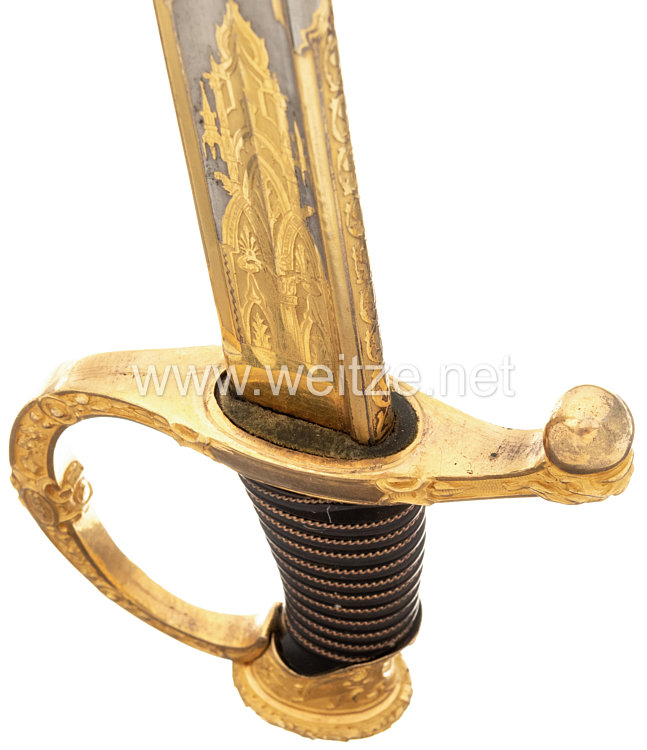
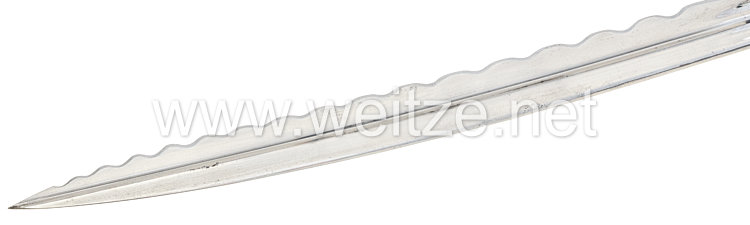
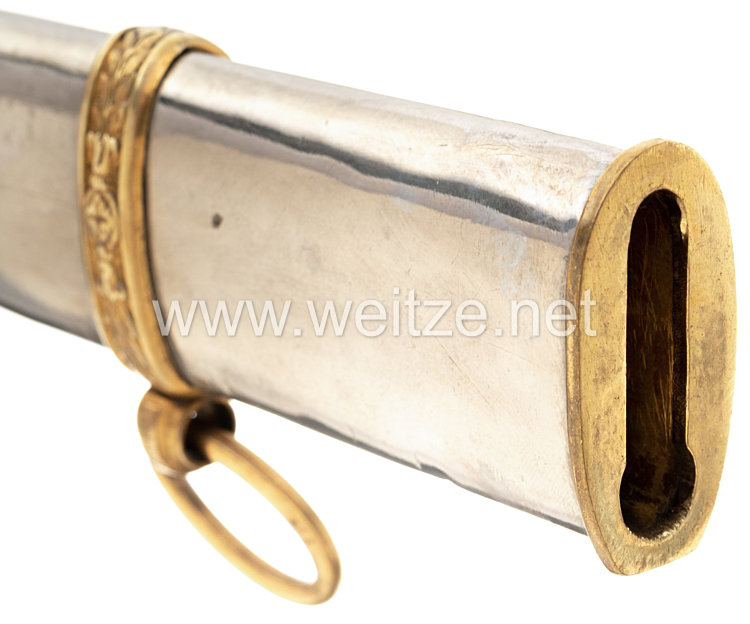
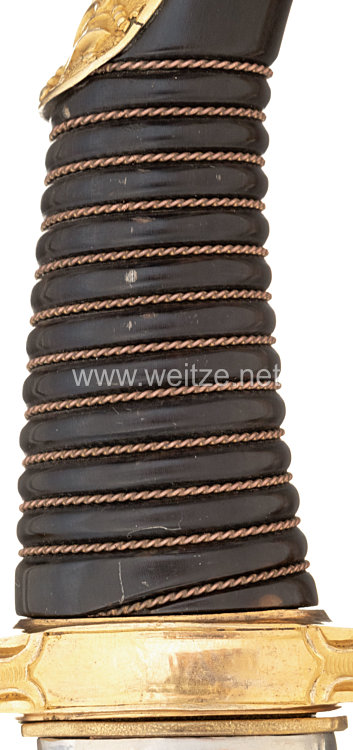
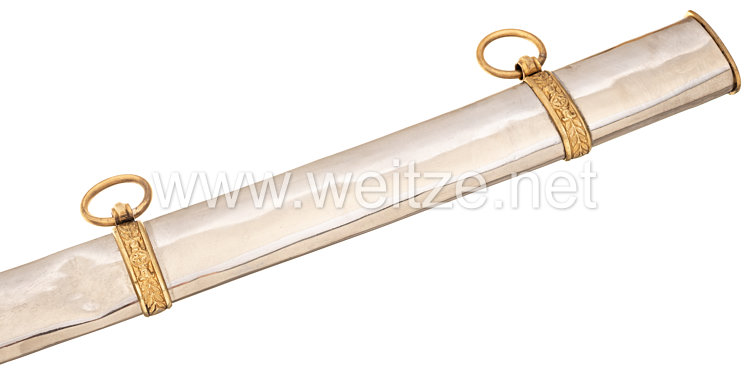
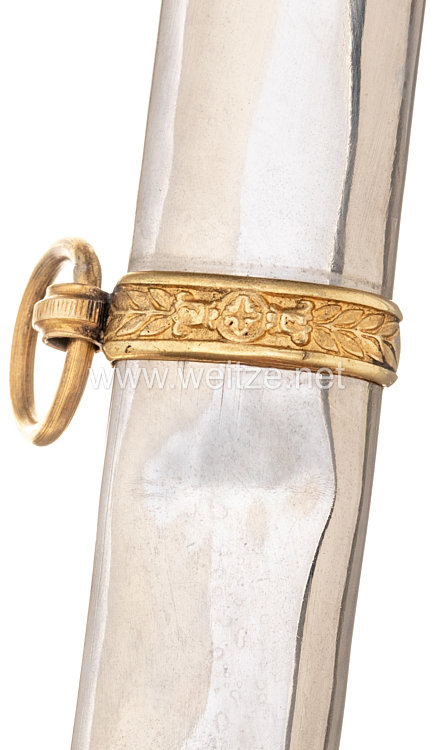
Heavy blade, 3.4 cm wide, with double fullers in the lower two-thirds of its length, the point with a ridge and flamed edge. The ricasso etched and decorated on both sides over a length of 14 cm with sacred architectural decoration, the decorations gilded, engraved on the false edge is the maker “P.D. Lüneschloß Solingen”. Gilt and hand-chased brass hilt with half-relief decorations, on both sides of the guard the representation of a “Lictor's” fasces, the quillon block terminal button formed as a flaming grenade. Horn grip with intact copper wire binding. The hilt with very slight play but originally riveted. Nickel-plated steel scabbard with gilt brass mounts. The scabbard slightly dented. Condition 2.

Overall length 103.5 cm.

This piece is a unique item. The blade was manufactured in Germany but exported to France. The hilt form resembles the “Sabre d'artillerie à cheval” model 1829 carried in France from 1829 to 1852, or the “Sabre des Officiers d'artillerie de marine” but is designed much more luxuriously. The blade form is known from French sabers dating back to the Restoration period. However, the lictor's fasces on the guard of the hilt identifies the piece as a “republican” piece. The period of manufacture and wear can thus be narrowed down to the time of the Second Republic (1848-1852).

The unusual and highly luxurious workmanship points to a high dignitary or officer as the former owner of the weapon, perhaps one of the marshals of the Second Republic.
394076
7.500,00

A Luxury Ceremonial Saber of the French Second Republic (1848–1852)

Among the finest edged weapons of the nineteenth century, this extraordinary ceremonial saber stands as a unique artifact that unites the blade-making mastery of Solingen, Germany, with the republican symbolism of France during one of its most volatile political periods — the Second Republic (1848–1852).

Historical Context: The French Second Republic

The February Revolution of 1848 toppled the July Monarchy and gave birth to the French Second Republic. This brief but profoundly significant era ended in December 1852 when Louis-Napoléon Bonaparte declared himself Emperor Napoléon III, inaugurating the Second Empire. During its short existence, the Second Republic adopted powerful symbols to embody its ideals. In September 1848, a Great Seal was introduced depicting Liberty holding a lictor’s fasces — the ancient Roman bundle of rods bound around an axe. The fasces represented the unity and strength of French citizens defending Liberty and became the emblem of the “one and indivisible” Republic.

It is precisely this symbol — the lictor’s fasces — that appears on both sides of this saber’s guard, unambiguously identifying it as a republican piece. Since this symbolism declined under the subsequent Second Empire, the saber can be dated with confidence to the narrow window of 1848 to 1852.

The Solingen Blade

The blade bears the engraved inscription “P.D. Lüneschloß Solingen” on its false edge, identifying its maker as the firm of P.D. Lüneschloss, based in Solingen — Europe’s preeminent center for blade manufacture. The company was founded in 1810 and commenced the production of edged weapons in 1848, a date that coincides precisely with the establishment of the Second Republic. P.D. Lüneschloss exported extensively to markets worldwide, and this blade was manufactured in Germany before being shipped to France, where it was fitted with a French-style hilt and scabbard bearing republican decorative motifs.

The blade itself is 3.4 cm wide, double-grooved in its lower two-thirds, with a ridged tip and wavy edge (flammée). At the blade root, both sides are etched over a length of 14 cm with gilded sacred architectural decoration. The blade form itself was already known from French sabers of the Restoration period, lending this weapon a sense of continuity with earlier French military traditions.

The Hilt and Its Symbolism

The gilded brass hilt is hand-chiseled with semi-relief decorations of remarkable quality. Two symbolic elements are of particular significance. First, the lictor’s fasces on both sides of the guard, which, as discussed, anchors this weapon firmly to the Second Republic. Second, the pommel knob is formed as a flaming grenade — a traditional artillery symbol with roots in the seventeenth-century grenadier tradition that was later adopted by both infantry and artillery branches. This motif suggests a connection to the artillery arm of the French military.

The horn grip retains its intact copper wire wrapping, and the hilt remains originally riveted to the blade — a detail that confirms the authentic assembly of this piece. The nickel-plated steel scabbard with gilded brass fittings completes the ensemble.

Classification and Military Context

In its hilt form, this saber closely resembles the French Sabre d’artillerie à cheval modèle 1829, which was carried by mounted artillery troops from 1829 to 1852, as well as the Sabre des Officiers d’artillerie de marine. However, the present example is far more luxurious than any regulation piece. The standard modèle 1829 was adopted in October 1829 for mounted artillery. Officer versions were not regulation weapons but rather privately commissioned purchases. Approximately 75,000 troop sabers of the modèle 1829 were produced at the Châtellerault manufactory — but this unique piece stands entirely apart from that standard production.

Following the end of the Second Republic, officers returned to the modèle 1822 cavalry saber from 1856 onward, while the standard troop model was phased out after the Franco-Prussian War (1870–1871).

A Unique Piece of Republican Heritage

This saber is classified as a unique piece (Unikat) — a one-of-a-kind privately purchased luxury weapon. Its exceptional quality of craftsmanship, combining gilded and chiseled metalwork with fine etching and precious materials, indicates that its original owner was a high-ranking officer or dignitary of the Second Republic. The total length of 103.5 cm and the lavish decoration throughout — from blade root to scabbard fittings — confirm its ceremonial rather than purely functional character.

For collectors of French military edged weapons, this saber represents a convergence of extraordinary rarity: a Solingen blade from the very first year of P.D. Lüneschloss’s edged weapon production, republican fasces symbolism datable to a mere four-year window, and a level of luxury craftsmanship that elevates it far above standard military issue. It is a tangible artifact of the brief, tumultuous French Second Republic — a period that reshaped French politics and whose symbols, embodied in metal and gold, survive in this remarkable weapon.

r