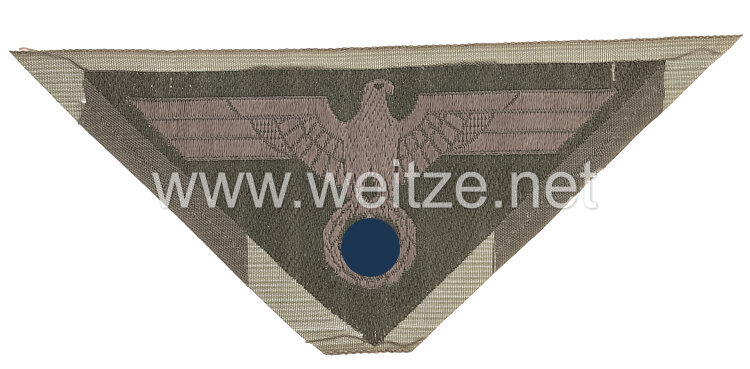
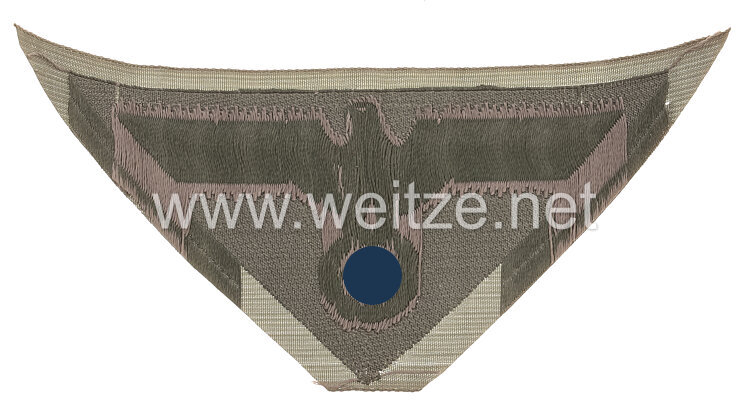
Wehrmacht Heer Breast Eagle for Enlisted Men
Condition may vary.
Price per piece: 75 Euro.
The Wehrmacht Heer Brustadler für Mannschaften (Army Breast Eagle for Enlisted Men) represents a characteristic insignia of the German armed forces during World War II. This specific example in Bevo-woven execution was manufactured for the Feldbluse M 44 (Field Tunic Model 1944) and represents the late wartime production of the Wehrmacht between 1944 and 1945.
The development of breast eagles for the Wehrmacht began with the reorganization of the German armed forces in the 1930s. Following the seizure of power in 1933 and the official reintroduction of universal conscription in 1935, new uniform regulations were issued. The Hoheitsadler (National Eagle), depicting the National Socialist symbol of an eagle with swastika, became the central identifying mark on all Wehrmacht uniforms.
The Bevo weaving technique owes its name to the Barmer Bandweberei Ewald Vorsteher, a leading German textile factory that perfected this special weaving process. This technique enabled the machine production of detailed insignia in large quantities. Bevo-woven eagles were characterized by their durability and relatively inexpensive production, making them particularly suitable for mass equipment of enlisted personnel.
The Feldbluse M 44 represents the last major uniform reform of the Wehrmacht during the war. Faced with increasing shortages of materials and labor, as well as rising casualties on all fronts, a simplified uniform was developed. The M 44 eliminated many details of earlier models: the number of pockets was reduced, the cut simplified, and the workmanship less elaborate. Its introduction was ordered through the Heeres-Verordnungsblatt (Army Regulations Gazette) in 1944.
The breast eagle for enlisted men was worn on the right chest of the field tunic, approximately at the level of the first or second button row. The position was precisely specified in the dress regulations. Unlike eagles for officers, which were often embroidered in higher-quality materials such as aluminum or silver thread, ordinary soldiers received these woven versions.
The manufacture of such insignia was carried out by various suppliers throughout the German Reich. Besides Bevo, companies such as RUM (Richard Underberg Magdeburg), BeVo Wuppertal, and other textile manufacturers were involved in production. Quality could vary depending on the manufacturer and production period. Toward the end of the war, the quality of many uniform components deteriorated noticeably due to material shortages.
The coloring of breast eagles for the Army was typically gray-green on field-gray background, corresponding to the general coloring of Army uniforms. This differed from the eagles of the Luftwaffe (blue-gray) or the Waffen-SS (various versions). The weaving technique allowed precise representation of the eagle with spread wings, holding a swastika in an oak wreath.
For collectors and historians, such unworn examples are of particular interest because they show the original condition without wear from use and field service. They allow precise examination of manufacturing technique, material quality, and coloring. The classification as Condition 2 indicates, according to common collector nomenclature, a very good, nearly mint condition.
The historical significance of these objects lies in their function as mass products of a military organization. They document not only uniform-technical aspects but also industrial manufacturing, resource allocation, and the organizational structures of the Wehrmacht. For military historical research, they provide insights into the everyday equipment of ordinary soldiers who constituted the majority of the Wehrmacht.
After the war ended in 1945, wearing all National Socialist symbols was prohibited. Many uniform items were destroyed, reworked, or confiscated by the occupying powers. Surviving examples entered private ownership as war souvenirs or later became collectors' items. Today they serve in museums and collections as historical witnesses of a past era and are preserved in the context of military historical research and documentation.
The study of such insignia contributes to understanding the material culture of World War II, the organization of military forces, and the industrial capacity of wartime Germany. They represent tangible connections to the experiences of millions of soldiers and the historical reality of the conflict that shaped the twentieth century.