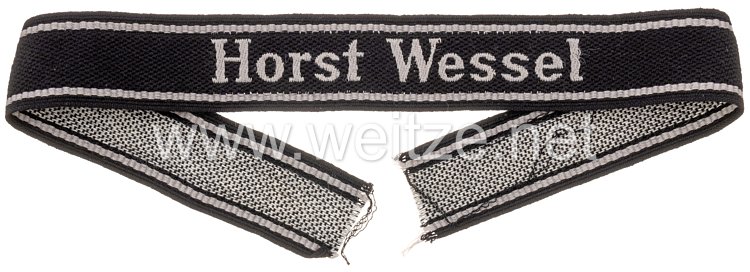
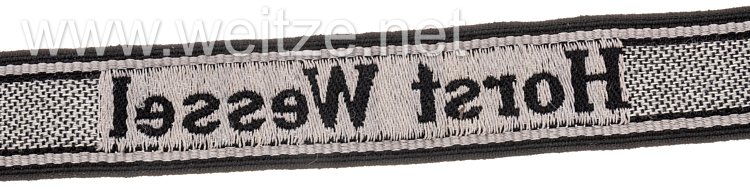
Waffen-SS Cuff Title for Enlisted Men of the 18th SS-Freiwilligen-Panzergrenadier-Division “Horst Wessel”

BeVo-style woven execution. Unworn, full length 47 cm. Unworn, condition 2.
422175
1.650,00

Waffen-SS Cuff Title for Enlisted Men of the 18th SS-Freiwilligen-Panzergrenadier-Division “Horst Wessel”

The cuff title of the 18th SS-Freiwilligen-Panzergrenadier-Division “Horst Wessel” represents a significant artifact in the study of Waffen-SS uniforms during the Second World War. This division, named after the National Socialist propaganda martyr Horst Wessel, was officially established in January 1944 and belonged to the later formations of the Waffen-SS.

The 18th SS Division originated from SS-Panzergrenadier-Regiment 1, which had previously served with the 1st SS Panzer Division “Leibstandarte SS Adolf Hitler.” The renaming and expansion into an independent division occurred as part of the massive expansion of the Waffen-SS during the later war years. The division fought primarily on the Eastern Front, particularly in Hungary and later in Czechoslovakia until the end of the war in 1945.

This cuff title was manufactured using Bevo-style weaving technique. The BeVo company (Bandfabrik Ewald Vorsteher) from Wuppertal was the most renowned manufacturer of woven insignia for the Wehrmacht and SS. The designation “Bevo-like” indicates that this is a product manufactured using similar machine-weaving technology, possibly by one of numerous subcontractors. This manufacturing method enabled precise, detailed representation of lettering and was superior to cheaper hand-embroidered or machine-embroidered variants.

Cuff titles were worn by the Waffen-SS on the lower left sleeve to identify divisional affiliation. The introduction of this tradition dates back to the early SS formations and was systematically expanded during the war. For enlisted men and non-commissioned officers, cuff titles were executed in black base color with silver or aluminum-colored lettering, while officers often wore variants with hand-embroidered details.

The length of 47 cm corresponds to the standardized version for enlisted ranks. This length allowed the cuff title to be completely wrapped around the upper arm and attached to the field tunic. The unworn condition of this specimen is remarkable, as most original cuff titles were either worn in combat or destroyed after the war's end.

The historical significance of such uniform items lies in their function as identification markers and instruments of unit cohesion. The SS placed great emphasis on the symbolism and uniforming of its formations, with cuff titles playing a central role in the visual hierarchy. The name “Horst Wessel” on the cuff title refers to the intensive ideological penetration of the Waffen-SS, which also manifested itself in the naming of its divisions.

From a collector's and museum perspective, originally preserved cuff titles are important study objects for uniform history and material research. The weaving technique, materials used, and manufacturing variants provide insight into the industrial production of uniform components in the Third Reich. At the same time, they serve as material evidence of a criminal organization whose acts and crimes must be historically documented and processed.

The “Horst Wessel” Division itself was recruited primarily from Hungarian Volksdeutsche and other foreign volunteers, which is expressed by the designation “Freiwilligen” (volunteer) in the division's name. The combat effectiveness of the division was variously assessed, and it suffered considerable losses in the final months of the war during Soviet offensives in Eastern Europe.

Today, such objects are found in military history collections and museums, where they are presented in the context of critical engagement with National Socialist history. The scientific and educational value lies in the possibility of documenting and analyzing the organization, structure, and appearance of the Waffen-SS through concrete material remains.