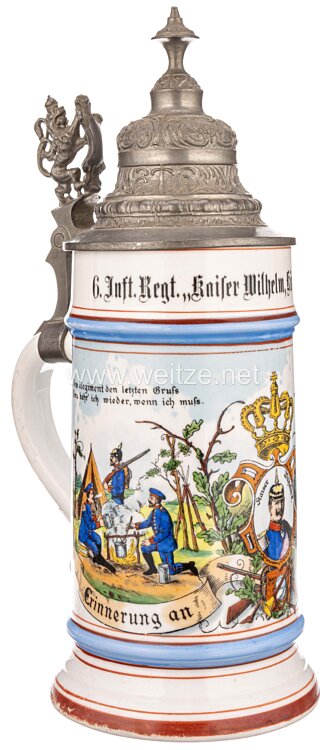
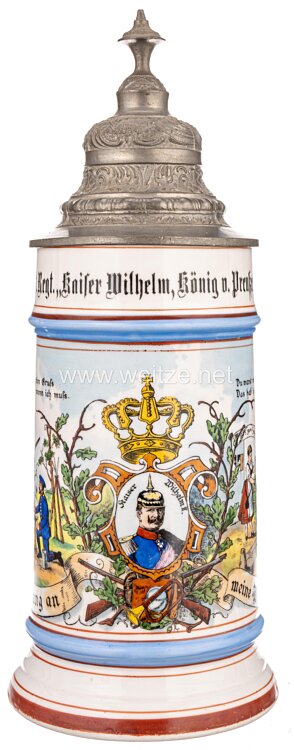
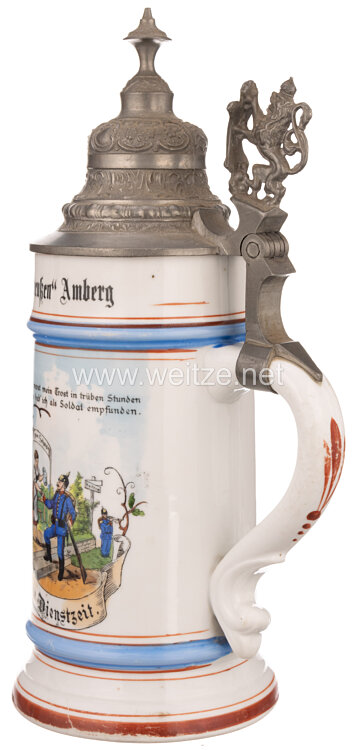
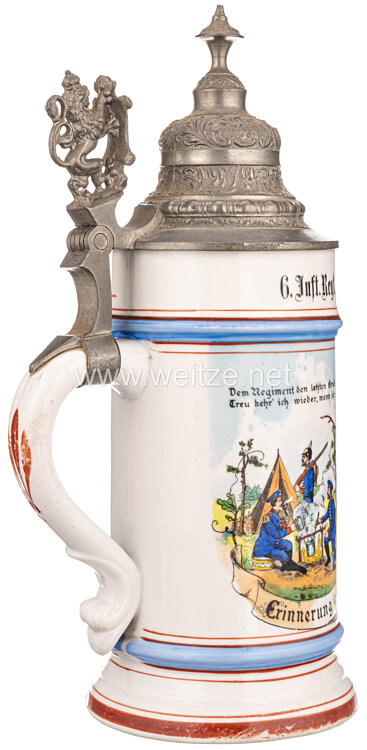
Bavarian Reservist Stein for a Reservist of the 6th Infantry Regiment Kaiser Wilhelm, King of Prussia
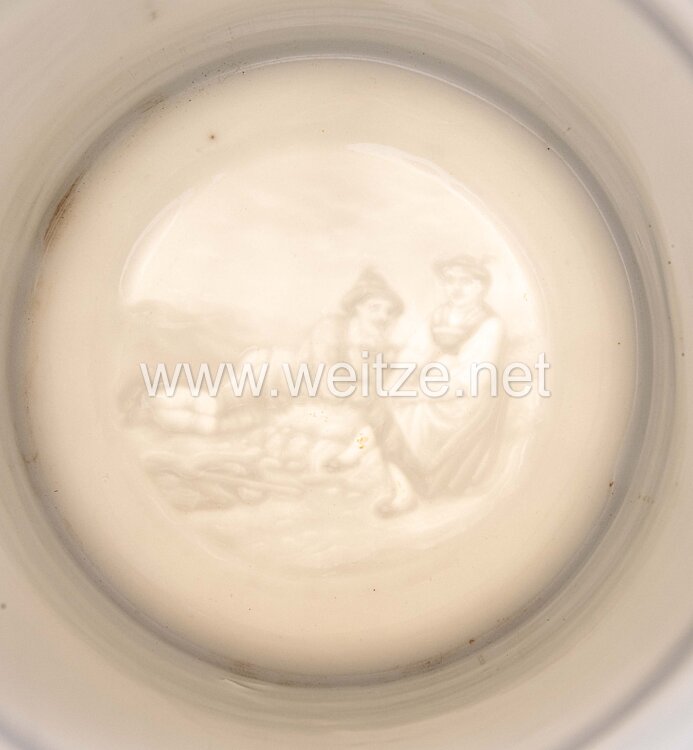
This Bavarian Reservist's Stein represents a significant tradition of German military culture at the turn of the 20th century. This 0.5-liter porcelain stein with colored decorations, bottom image, and pewter lid was made for a reservist of the 6th Infantry Regiment “Kaiser Wilhelm, King of Prussia”, which was garrisoned in Amberg.
The 6th Infantry Regiment belonged to the Royal Bavarian Army and bore the honorary name of the German Emperor and Prussian King Wilhelm II, symbolizing the close connection between the Kingdoms of Bavaria and Prussia within the German Empire. This naming practice was not uncommon, as after the founding of the Reich in 1871, many Bavarian regiments received Prussian traditions and honorary names, while Bavaria nevertheless maintained its independent army organization.
Amberg, the garrison town in the Upper Palatinate, had a long military tradition. The city was strategically located and housed significant military installations. The 6th Infantry Regiment was deeply rooted in the region and recruited its troops mainly from the Upper Palatinate and adjacent areas.
The tradition of reservist steins developed in the second half of the 19th century into an integral part of German military culture. After completing their active service, which typically lasted two to three years, soldiers received their discharge and entered the reserves. This transition was celebrated as a significant event, and many reservists commissioned personalized steins to commemorate their service.
The production of such steins had become a flourishing business by 1900. Specialized manufacturers in various German regions, particularly in Thuringia and Bavaria, produced these memorabilia. The steins were typically made from high-quality porcelain and decorated with elaborate, colored lithographs. The pewter lid with its characteristic thumb lift was not only decorative but also functional – it kept the beer fresh and protected it from contamination.
The decoration of such reservist steins followed established patterns: they typically displayed military scenes such as parades, maneuvers, or barracks life, regimental coats of arms, portraits of the monarch, and patriotic symbols. Personal information such as the reservist's name, service period, and garrison location was often included. The bottom image, a special feature of many high-quality steins, often showed humorous or sentimental motifs that became visible only when the stein was emptied.
These steins were more than mere drinking vessels – they were status symbols and expressions of pride in fulfilled military duty. At a time when military service was considered an honorable civic duty and enjoyed high social recognition, these steins documented membership in the military community. They were prominently displayed in households, often in special display cases or on wall shelves.
The period around 1900 was characterized by strong militarism in the German Empire. Kaiser Wilhelm II actively promoted the veneration of the military, and the army enjoyed high esteem in all social classes. Veterans and reservists organized themselves into veterans' associations that held regular meetings where such steins were naturally used.
The Bavarian Army maintained its independence within the German armed forces until the end of World War I. It had its own uniforms, rank insignia, and traditions that differed from the Prussian Army. This is also reflected in the design of Bavarian reservist steins, which often featured Bavarian lozenge patterns, the Bavarian state coat of arms, or regionally specific motifs.
The craftsmanship quality of these steins varied considerably, depending on the reservist's budget. While simpler models with standardized decorations were available, wealthier veterans could commission elaborately designed, individualized pieces. The present stein with its colored design and bottom image indicates a piece of medium to high quality.
After the end of World War I and the collapse of the monarchy, the tradition of reservist steins lost significance. The Weimar Republic and later the Federal Republic of Germany developed a different relationship with the military. Today, these steins are sought-after collectibles that are of interest not only from a military-historical perspective but also from an art and cultural-historical standpoint. They document a bygone era, its social values, and the central role that the military played in the German Empire.