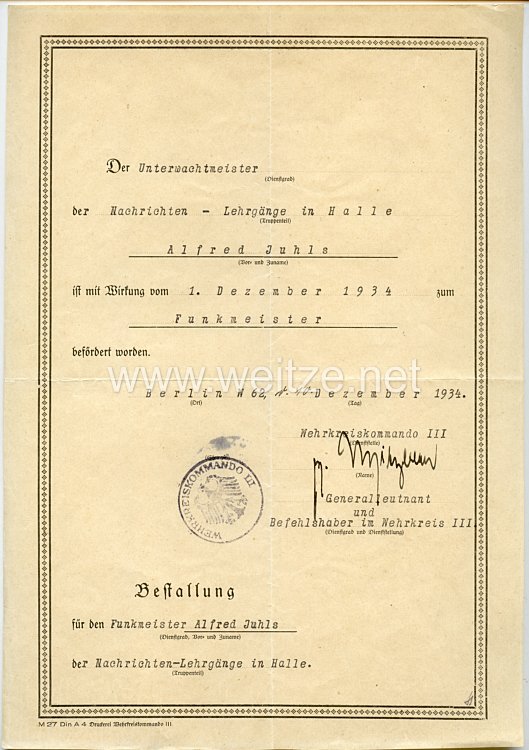
July 20, 1944 Assassination Attempt - Original Signature of Later Knight's Cross Recipient Generalleutnant Erwin von Witzleben

on an appointment certificate for an Unterwachtmeister to Funkmeister of the Nachrichten-Lehrgänge in Halle, issued in Berlin on December 10, 1934 with a very fine ink signature “v. Witzleben” as Commander of Wehrkreis III; folded twice, used condition.
In 1944, Erwin von Witzleben was designated for a key position in the coup d'état plans of the conspiracy group around Claus Schenk Graf von Stauffenberg. He was sentenced to death on August 8, 1944. On the day of the verdict, Erwin von Witzleben was executed by hanging at the Strafgefängnis Berlin-Plötzensee on Hitler's express order, instead of by firing squad as was customary for military personnel.
397675
350,00

July 20, 1944 Assassination Attempt - Original Signature of Later Knight's Cross Recipient Generalleutnant Erwin von Witzleben

This appointment certificate from 1934 bears the original signature of future Field Marshal Erwin von Witzleben, one of the central figures in the failed July 20, 1944 assassination attempt on Adolf Hitler. The document was issued on December 10, 1934, in Berlin and promoted a junior non-commissioned officer to radio operator master of the signals training courses in Halle. At this time, von Witzleben served as Commander of Military District III, which encompassed Berlin and Brandenburg.

Erwin von Witzleben (1881-1944) came from an old Prussian military family and pursued a classical military career through the Imperial and Weimar Republic eras. After the Nazi seizure of power in 1933, he rose to the highest military positions but remained increasingly critical of the regime. As early as 1938, he was involved in the September Conspiracy, an early coup plot against Hitler that was not executed due to the Munich Agreement.

As commander of the 1st Army during the Western Campaign of 1940, von Witzleben earned military distinction that brought him the Knight's Cross of the Iron Cross. He was promoted to Field Marshal in 1940. Despite these honors, his relationship with Hitler deteriorated progressively, leading to his forced retirement in 1942 – officially for health reasons.

The historical significance of such appointment certificates lies in their function as official commissioning documents within the military hierarchy. They documented the promotion and transfer of non-commissioned officers and enlisted men to special functions. The signals troops, to which radio operator masters belonged, were essential for modern warfare. The training courses in Halle formed the backbone of the Wehrmacht's technical communications training.

Von Witzleben's signature on this document from 1934 dates from a period of relative stability in his career, years before he would decisively turn to resistance against Hitler. Such signatures on routine documents were part of the daily administrative duties of a military district commander and were placed on numerous appointments and transfers.

Von Witzleben's evolution from loyal officer to resistance fighter reflects the inner conflicts of many Wehrmacht officers. In the planning for July 20, 1944, he was designated to serve as Commander-in-Chief of the Wehrmacht in the event of a successful coup. This central position was meant to ensure military control after Hitler's planned assassination.

After the plot's failure, von Witzleben was arrested on July 21, 1944. Before the infamous People's Court under Roland Freisler, he stood trial on August 7 and 8, 1944, in the first major show trial against the conspirators. The proceedings were marked by deliberate humiliation – the defendants had their belts removed so they had to constantly hold up their trousers, which enhanced the propagandistic staging.

The death sentence was pronounced on August 8, 1944, and von Witzleben was executed the same day at Berlin-Plötzensee Prison. On Hitler's explicit orders, the execution was carried out by hanging, not by firing squad as would have been customary for military personnel. This method was intended to further dishonor the conspirators and serve as a deterrent example.

Documents bearing von Witzleben's signature hold special historical value today. They connect the routine administration of the Wehrmacht with the fate of a man who sacrificed his life in resistance to the Nazi dictatorship. The double folding and used condition of this certificate attest to its authentic use during the 1930s. Such original signatures on contemporary documents are important testimonies to German military history and resistance against National Socialism.

The signals training courses in Halle referenced in the document were part of the systematic expansion of the Wehrmacht after 1933. The training of radio operator masters was of strategic importance given the increasing mechanization of warfare and was subject to strict military standards.

r