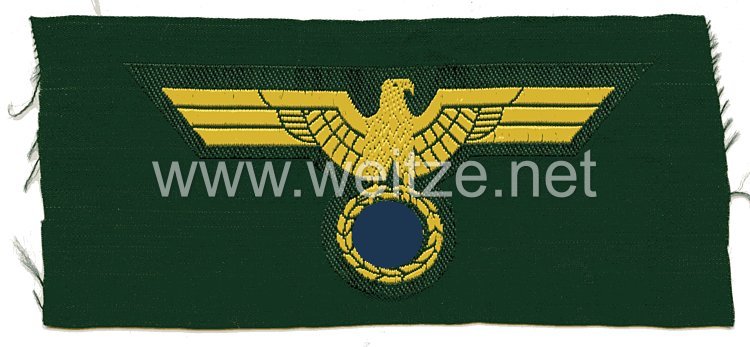
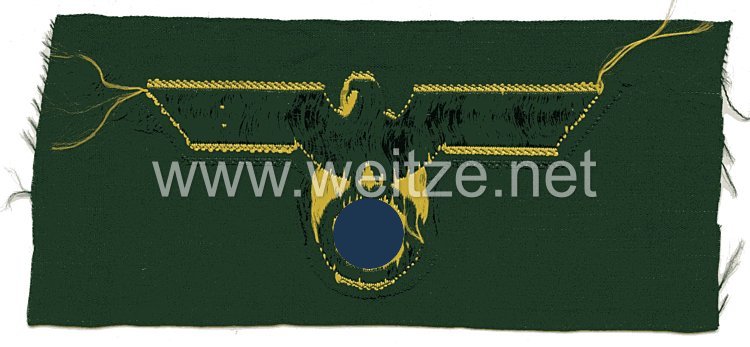
Kriegsmarine Breast Eagle for Enlisted Men Coastal Artillery - Land Units
The Kriegsmarine Breast Eagle for Enlisted Personnel of Coastal Artillery represents a significant example of the uniform insignia of the German Navy during World War II. This special version was worn by members of the land-based units of the coastal artillery and differs through characteristic features from the standard insignia of ship crews.
The Coastal Artillery of the Kriegsmarine formed an essential component of German coastal defense between 1935 and 1945. These units were responsible for protecting harbors, naval bases, and strategically important coastal sections. Unlike crews aboard ships, members of the coastal artillery wore uniforms designed for land service that differed in color and execution from standard naval clothing.
The present specimen shows the characteristic BeVo weaving technique, an abbreviation for Bandfabrik Ewald Vorsteher from Wuppertal-Barmen. This company was one of the main suppliers of woven insignia for the Wehrmacht and developed a highly specialized process for the mechanical production of hollow-woven badges. The BeVo technique enabled the production of detailed, durable insignia in large quantities, which was essential for the mass supply of the armed forces.
The green base color of this breast eagle is the decisive distinguishing feature. While naval personnel aboard ships wore their insignia on a dark blue background, the land-based units of the coastal artillery used a green or field-gray background. This coloring was oriented toward the uniform of the land forces and was intended to improve camouflage during land operations. The green color also symbolized affiliation with land-based units, while the retention of Kriegsmarine insignia clarified the organizational assignment to the Navy.
The national eagle itself displays the standardized design of the Kriegsmarine: a rightward-facing eagle with outstretched wings, holding a swastika in its talons. This symbol was worn on the right breast above the pocket according to the Dress Regulations for the Kriegsmarine. For enlisted ranks, the badge was sewn directly onto the uniform fabric, while officers often wore embroidered variants of higher quality.
The introduction of standardized insignia occurred as part of the reorganization of the German armed forces after 1935. With the Law for the Reconstruction of the Wehrmacht of March 16, 1935, official rearmament was initiated, and the Kriegsmarine received its own uniform regulations and insignia. The coastal artillery was organized as an independent branch within the Kriegsmarine and received specific uniform regulations.
During the war, the importance of the coastal artillery increased significantly. Especially after the beginning of Allied bombing raids and the increasing threat of landing operations, the expansion of coastal defense was intensified. This led to an increased need for corresponding uniform insignia. The Atlantic Wall defense, for example, tied up tens of thousands of soldiers of the naval coastal artillery, all of whom had to be appropriately marked.
The BeVo weaving technique proved particularly practical in this regard. Unlike hand-embroidered badges, woven specimens could be produced quickly and cost-effectively in large quantities. The quality was nevertheless high, with clear details and good durability. The weaving technique made it possible to create complex patterns with different colors, with the threads woven directly into the backing material.
After 1945, all insignia with National Socialist symbols were banned in Germany. Original Kriegsmarine insignia are today historical documents preserved in museums and collections. They serve the scientific study of military history and uniformology. The condition of such objects is usually evaluated according to a scale from 1 (mint) to 5 (heavily damaged), with Condition 2 designating a well-preserved specimen with minor signs of use.
For historical research, such insignia are important sources for understanding the organization, hierarchy, and identity of military units. They document the material culture of World War II and demonstrate the importance of symbolism and uniforming for the military apparatus of the Nazi regime.