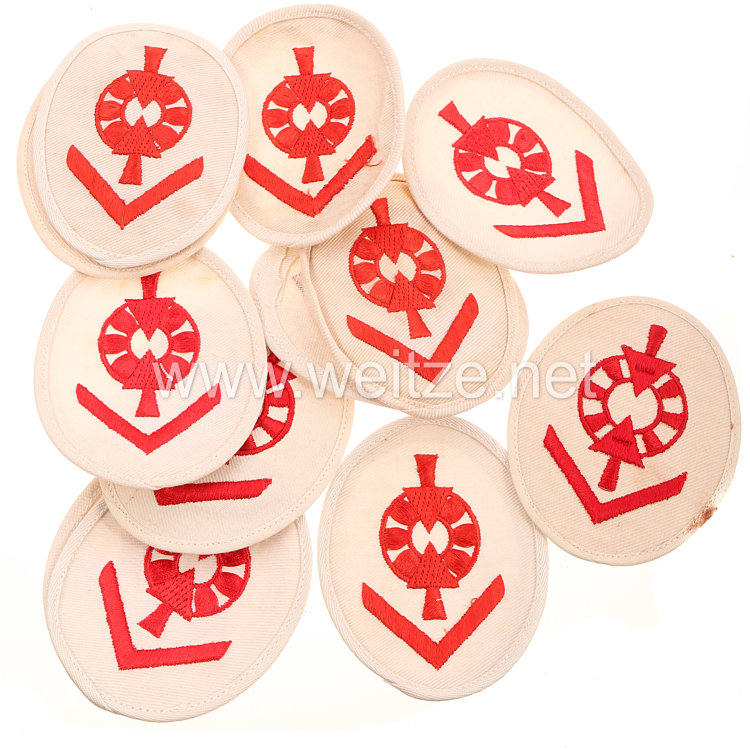
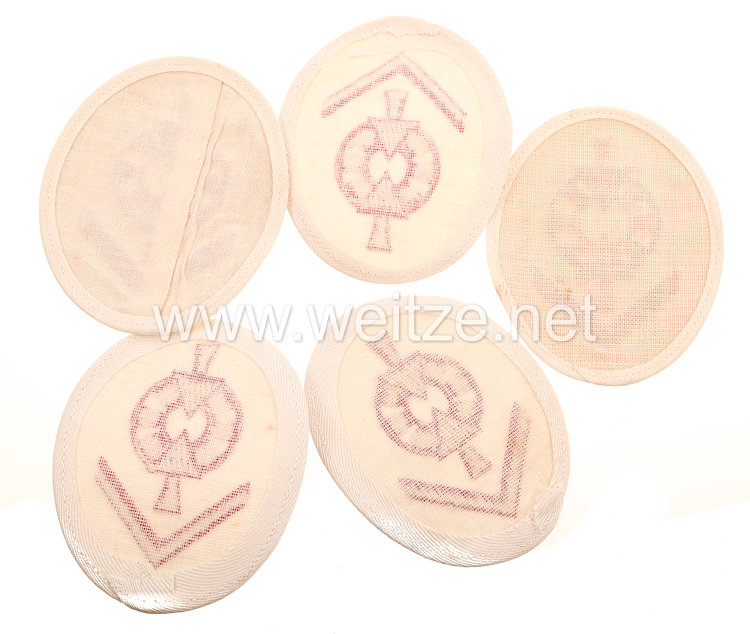
Kriegsmarine Sleeve Insignia Special Training Fire Control Petty Officer Art. Flak Coast

For the white blouse. Condition 2.

Price per piece: 12 Euro.

Condition may vary.
440874
12,00

Kriegsmarine Sleeve Insignia Special Training Fire Control Petty Officer Art. Flak Coast

The Kriegsmarine Sleeve Badge for Special Training in Weapons Direction Petty Officer for Coastal Flak Artillery represents a remarkable testament to the highly specialized training systems of the German Navy during World War II. These cloth badges were worn on the white summer blouse and identified naval personnel who had completed special training in artillery fire direction for coastal anti-aircraft guns.

The Kriegsmarine developed a comprehensive system of career badges and special training insignia from the late 1930s onwards to reflect the increasing complexity of modern naval weapons and systems. The rank of Waffenleitvormann designated a petty officer responsible for coordinating and directing weapons systems - a position requiring considerable technical knowledge and leadership skills.

The specialization Art. Flak Küste (Artillery Anti-Aircraft Coastal) was particularly significant in the context of German coastal defense. After the outbreak of war in 1939, and especially following the construction of the Atlantic Wall from 1942 onwards, coastal defense became a priority task. Coastal batteries were equipped not only with heavy guns for engaging naval targets but also with anti-aircraft guns of various calibers, typically 2cm, 3.7cm, and 8.8cm Flak.

Training to become a Waffenleitvormann was demanding and lasted several months. It included theoretical knowledge in ballistics, fire control technology, and target tracking, as well as practical exercises on the guns. Trainees had to learn how to operate rangefinders, command devices, and optical sighting equipment. Anti-aircraft defense added the complication of shooting at fast-moving aerial targets, which required complex lead calculations.

The sleeve badge itself was typically worn on the left upper arm. These badges consisted of navy blue cloth with embroidered or woven representations symbolizing the respective specialty. For weapons specialists, these were often stylized depictions of guns, crossed barrels, or other military symbols. The badges were attached according to the Kriegsmarine uniform regulations, which precisely specified where and how such insignia were to be worn.

The white summer blouse (Weißrock) was part of the Kriegsmarine's summer uniform and was worn during warmer months and in tropical deployment areas. Unlike the standard dark blue uniform, the white blouse provided a stark contrast on which the dark blue sleeve badges were particularly visible. The uniform followed the long tradition of white naval uniforms common in many of the world's navies.

The importance of coastal anti-aircraft defense grew steadily throughout the war. After the Allied landing in Normandy on June 6, 1944, and with increasing air attacks on coastal positions, it became clear how important well-trained personnel were for anti-aircraft defense. Coastal batteries had to defend not only against naval targets but increasingly against fighter-bombers and low-level attacks.

Organizationally, coastal defense units were subordinate to various command structures. The naval coastal batteries were part of the respective Naval High Commands and worked closely with the Luftwaffe and Wehrmacht. Coordination between different branches of service was essential for effective defense.

The training facilities for these specialists were located at various naval schools and coastal installations throughout German-occupied Europe. The curriculum was constantly updated to reflect new tactical developments and technological advances in both anti-aircraft weaponry and aircraft capabilities.

Today, such sleeve badges are sought-after collectibles that provide insight into the detailed organizational structure and training system of the Kriegsmarine. They document the specialization and professionalization within the German armed forces and are important objects for military historical research. The condition of such textile badges varies greatly, as they were made from delicate materials and often worn under difficult conditions.

The study of these military insignia contributes to understanding the social history of World War II and reveals the complex hierarchies and specializations within the military structures of the Nazi regime.