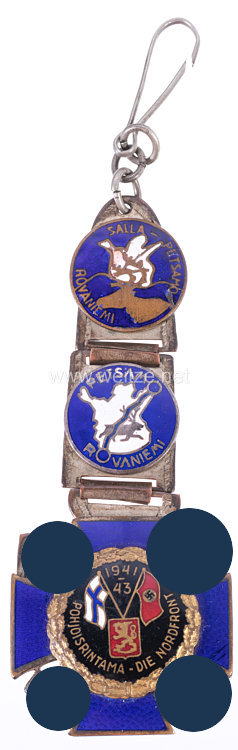
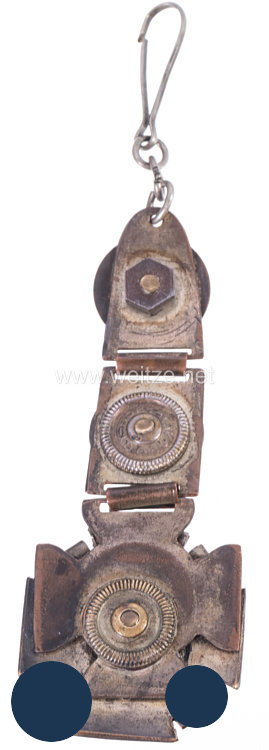
This object represents a fascinating testimony to German military history in the Far North during World War II. It is a pocket watch fob belonging to a mountain trooper who fought on the Northern Front between 1941 and 1942, featuring three unofficial badges commemorating service in Finland.
The three mounted badges display the Northern Front Cross 1941-42 along with two smaller pendants inscribed Rovaniemi-Petsamo and Rovaniemi-Petsamo-Salla. These names designate geographic locations in Finnish Lapland that were of strategic importance during Operation Barbarossa and the Continuation War between Finland and the Soviet Union.
Following the invasion of the Soviet Union on June 22, 1941, German and Finnish troops fought side by side against the Red Army. The Army Command Norway under Colonel General Nikolaus von Falkenhorst was responsible for German operations in northern Norway and northern Finland. German forces consisted mainly of the Mountain Corps Norway, later renamed the XIX Mountain Corps.
The 2nd and 3rd Mountain Divisions as well as the 6th SS Mountain Division Nord operated in this inhospitable region. The primary objective was the conquest of Murmansk, the ice-free Soviet port on the Arctic Ocean, and the interdiction of the Murmansk Railway, through which Allied aid shipments reached the Soviet Union.
Petsamo (today Pechenga in Russia) was a Finnish port on the Arctic Ocean and an important transshipment point for nickel ore. Rovaniemi served as a crucial logistics center and transportation hub in Finnish Lapland. Salla was a location on the Finnish-Soviet border where heavy fighting took place.
Combat on the Northern Front was characterized by extreme climatic conditions. In the Arctic winter, temperatures plummeted to minus 40 degrees Celsius, while in summer the midnight sun and myriads of mosquitoes plagued the soldiers. The difficult terrain of tundra, swamps, and dense forests severely hampered military operations.
The Northern Front Cross was not an official German decoration but an unofficial commemorative badge manufactured in Finland. Such privately produced badges were widespread among Wehrmacht personnel, although their wear was not officially authorized. The Finnish jewelry industry, particularly in Helsinki and Rovaniemi, produced various versions of such memorabilia for German soldiers.
These badges were often worn as pocket watch fobs attached to watch chains, a common practice in the early 20th century. Soldiers purchased them as personal mementos of their service under extreme conditions. The Northern Front Cross resembles the Iron Cross in design but contains specific elements referencing the Northern Front, such as Nordic symbols or dates.
The combination of three badges on one pendant suggests that the wearer participated in multiple operations or served in different sectors of the Northern Front. The mention of Rovaniemi, Petsamo, and Salla documents the geographic extent of his deployments in Lapland.
In September 1944, following the armistice between Finland and the Soviet Union, German troops had to evacuate Finland. During the Lapland War (September 1944 to April 1945), former allies became enemies as Finnish troops attacked the retreating German units. Rovaniemi was almost completely destroyed in the process.
From a collecting perspective, such unofficial badges are sought-after military historical objects today. They document not only official military history but also the personal experiences and the soldiers' need to preserve their memories. The described condition 2 (worn, minimally damaged) underscores its authenticity as an actually worn piece.
These objects raise important questions about memory culture, the production of private military devotional items, and the everyday history of soldiers in one of the least known theaters of World War II. They complement our understanding of German-Finnish military cooperation and the lived reality on the Northern Front.