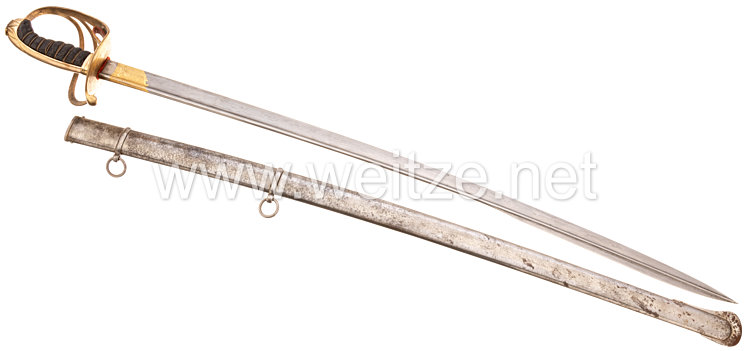
Mecklenburg-Schwerin Heavy Saber in Deluxe Execution for a Noble Officer in Dragoon Regiment 17 or 18

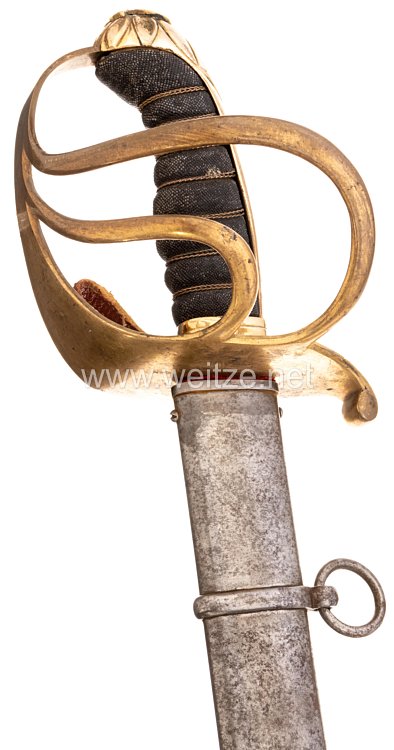
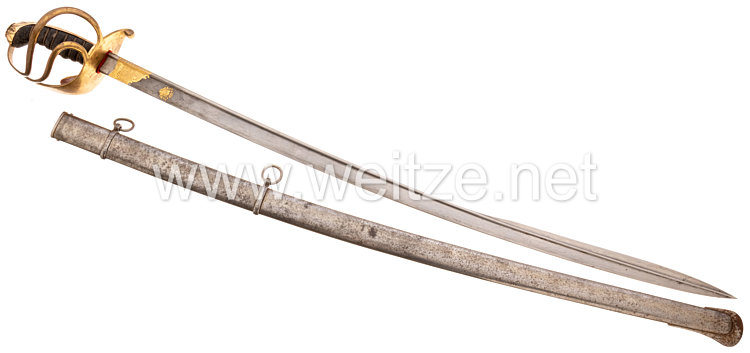
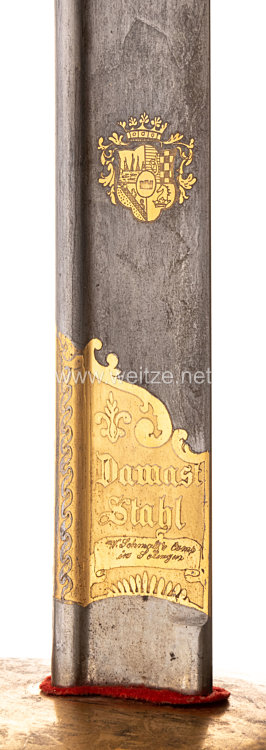
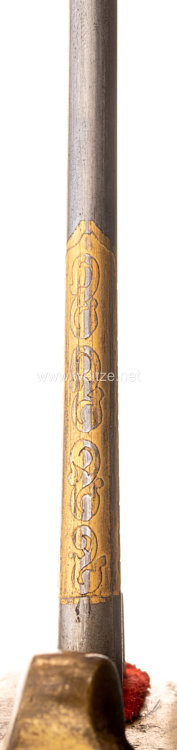
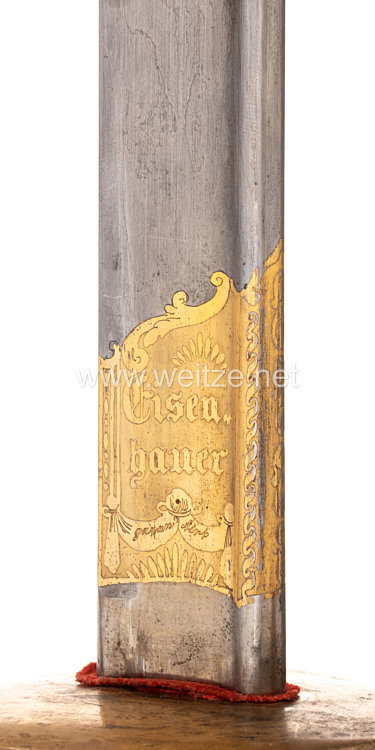
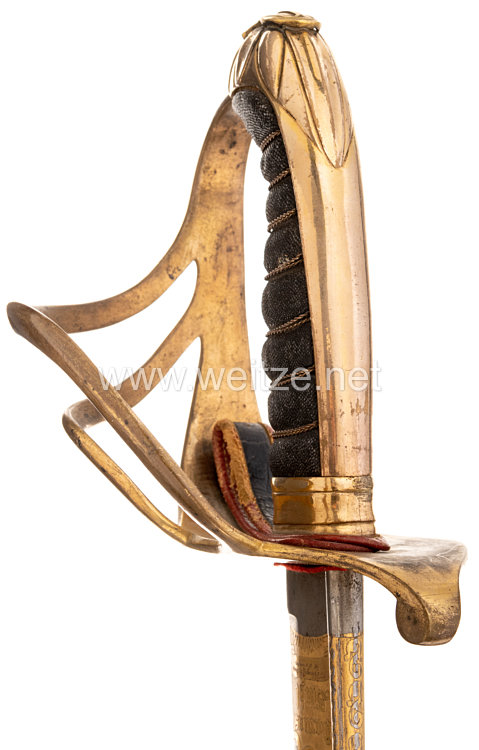
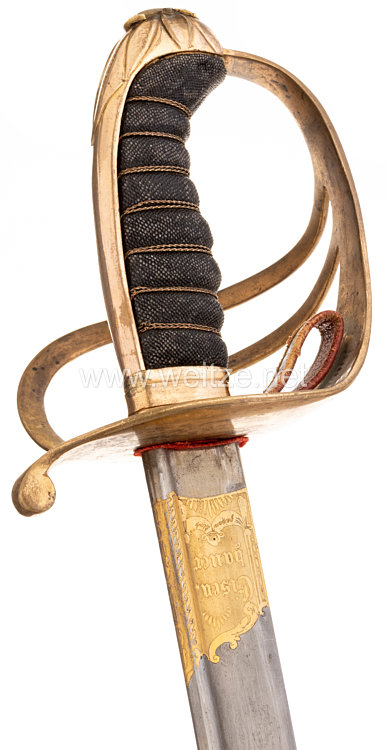
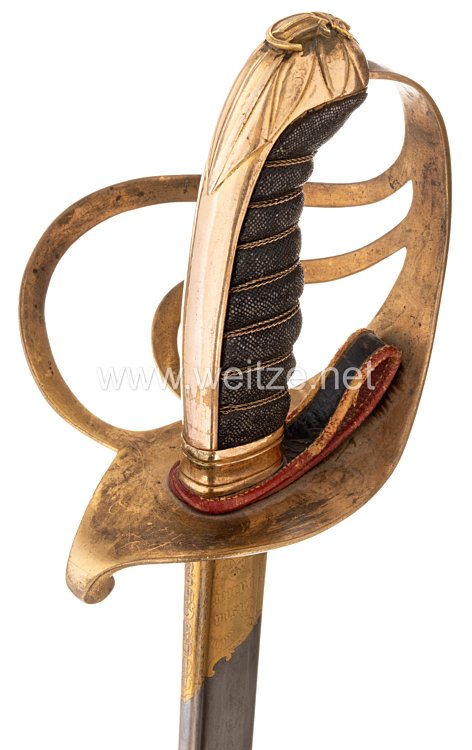
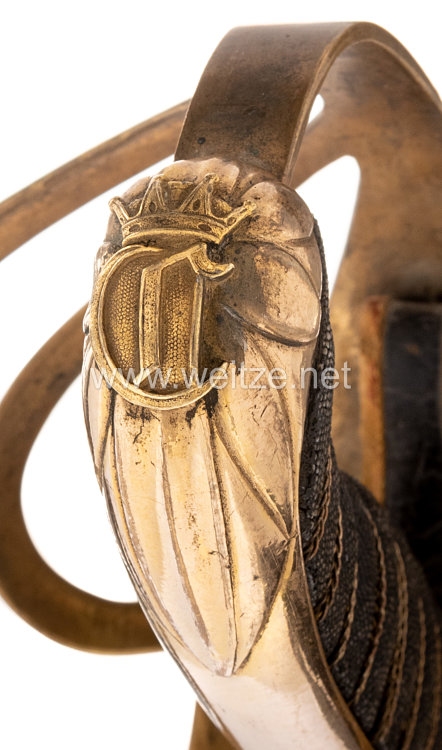
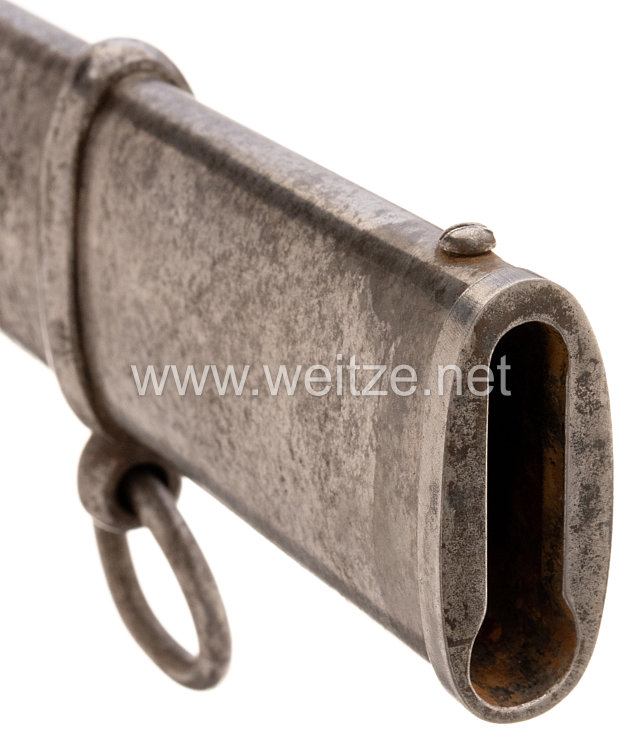
Circa 1860/70. Full-length fuller blade approximately 3 cm wide and 85.7 cm long with Schör, the ricasso above the false edge etched and gilded on both sides, circumferentially with quality guarantee “Eisenhauer Damaststahl garantirt” as well as the manufacturer “W. Schmalz & Comp. in Solingen”, on the obverse side the gilded coat of arms of a noble family. Solid gilded brass hilt with three bars, the pommel cap florally faceted, with applied crowned cipher “C”; shagreen grip with complete wire wrap, slightly loosened, intact finger loop. Bright steel scabbard with two ring bands and movable suspension rings, the drag with manufacturer “W S & C”, the scabbard spotted and somewhat fly-specked with rust. Condition 2.

Overall length 103.5 cm.

This is a luxurious weapon that was carried during the Franco-Prussian War period. The quality of the weapon suggests that it was carried by a high-ranking personality in the officer corps of the two Dragoon regiments, or even originates from the circle of the Grand Ducal house.
443373
9.500,00

Mecklenburg-Schwerin Heavy Saber in Deluxe Execution for a Noble Officer in Dragoon Regiment 17 or 18

This magnificent sabre from around 1860/70 represents the military tradition of the Grand Duchy of Mecklenburg-Schwerin during an era of significant political and military upheaval in Germany. Crafted as a luxury weapon for a noble officer, it embodies both the social hierarchy of the Prussian-influenced military system and the technical excellence of Solingen blade manufactories.

The Grand Duchy of Mecklenburg-Schwerin maintained its own military organization in the 19th century, though it was closely connected to the Prussian Army. Following the conventions of 1867, the Mecklenburg army was effectively integrated into the Prussian forces while retaining certain autonomies. The two Dragoon Regiments No. 17 and 18 formed important cavalry units, with Dragoon Regiment No. 17 based in Schwerin and directly subordinate to the Grand Duke.

The blade of this sabre originates from the renowned manufactory W. Schmalz & Comp. in Solingen, which was famous for its high-quality military blades. The designation “Eisenhauer Damaststahl garantirt” (Eisenhauer Damascus steel guaranteed) indicates particularly fine workmanship. The term “Eisenhauer” refers to a special steel quality, while the mention of Damascus steel points to the traditional technique of forge-welding different steel grades, which gave the blade special strength and elasticity.

The crowned cipher “C” on the pommel cap suggests a connection to the grand ducal house. During the period in question, Friedrich Franz II (1842-1883) and later Friedrich Franz III ruled. The “C” could refer to various members of the grand ducal family, as connections to other German princely houses were manifold.

The etched and gilded noble coat of arms on the blade underscores the exclusive character of this weapon. In the 19th century, the officer corps of German armies was firmly in noble hands. Particularly in cavalry regiments, to which the dragoons belonged, officer positions were almost exclusively reserved for the nobility. The expensive acquisition of such a presentation weapon was both an expression of social status and personal honor.

The technical execution of the sabre corresponds to the standards of the 1860s and 1870s. The massive gilded brass hilt with three bars and the characteristic sharkskin grip wrapping were typical for higher officer ranks. The bright steel scabbard with two ring bands and movable suspension rings enabled wearing on horseback, as prescribed for dragoon officers.

The period of this weapon's creation coincides with dramatic military events. The Wars of Unification - the Second Schleswig War (1864), the Austro-Prussian War (1866), and finally the Franco-Prussian War (1870/71) - defined this epoch. Mecklenburg troops participated in these conflicts and contributed to the founding of the German Empire in 1871. A sabre of this quality would certainly have been worn during such historical events, although the practical importance of edged weapons in warfare was already declining.

The dragoon regiments of the Mecklenburg army represented a centuries-old military tradition. Originally conceived as mounted infantry, dragoons evolved into true cavalry units in the 19th century. Their uniforms and armament distinguished them from the light hussars and heavy cuirassiers. The “heavy sabre” described here was characteristic of this branch of service.

The Solingen blade industry experienced its heyday in the 19th century. Companies like W. Schmalz & Comp. supplied not only German but also European and non-European armies. The quality guarantee on the blade was an important selling point in an increasingly competitive market. The combination of traditional craftsmanship and emerging industrialization enabled the production of both mass-produced goods for common soldiers and luxury versions for wealthy officers.

Today, such presentation weapons are important witnesses to 19th-century military history. They document not only technical skills but also social structures, aesthetic concepts, and the symbolic significance of weapons in a society where military virtues were highly valued. This sabre stands as an exemplar of an era in which tradition and modernity, courtly representation and military functionality still formed a unity.

r