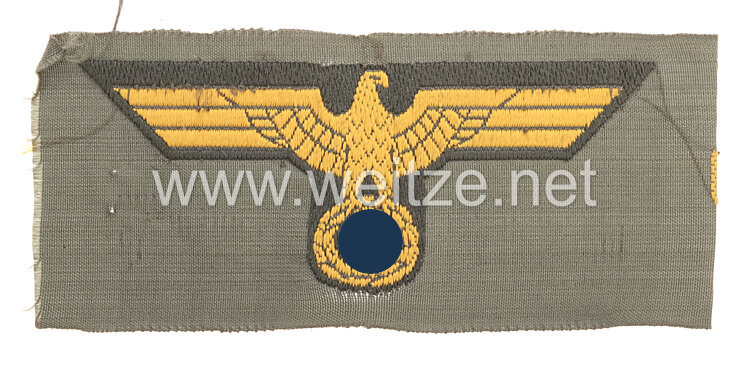
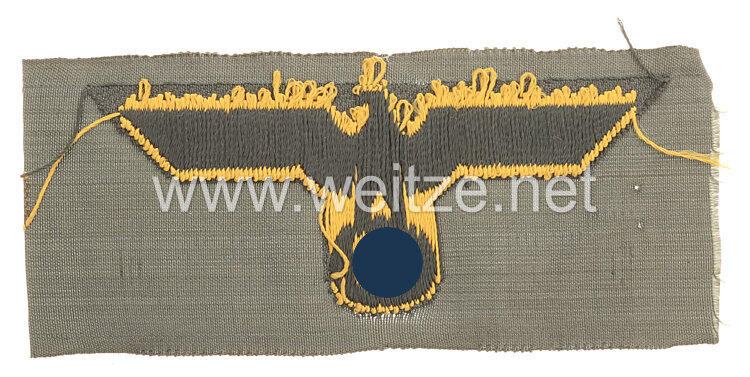
Kriegsmarine Enlisted Men's Side Cap Eagle for Coastal Artillery
The Kriegsmarine ship cap eagle for enlisted ranks of the Coastal Artillery represents a characteristic badge of the German Navy during World War II. This example, manufactured using BEVO weaving technique, displays the typical national eagle in yellow on field grey background and was worn on the side cap (Schiffchen) of enlisted personnel.
The Coastal Artillery of the Kriegsmarine formed an essential component of German coastal defense and was operationally subordinate to the Navy. This branch was responsible for defending important harbors, naval bases, and strategic coastal sections. Unlike the Army's coastal artillery, members of the Naval Coastal Artillery wore the dark blue-grey uniforms of the Kriegsmarine, while their weapons and equipment corresponded to those of naval artillery units.
The BEVO weaving technique refers to a special manufacturing process named after Bandfabrik Ewald Vorsteher from Wuppertal. This company was one of the main suppliers of woven insignia for the Wehrmacht. The BEVO technique enabled the mechanical production of highly detailed badges in large quantities. Unlike embroidered versions, woven badges were more cost-effective to produce and were therefore frequently used for enlisted ranks. The characteristic weave is recognizable by the fine, uniform threads that create a precise pattern without raised embroidery.
The eagle as a national emblem had been prescribed on all Wehrmacht uniform parts since 1935. In the Kriegsmarine, the representation of the eagle differed according to branch and uniform type. For the enlisted men's side cap, a special version applied that differed from the breast eagles on uniform jackets. The eagle sat on an oak leaf wreath with swastika, with the wings characteristically pointing upward.
The color scheme of yellow on field grey was specific to certain Kriegsmarine units. While regular naval infantry and ship crews mostly wore silver or white insignia on dark blue background, specialized land units of the Navy, including coastal artillery, frequently used field grey base materials. The yellow color of the eagle followed the traditions of artillery as a branch of service, whose traditional branch color was red, but which in woven versions was often represented as yellow or gold.
The side cap (Schiffchen) was the standard headgear for enlisted ranks of the Wehrmacht when serving on land. In the Kriegsmarine, it was worn with the work uniform and certain land service uniforms. Unlike the characteristic flat cap with ribbons that belonged to the shipboard uniform, the side cap was more practical for land service and with the coastal artillery.
The organization of the Coastal Artillery was continuously expanded during the war. Initially, only smaller batteries existed to protect the most important naval bases. With the occupation of Norway, the Netherlands, Belgium, and France from 1940 onward, an extensive system of coastal fortifications was built, known as part of the Atlantic Wall. The Naval Coastal Artillery operated heavy guns with calibers up to 40.6 cm that could engage long-range naval targets.
Condition 2 in military collectibles indicates, according to common classification, a well-preserved object with light signs of use but without significant damage. For textile insignia, this typically means the piece is completely intact, possibly showing slight signs of aging or wear, but no tears, holes, or heavy soiling.
Such badges were produced in large quantities during the war and issued to the troops. After the war ended in 1945, many of these insignia were destroyed or kept by soldiers as mementos. Today, they are important historical documents that provide insight into the organization, uniforming, and material culture of the German armed forces. For military historical research, such objects are valuable as they document the regulations, production methods, and organizational structures of the period.